
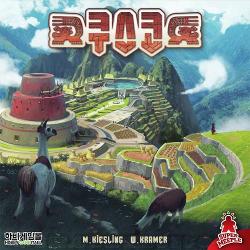
2018 · 도시 건설
쿠스코
Players expand an Andean city by placing tiles to build farms, lakes, and stacked temple pieces, competing for influence across a shared board. Each turn players draft tiles, manage resources, and add or upgrade 3D temple stacks to score points; area control, tile placement, and timing of actions drive interaction and scoring.
- 인원
- 2–4 최적 3명
- 플레이 시간
- 90분
- 연령
- 12+
- 복잡성
- 2.7 / 5
게임 소개
- Publisher




Ludoya 테이블에서는
Ludoya에서 전체 통계 보기- 24
- 기록된 플레이
- 45
- 플레이어
- 2h
- 평균 플레이 시간
- 26
- 컬렉션 보유
- 6
- 위시리스트 등록
3.6/10
Ludoya 리뷰 12개 기준
Evan2.5 I thought I'd give this game another try now that it's had a component face lift. I found it very frustrating in the same ways I did years ago playing the older edition. The new components are marvelous, and give a fantastic look to the board as it develops, despite the tiles being a little thinner than I remember them being in the first edition. Essentially, on your turn you have 6 action points to spend on whatever actions you want in whatever order you want, so long as at least 1 action point is spent laying a new tile on the board. Tiles can be placed on previous tiles so long as they lay flat, don't cover water tiles, and don't cover pieces on the board. The tiles have two terrain types, town spaces and farm spaces. It's an action point or two to enter the board with a meeple, free to move a meeple as far as you want in one of the two terrain types, and costs 1 to move from one terrain type to another. Ultimately the farms become highways as the focus of the game is entirely to do with the town spaces. When they get put into groups, players can place a temple equal to the size of the town. Once a town has a temple, it can be expanded, and the temple can grow higher, or it can be cut up by having green spaces laid across the town spaces assuming game state allows for it following the placement rules. The tricky part is only the player who is on the physically highest spot in the town gets to do any temple placement. Doing so scores you half the printed value of the temple in victory points. At the end of the game the highest player in each town gets the full value of the temple, which goes up to 10. So far I'm on board, but it starts to run into problems here. The game rules are such that you can't cross a temple or another player's meeple. The implication being that you can block other players from contesting your position, but the spaces on the tiles are hex shaped, and players get a small hand of smaller tiles they can use in a pinch, so nothing is ever really closed off or uncontestable until the final round of the game. Additionally troublesome, one action you can take is to draw cards. The cards have one or two colors. Once per turn a player can "start a festival" where they have a meeple, and there is a temple that hasn't had a festival yet at it's current height. They then make a bid by laying cards that match the top card of the discard pile. Players in the city go around, trying to play cards that match the color of the card, until one or more players win the bid and score points according to a chart. Then everyone who bid loses their cards, even if they didn't win the bid. Hard pass on this mechanism. It's frustrating because there are a number of cool things happening here. It's a game I want to like, but it's too chaotic. It sucks being starting player because everyone builds off your work. It sucks being fourth because the board state is massive by the time it comes around to you, and you've missed out on a number of festival scorings. :star: Art, Iconography and components functional :star: Clever or interesting mechanisms :star: Reasonably low downtime between turns with mildly AP players :star: Multiple plays stay interesting :nostar: Low or mitigatable luck elements :nostar::nostar::nostar::nostar::nostar: Raw enjoyment
evilangel7.8 Pte.






게임 정보(인원, 플레이 시간, 연령, 제작진) 출처: BoardGameGeek.