
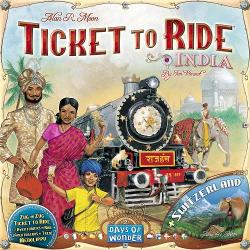
2011 · 기본 보드게임용 확장
Ticket to Ride Map Collection 2: India & Switzerland
Two double-sided maps present distinct regional scenarios for Ticket to Ride gameplay. The India side (2–4 players) adds scoring for the longest continuous path and for connecting cities on tickets via two distinct routes; the first two qualifying tickets score +5 each and the next three score +10 each, up to a 40-point bonus. Players still score normally for claiming routes and completing tickets. The Switzerland side (2–3 players) reprints the 2007 design with tickets that may link a city to a country or a country to its neighbors; completing such tickets scores the highest applicable value. Discarded tickets are removed from play, and Locomotives may be used only to build tunnels.
- 인원
- 2–4 최적 3명
- 플레이 시간
- 30–60분
- 연령
- 8+
- 복잡성
- 2 / 5





Ludoya 테이블에서는
Ludoya에서 전체 통계 보기- 216
- 기록된 플레이
- 106
- 플레이어
- 44m 45s
- 평균 플레이 시간
- 87
- 컬렉션 보유
- 4
- 위시리스트 등록
7.5/10
Ludoya 리뷰 21개 기준
FazerGD7.5 +
플레이 기록 없음
Mestremuten6.0 Rating: 3/5 Production value: 3/4 Is the game in my collection/Love to have?: 0/1
5회 플레이함
Mohasz8.0 I really like the India map, it's great for 2 players and it works with more as well. The Mandala rule is a nice touch. The board looks beautiful. I'm not so keen on Switzerland though. It's not particularly bad but it has too many tunnels and can get frustrating easily. Also, the game can end in a ridiculous card drawing fest since there are several repeated country-to-country tickets.
플레이 기록 없음

룰 질문
Ludoya 룰 도우미가 룰북을 바탕으로 답변했습니다.
How do double routes work with different player counts?
On the India map, 4 players may claim both tracks; with 2 or 3 players, claiming one makes the other unavailable. On the Switzerland map, both tracks are available with 3 players, but not with 2 (Rulebook, India p. 2; Switzerland p. 2).
How many destination tickets do we keep, and do rejected ones come back?
On India, keep at least 2 of the 4 tickets dealt at the start, or at least 1 of 3 drawn later; rejected tickets go to the bottom of the deck. On Switzerland, the same minimums apply to 5 starting tickets or 3 later tickets, but rejected tickets are removed from the game (India p. 2; Switzerland p. 2).
How do I claim a ferry route?
On India, play a locomotive for each locomotive symbol on the ferry, then use the usual matching-color cards for its other spaces (Rulebook, India p. 2).
What counts for the Grand Tour bonus on the India map?
A destination ticket qualifies when its cities are connected by at least two distinct continuous paths made from your trains; the paths may intersect but cannot share trains. The bonus is 5 points for each of the first two qualifying tickets, then 10 for each of the next three, up to 40 total (Rulebook, India p. 2).
How do the Switzerland tickets that show countries work?
For a city-to-country ticket, connect the city to any listed country; for a country-to-country ticket, connect the primary country to any one of the others listed. Score the highest-value connection you completed, or, if you completed none, lose the lowest listed value (Rulebook, Switzerland p. 2).
Can I use or draw locomotive cards normally on the Switzerland map?
You may draw locomotives like regular train cards, including taking two face-up locomotives in one turn, but you can play them only on tunnels. When claiming a tunnel, reveal three cards; each matching color or locomotive revealed requires you to add a matching card or locomotive (Rulebook, Switzerland p. 2).
무료, 웹·Android·iOS 지원
Ludoya로 Ticket to Ride Map Collection 2: India & Switzerland 플레이하기
게임 정보(인원, 플레이 시간, 연령, 제작진) 출처: BoardGameGeek.