
2012 · Gevecht
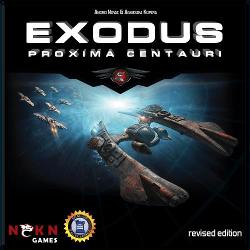
Exodus: Proxima Centauri
Zes menselijke facties bouwen hun beschaving opnieuw op na een instorting. Ze vestigen zich op planeten die door een buitenaardse beschaving zijn achtergelaten en strijden om de controle terwijl hun beschermers vertrekken. Spelers bouwen aanpasbare ruimtevloten, verkennen en veroveren stersystemen, beheren grondstoffen en logistiek, en onderzoeken een buitenaardse technologietak om hun rijken uit te breiden. Verborgen bewegingen en gevechten tegen zowel door de AI bestuurde tegenstand als rivaliserende spelers bepalen de territoriale winst, terwijl wapens, scheepsupgrades en het veroveren van planeten je engine-building aandrijven. Een politieke laag maakt gebruik van blinde biedingen en stemmingen om wetten en resoluties door te voeren die alle spelers beïnvloeden. Het spel beloont militaire actie naast economische en technologische ontwikkeling.
- Spelers
- 2–6 best met 6
- Speeltijd
- 180 min
- Leeftijd
- 14+
- Complexiteit
- 3,6 / 5
Over het spel
- Ontwerp
- Illustraties
- Uitgever


Uitbreidingen
Bekijk ze in Ludoya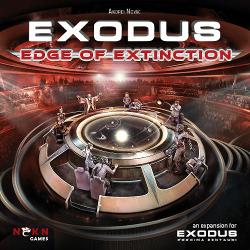 Exodus: Edge of Extinction2015
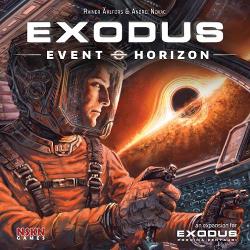 Exodus: Event Horizon2017
 Exodus: Edge of Extinction – Kickstarter Edition2015
 Exodus: Proxima Centauri – Ymnighet Mini-Expansion2017
 Exodus: Generals2012
 Exodus: Edge of Extinction – Kickstarter Limited Components2015
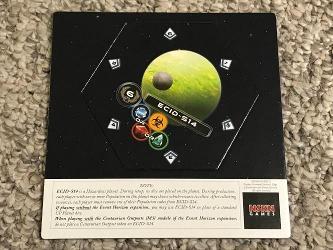 Exodus: Proxima Centauri – ECID-S14 Mini-Expansion2018
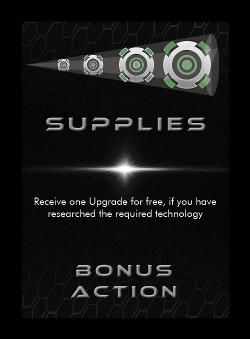 Exodus: Supplies bonus card2012
 Exodus: Edge of Extinction – Kickstarter Limited Action Cards2015Exodus: Edge of Extinction – Kickstarter Limited Political Cards2015Exodus: Edge of Extinction – Kickstarter Limited Combat Cards2015
Aan de tafels van Ludoya
Alle statistieken in Ludoya- 14
- Vastgelegde speelsessies
- 14
- Spelers
- 6
- In collecties
- 7
- Op verlanglijsten
6,9/10
uit 4 Ludoya-recensies
Balleflass7,0 Has it all and wont overstay its welcome as long as you have a semi-aggressive group
Geen speelsessies geregistreerd
Evan7,0 (Revised edition) The game is often described as a cross between Eclipse and Twi Imp. From Eclipse, it gets the upgradable space ships mechanic. From Twi Imp it gets a system of playing action cards where you use the primary, and then any player can pay cubes to use any of the secondaries available. The tech tree is imported in style from Clash of Cultures, although it again looks to Eclipse by making lower level technologies provide not a requirement but a discount for the higher level ones. The unique things about the game are that planets can be shared by multiple players, and endgame points for holding the planet go to most cubes on that planet, or shared in a tie. The movement rules are interesting, every hex has a number 1 to 6 on the edge. You take number tokens and log in the moves of each of your ships and simultaneously execute. I thought this was a really fun way to do movement, and bluff your opponents at the same time. I loved how your borders were somewhat fluid, and sometimes fleets would accidentally meet in space and have conflict. This mechanism was met with utter hate from my playgroup unfortunately, and was a major barrier to getting this game played. Unfortunately, the process of gathering and assigning the movement tokens is a bit complicated and fiddly. A better implementation of this system might have kept this game in my collection. I had heard this system got removed and replaced in one of the expansions, but by that point my group was categorically against trying this again. Combat is rolling dice, and if you get destroyed the ships are easily reconstructed, allowing for a decent comeback if you get blown to pieces. A flaw of the game might be that the game deeply rewards players for winning in combat. The most punchy player can become a runaway leader by virtue of lucky die rolls, or by picking on weaker fleets. All non-combat points are limited by what's printed on the board and remaining alien tokens. This is perhaps just the nature of the game. Cubes also have a strange component limitation. Players have a limited number of cubes despite that cubes are used for both charts and as people on planets. ★ Art, Iconography and components functional ★ Clever or interesting mechanisms ☆ Reasonably low downtime between turns with mildly AP players ★ Multiple plays stay interesting ☆ Low or mitigatable luck elements ★★★★☆ Raw enjoyment
Eerste indrukken · 2 speelsessies
Vergelijkbare spellen
 Twilight Imperium: Third Edition2005
 Andromeda's Edge: Deluxe Edition2024
 Empires of the Void II2018
 Eclipse: Second Dawn for the Galaxy2020
 Andromeda's Edge2024
 Twilight Imperium: Fourth Edition2017
 StarCraft: The Board Game2007
 Space Empires 4X2011
 Innovation Ultimate2025
 Eclipse: New Dawn for the Galaxy2011
 Star Trek: Ascendancy2016
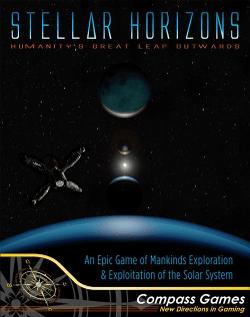 Stellar Horizons2020
Gratis, op het web, Android en iOS
Speel Exodus: Proxima Centauri met Ludoya
- Houd het bij in je collectieHoud je exemplaar en de uitbreidingen bij, leen het uit aan vrienden of zet het op je verlanglijst en krijg bericht als de prijs daalt.Voeg het toe aan je collectie
- Leg elke speelsessie vastScores, winnaars, timers en foto's, en dan je statistieken: winpercentage, favoriete spelersaantal, beste score.Speelsessie vastleggen
- Scoor zonder papierGebruik de scoreformulieren en speelhelpers van de community en laat Ludoya de punten optellen.Scoreformulieren zoeken
- Vind mensen om het mee te spelenClubs, spelavonden en evenementen bij jou in de buurt waar dit spel op tafel komt.Bekijk evenementen
Speldata (spelers, speeltijd, leeftijd, makers) van BoardGameGeek.