
2020 · Dobbelstenen
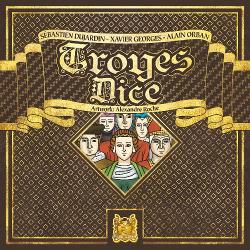
Troyes Dice
Players represent a wealthy medieval family shaping the development of a city divided among three social orders: nobility, commons, and clergy. The game uses rolled dice as shared resources; players assign dice to actions on their personal sheet to recruit citizens, develop markets, fund the cathedral, build prestige buildings, and respond to twice-daily events and raids. Choices balance immediate gains against longer-term scoring opportunities across multiple tracks and construction goals. Score results from fame accrued through buildings, market development, event resolution, and civic contributions; the highest total wins.
- Spelers
- 1–10 best met 1
- Speeltijd
- 20–30 min
- Leeftijd
- 12+
- Complexiteit
- 2,3 / 5
Over het spel
- Illustraties
- Uitgever





Waar te koop
Winkelprijzen en tweedehands exemplaren, elke dag gecontroleerd.
- Cardhaus GamesOp voorraad24.95 $
- LudifolieVoorraad controleren22.5 €
- Zatu GamesOp voorraad20.1 £
- AlphaspelOp voorraad290 kr
- GameplayVoorraad controleren26.55 €
- 401 GamesNiet op voorraad24.95 $
- Travelling ManNiet op voorraad17 £
- Games EmpireOp voorraad35.99 $
Aan de tafels van Ludoya
Alle statistieken in Ludoya- 122
- Vastgelegde speelsessies
- 115
- Spelers
- 39m 14s
- Gemiddeld potje
- 38
- In collecties
- 4
- Op verlanglijsten
6,8/10
uit 9 Ludoya-recensies
Mestremuten7,0 Rating: 3/5 Production value: 3/4 Is the game in my collection/Love to have?: 1/1
Eerste indrukken · 2 speelsessies
Regelvragen
Beantwoord vanuit het spelregelboek door de regelassistent van Ludoya.
How do I know what a die costs, and can I ever use the black die?
Pay the cost shown for that die’s plaza; the die on the 0-cost plaza is free. You choose from the three remaining transparent dice— the black die is never available to buy or use (p. 5).
When does the black die attack my scoresheet, and what gets crossed out?
The black die attacks a scoresheet starting on day 3, targeting the die matching its value and the destroyed plaza’s color. Cross out that die and any unbuilt prestige or work buildings in that colored section of the column; buildings already constructed remain, and a Fortress protects its column (pp. 4, 7).
Can I change a die’s value or color before using it?
Yes. Spend 1 influence per step to adjust its value, without wrapping from 1 to 6; spend 2 knowledge to change its color. Pay the plaza cost to take the die before modifying it (pp. 5–6).
When I gain resources, do I also get citizens?
Circle resources equal to the chosen die’s value on the track matching its color. If a resource space is linked to a citizen, circle that citizen too; each circled citizen is worth 1 VP (p. 6).
What if I can’t afford any die?
If you don’t have enough resources to buy a die and no die is available for free, you take no action and gain 1 of each resource instead (p. 5).
Vergelijkbare spellen






Gratis, op het web, Android en iOS
Speel Troyes Dice met Ludoya
- Houd het bij in je collectieHoud je exemplaar en de uitbreidingen bij, leen het uit aan vrienden of zet het op je verlanglijst en krijg bericht als de prijs daalt.Voeg het toe aan je collectie
- Leg elke speelsessie vastScores, winnaars, timers en foto's, en dan je statistieken: winpercentage, favoriete spelersaantal, beste score.Speelsessie vastleggen
- Regelvragen beslechtenVraag alles over de regels en krijg een antwoord uit het spelregelboek, met de pagina om het na te lezen.Vraag de regelassistent
- Vind mensen om het mee te spelenClubs, spelavonden en evenementen bij jou in de buurt waar dit spel op tafel komt.Bekijk evenementen
Speldata (spelers, speeltijd, leeftijd, makers) van BoardGameGeek.