

2018 · Økonomisk
Raiatea
Players take the roles of members of the Arioi, a secret Polynesian religious society seeking the favor of the god Oro by building colossal To'o statues. During action rounds, players lead the group to different locations to gather resources and prepare. In ceremony rounds, they invoke the gods and decide how much mana to sacrifice, since construction can fail without sufficient divine aid. After the final ceremony, the player with the most victory points becomes the new High Priest.
- Spillere
- 3–5 bedst 4
- Spilletid
- 60–120 min
- Alder
- 12+
- Kompleksitet
- 3,1 / 5
Om spillet
- Design
- Illustration
- Publisher


Udvidelser
Se dem i Ludoya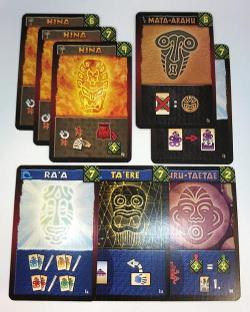
Hvor du kan købe det
Butikspriser og brugte eksemplarer, tjekket hver dag.
På Ludoyas borde
Al statistik i Ludoya- 4
- Registrerede partier
- 4
- Spillere
- 2h 14m
- Gennemsnitligt parti
- 8
- I samlinger
- 1
- På ønskelister
5,3/10
fra 2 anmeldelser på Ludoya
Evan4,6 The cover of the game box is pointlessly bad. The illustration is reprized on the board three times and the way it's used actually obfuscates what it's trying to indicate, that being your rank on a track. There are achievement tiles that give you points for being a certain ranking along the track, yet the illustration is that of the cover of the game, with some tiny text where they wrote the name of the given ranking. I open with this because this is how the game presents itself. Sloppy, potentially racist. The rulebook is difficult to understand. The iconography isn't very clear. I have unanswered questions as to exactly how some of the ritual cards work. Incredibly, despite these things, this is a very enjoyable euro game. I'm as surprised as anyone. The core of the game is job selection, with the starting player picking a job tile, preforming the action with a bonus, then each other player preforming the normal version of that action. Points come from four places. collecting identical pairs of purple Mask cards, being at high levels of the ranking track, grabbing and paying for recipe tiles, and then four or so ritual cards have printed victory points. It's a low scoring game, and every point matters. One of the actions you can take is to buy worker cards. Each type of worker is connected with a specific job tile, and when that job tile is claimed, the selector rolls a D4. If you have a number of the matching worker equal to or greater than the roll, you get a bonus effect. Even if this die roll never works out for you, each worker comes with a powerful once per game ability. When the round marker hits a red phase indicator, players get to mark and select 2 to 3 ritual cards they've claimed and they place them into a red sack. Then, a simultaneous blind bid happens, to determine turn order for the red phase. Top 3 bidders get a bonus, but everyone pays into the sack. Then the ritual cards are revealed along with the bids of all players, and any other tokens that were put into the sack through previous round bids or actions. The cards then get resolved from least to most expensive, consuming the pool of tokens as it goes. This is incredible push your luck, as putting in a cheap card will happen, but putting in an expensive card means you might need to put in a big bid to break ties in your favor and make sure there's enough tokens to get to your card. Ultimately then also you are bidding with many of the same tokens you need for the final phase which is claiming recipe tiles. This is done one at a time in the red phase order, and this is where the majority of points in the game come from. The thing I love about this game is that every decision is difficult. The game is constantly giving you alternate ways of doing things and temptations to stray from your path in the name of efficiency. It has luck elements with forest cards and ritual cards, it has that die roll for bonus effects on workers, it has the blind bid, but most everything is built in a way where you can guarantee what you want to have happens, it's just at an overall efficiency cost. There are ways to claim the objective tiles outside of the red phase, there are ways to complete ritual cards directly from your hand outside the red phase. The luck element of the bonus workers is mitigated by the fact they all have use outside the die roll element. :nostar: Art, Iconography and components functional :star: Clever or interesting mechanisms :star: Reasonably low downtime between turns with mildly AP players :star: Multiple plays stay interesting :star: Low or mitigatable luck elements :star::star::star::nostar::nostar: Raw enjoyment
Garfield7,0 #29.1 I like the theme and the quite easy gameplay. But I hated the ritual cards, because you have to lookup the meaning of it on a huge reference card. This slowdowns the game so much! I really like the mechanism to contribute for rituals. [c] Theme: :star::star::star::nostar::nostar: <!-- size 7]Good --> Gameplay: :star::star::star::star::nostar: <!-- size 7]Good amount of choices --> Interaction: :star::star::star::nostar::nostar: <!-- size 7]Ok --> Artwork: :star::star::star::star::nostar: <!-- size 7]Nice --> Luck: :star::star::star::nostar::nostar: <!-- size 7]Random cards and blind bidding --> Strategy: :star::star::star::nostar::nostar: <!-- size 7]Different strategies possible --> Components: :star::star::star::nostar::nostar: <!-- size 7]Ok --> Play duration: :star::star::nostar::nostar::nostar: <!-- size 7]Too long! --> Easy to teach: :star::star::star::nostar::nostar: <!-- size 7]Ok (35min) --> Rules quality: :star::star::star::star::nostar: <!-- size 7]Very good --> Setup time: :star::star::nostar::nostar::nostar: <!-- size 7]A lot to setup --> No downtime: :star::star::star::star::nostar: <!-- size 7]All players can do something also in other players turn --> Replay value: :star::star::nostar::nostar::nostar: <!-- size 7]Trying different strategy? --> [/c]











Gratis, på web, Android og iOS
Spil Raiatea med Ludoya
- Hav det i din samlingHold styr på dit eksemplar og dets udvidelser, lån det ud til venner, eller sæt det på din ønskeliste, og få besked, når prisen falder.Føj det til din samling
- Registrér hvert partiPoint, vindere, timere og fotos, og så din statistik: vinderprocent, foretrukket spillerantal, bedste score.Registrér et parti
- Hold score uden papirBrug fællesskabets scoringsark og spilhjælpere, og lad Ludoya lægge pointene sammen.Find scoringsark
- Find nogen at spille det medKlubber, spilaftener og arrangementer nær dig, hvor dette spil kommer på bordet.Se arrangementer
Spilfakta (spillere, spilletid, alder, medvirkende) fra BoardGameGeek.