
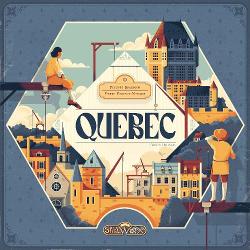
2011 · Costruzione di città
Québec
I giocatori guidano una famiglia illustre attraverso quattro secoli, competendo per plasmare e conquistare influenza nella città in espansione. A ogni turno, i giocatori scelgono se avviare una costruzione con un architetto, completare sezioni di edifici, inviare lavoratori in una delle cinque zone d’influenza (religione, politica, commercio, cultura e la Cittadelle) oppure prendere una carta leader. Il contributo agli edifici e il piazzamento dei lavoratori fanno guadagnare influenza e attivano un meccanismo di maggioranza a cascata: la maggioranza in una zona sposta metà dei propri lavoratori nella zona successiva, creando potenzialmente effetti a catena e ulteriori punteggi. Il gioco assegna punti alla fine di ogni secolo per le maggioranze nelle zone e concede punti finali per gli edifici completati dopo il quarto secolo.
- Giocatori
- 2–5 ideale in 4
- Tempo di gioco
- 75 min
- Età
- 13+
- Complessità
- 3 / 5
Il gioco
- Illustrazioni
- Editore




Espansioni
Vedile in Ludoya
Dove comprarlo
Prezzi dei negozi e copie usate, controllati ogni giorno.
- AlphaspelDisponibile569 kr
- Dungeon MarvelsPreordine42.95 €
- Milan SpieleDisponibile46.9 €
- World of Board GamesEsaurito519 kr
- SpielezarPreordine64.9 Fr.
Sui tavoli di Ludoya
Tutte le statistiche in Ludoya- 20
- Partite registrate
- 28
- Giocatori
- 2h 30m
- Partita media
- 5
- Nelle ludoteche
- 3
- Nelle liste dei desideri
6,9/10
da 3 recensioni Ludoya
Evan7,0 The central board in this game is made up of a bunch of these interconnected, single colored, four circle blobs. The center circle of each blob has a special ability, whereas the three connected circles have spaces for players to put cubes. The way things work is like this. On your turn, you either place your pawn onto one of the available circles for the round, which gets you three cubes into your active supply from your passive supply, or you contribute cubes to a circle that has a player's pawn. If it's your pawn, you get no cool extra benefit, but if you contribute to someone else's pawn, you get to do the effect of the center circle connected to where you placed. Each contribution space costs 1-3 cubes. Alternately to all that there are powerful role cards you can select, which give you a special asymmetric ability for that round. Ultimately what happens is when the player with the pawn wants to start a new building, they move the pawn which puts all the cubes that were on it's space into the bin at the corner of the map that matches the color of the circle. The benefit is that the player moving their pawn gets to place a stars token of their color in the completed space. The value of the token is larger depending on how many of the three contribution spaces were occupied, so players want to be mindful of which bonus actions other people might want to take that round. For the players who contributed cubes, at the end of the round each corner of the board gets scored, where you get 1 point per cube, and then the player with the most moves half clockwise into the next corner for them to score again, and if planned well potentially get majority again. This can be a lot of points for proper planning, but there's also a bonus for having large connected chains of buildings with your star token on it, so while all this is happening clever players are engaged in a route building process as well. Despite a complicated explanation, turns flow well, and there are good decision points and trade-offs to be made. Do you complete that building now, which would put the cubes in the building on the corners, or try to wait until next round. Which of the powerful ability cards will you draft? Do you draft one at the start of the round to get the one you want, or wait and get one that comes with more free cubes as compensation for taking the least desired one? When is it good to help someone else's building vs helping your own position. I absolutely love this game, and wish I could get it to the table more. While the iconography in the game is great, the colors are a bit hard on the eyes, and the art could definitely use a facelift. ★ Art, Iconography and components functional ★ Clever or interesting mechanisms ★ Reasonably low downtime between turns with mildly AP players ★ Multiple plays stay interesting ★ Low or mitigatable luck elements ★★☆☆☆ Raw enjoyment
L'ha giocato 3 volte






Gratis, sul web, Android e iOS
Gioca a Québec con Ludoya
- Tienilo nella tua ludotecaTieni traccia della tua copia e delle sue espansioni, prestala agli amici o mettila nella lista dei desideri e ricevi un avviso quando il prezzo scende.Aggiungilo alla tua ludoteca
- Registra ogni partitaPunteggi, vincitori, timer e foto, poi le tue statistiche: percentuale di vittorie, numero di giocatori preferito, miglior punteggio.Registra una partita
- Segna i punti senza cartaUsa i fogli punteggio e gli assistenti di gioco della community e lascia che Ludoya sommi i punti.Trova fogli punteggio
- Trova persone con cui giocarloClub, serate di gioco ed eventi vicino a te che portano questo gioco in tavola.Vedi gli eventi
Dati del gioco (giocatori, durata, età, crediti) da BoardGameGeek.