

2011 · 都市建設
Québec
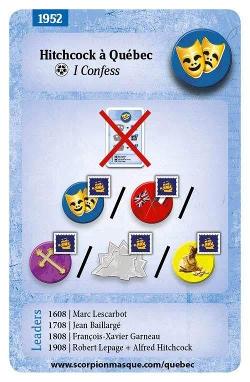
Players lead a prominent family across four centuries, competing to shape and claim influence in the growing city. On each turn players choose to start a building with an architect, complete building sections, send workers to one of five zones of influence (religion, politics, commerce, culture, and the Citadelle), or take a leader card. Contribution to buildings and worker placement earn influence and trigger a cascading majority mechanism: the majority in a zone moves half their workers into the next zone, potentially creating ripple effects and additional scoring. The game scores at the end of each century for zone majorities, and awards final points for completed buildings after the fourth century.
- プレイ人数
- 2–5 ベスト4人
- プレイ時間
- 75分
- 対象年齢
- 13+
- 複雑さ
- 3 / 5




購入先
ショップ価格と中古品を毎日チェックしています。
Ludoyaのテーブルでは
Ludoyaで詳しい統計を見る- 20
- 記録されたプレイ
- 29
- プレイヤー
- 2h 30m
- 平均プレイ時間
- 5
- コレクション登録
- 1
- ウィッシュリスト登録
5.9/10
Ludoyaのレビュー3件より
Evan5.9 The central board in this game is made up of a bunch of these interconnected, single colored, four circle blobs. The center circle of each blob has a special ability, whereas the three connected circles have spaces for players to put cubes. The way things work is like this. On your turn, you either place your pawn onto one of the available circles for the round, which gets you three cubes into your active supply from your passive supply, or you contribute cubes to a circle that has a player's pawn. If it's your pawn, you get no cool extra benefit, but if you contribute to someone else's pawn, you get to do the effect of the center circle connected to where you placed. Each contribution space costs 1-3 cubes. Alternately to all that there are powerful role cards you can select, which give you a special asymmetric ability for that round. Ultimately what happens is when the player with the pawn wants to start a new building, they move the pawn which puts all the cubes that were on it's space into the bin at the corner of the map that matches the color of the circle. The benefit is that the player moving their pawn gets to place a stars token of their color in the completed space. The value of the token is larger depending on how many of the three contribution spaces were occupied, so players want to be mindful of which bonus actions other people might want to take that round. For the players who contributed cubes, at the end of the round each corner of the board gets scored, where you get 1 point per cube, and then the player with the most moves half clockwise into the next corner for them to score again, and if planned well potentially get majority again. This can be a lot of points for proper planning, but there's also a bonus for having large connected chains of buildings with your star token on it, so while all this is happening clever players are engaged in a route building process as well. Despite a complicated explanation, turns flow well, and there are good decision points and trade-offs to be made. Do you complete that building now, which would put the cubes in the building on the corners, or try to wait until next round. Which of the powerful ability cards will you draft? Do you draft one at the start of the round to get the one you want, or wait and get one that comes with more free cubes as compensation for taking the least desired one? When is it good to help someone else's building vs helping your own position. I absolutely love this game, and wish I could get it to the table more. While the iconography in the game is great, the colors are a bit hard on the eyes, and the art could definitely use a facelift. :star: Art, Iconography and components functional :star: Clever or interesting mechanisms :star: Reasonably low downtime between turns with mildly AP players :star: Multiple plays stay interesting :star: Low or mitigatable luck elements :star::star::nostar::nostar::nostar: Raw enjoyment



ゲーム情報(人数、プレイ時間、対象年齢、クレジット)の出典:BoardGameGeek。