
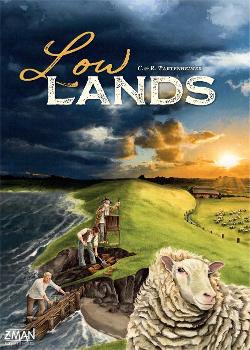
2018 · Landbouw
Lowlands
Players build and expand individual farms on a flood-prone coastal plain, using resource cards to create pastures, add buildings, and breed sheep for profit. A worker-placement mechanic assigns farmers to actions on the farm or to construction of a communal dike; contributing resources to the dike helps protect everyone from periodic tides but diverts labor from personal development. Buildings and farm expansions unlock new abilities and scoring opportunities, while progress on the dike track grants rewards and mitigates penalties if floods occur. Players balance personal growth and cooperative defense to maximize points by game end.
- Spelers
- 2–4 best met 3
- Speeltijd
- 50–100 min
- Leeftijd
- 12+
- Complexiteit
- 3,1 / 5
Over het spel
- Illustraties
- Publisher

Uitbreidingen
Bekijk ze in Ludoya
Waar te koop
Winkelprijzen en tweedehands exemplaren, elke dag gecontroleerd.
Aan de tafels van Ludoya
Alle statistieken in Ludoya- 64
- Vastgelegde speelsessies
- 96
- Spelers
- 1h 40m
- Gemiddeld potje
- 40
- In collecties
- 8
- Op verlanglijsten
6,5/10
uit 19 Ludoya-recensies
Poteet9,0 Something about this game is so damn fun. There's plenty of meats on these bones. The dyke is a little flimsy as a mechanic at 2, but it's not awful. Really shines bright at 3-4 and is still great at 2.
Evan5,9 In this game, players get their own player board with their own worker placement spaces along the side. In turn order you place a worker, then resolve the action you chose with action points to spend according to the number on the back of the worker you placed. Generally these actions involve getting resource cards, buying buildings with those resource cards, raising sheep, or working on the dike. Each round a new dike card flips, and if players collectively haven't worked on the dike enough to hold back the water, then they get breach tokens based on how far behind the leader on the dike track they are. At the end of the game if the dike doesn't hold, then each player will lose one sheep per token they hold. The tension in the game also comes from a mechanism where every time the dike check is failed, a marker gets moved which reduces the value of having sheep, and increases the value of each dike track threshold. Each time the dike check is met, the value of sheep goes up and the value of the dike track goes down. I really loved this game. It's crunchy and players can sort of do their own thing like in a Rosenberg game, but competing for buildings and who chooses to work on the dike when adds plenty of interesting player interaction. I'm hoping to get another game of this in this week if I at all can. That being said, there are some issues. The component quality isn't great. The texture of the cardboard feels rough like a cheap Mayfair game. The iconography isn't amazing either, so throughout the game you'll have to carefully look up each building that flips in the appendix. In particular, there's a rule where when someone works on the Dike, they have to ask another player if they want to take a bonus follow action to also work on the Dike with the same number of action points the active player spent. Some buildings have effects when you work on the Dike, but according to the appendix, only one of them doesn't function during a follow action, yet the iconography makes no attempt to communicate that. The punchboard tokens aren't quite aligned right in my copy at least. Some of the boards it was also difficult to remove the bits without tearing, as the machine didn't cut the boards quite enough. It's not enough to hinder my enjoyment of the game, but it's worth noting. :star: Art, Iconography and components functional :star: Clever or interesting mechanisms :star: Reasonably low downtime between turns with mildly AP players :nostar: Multiple plays stay interesting :star: Low or mitigatable luck elements :star::star::star::nostar::nostar: Raw enjoyment
Regelvragen
Beantwoord vanuit het spelregelboek door de regelassistent van Ludoya.
Wanneer lossen we overstromingen op (Turn of the Tide), en wat doen we als er eentje verschijnt?
Los overstromingsgebeurtenissen op wanneer een Turn of the Tide-kaart tijdens de ronde wordt geactiveerd; volg de overstromingsoplossingsprocedures en timing zoals beschreven in de Turn of the Tide / Werkfase-sectie (zie pagina 5).
Kan ik boerderij-uitbreidingstegels overal op mijn boerderij plaatsen, of zijn er plaatsingsbeperkingen?
Uitbreidingen en featuretegel(s) moeten worden geplaatst volgens de bouwplaatsingsregels en de plaatsingsiconen die op die tegels staan; zie de gebouwvoorbeelden en plaatsingsregels op pagina 6–7 voor de exacte beperkingen. (Pagina 6 legt tegeltypes en iconen uit; pagina 7 behandelt plaatsingsvoorbeelden.)
Hoe werkt de actie 'bijdragen aan de dijk' precies — moet ik tegels plaatsen of grondstoffen betalen, en wat levert het me op?
De actie ‘bijdragen aan de dijk’ wordt opgelost zoals beschreven op pagina 7: je volgt de plaatsings- en bijdrageregels van de actie om dijkdelen vooruit te zetten, en voltooide delen leveren de effecten en voortgangstokens op die daar en op pagina 8 worden beschreven. (Pagina 7–8 behandelen voorbeelden, het voltooien van delen en voortgangstokens.)
Wat gebeurt er tijdens de Upkeep — wanneer fokken schapen en wanneer innen we inkomen?
Alle Onderhoudsstappen (fokken, inkomen, boeren, aanpassingen aan de schapenmarkt, bepaling van de startspeler en overstroming/Hoogwater-controles) worden uitgevoerd in de volgorde zoals weergegeven in de sectie II Onderhoud; de timing voor het oplossen van fokken en inkomen wordt uitgelegd op pagina 10. (Op pagina 10 staat elke Onderhoudsstap vermeld en wanneer je die moet toepassen.)
Als een stormvloed een dijksegment doorbreekt, wat zijn de gevolgen en hoe beïnvloedt dat de scoring?
De afhandeling van een stormvloed, de verschillen tussen een dijk die standhoudt of doorbreekt, en hun effecten op componenten en de eindscore worden подробно uitgelegd in de sectie Stormvloed / eindscore op pagina 11; volg die procedures om ondergelopen stukken en score-aanpassingen te bepalen. (Zie pagina 11 voor de effecten van doorbreken/standhouden en de regels voor de eindscore.)
Kan ik extra schapen in gebouwen onderbrengen, en wanneer worden ondergebrachte schapen meegeteld (voor fokken/scores)?
Het onderbrengen van schapen en de regels voor wanneer ondergebrachte schapen worden meegeteld (voor voortplanting en scoring) worden beschreven in de regels voor onderhoud en huisvesting op pagina 10; raadpleeg die pagina voor hoe gebouwen met huisvesting samenwerken en wanneer die schapen worden meegeteld. (Zie pagina 10 voor de regels voor het onderbrengen van schapen.)




Gratis, op het web, Android en iOS
Speel Lowlands met Ludoya
- Houd het bij in je collectieHoud je exemplaar en de uitbreidingen bij, leen het uit aan vrienden of zet het op je verlanglijst en krijg bericht als de prijs daalt.Voeg het toe aan je collectie
- Leg elke speelsessie vastScores, winnaars, timers en foto's, en dan je statistieken: winpercentage, favoriete spelersaantal, beste score.Speelsessie vastleggen
- Regelvragen beslechtenVraag alles over de regels en krijg een antwoord uit het spelregelboek, met de pagina om het na te lezen.Vraag de regelassistent
- Vind mensen om het mee te spelenClubs, spelavonden en evenementen bij jou in de buurt waar dit spel op tafel komt.Bekijk evenementen
Speldata (spelers, speeltijd, leeftijd, makers) van BoardGameGeek.