
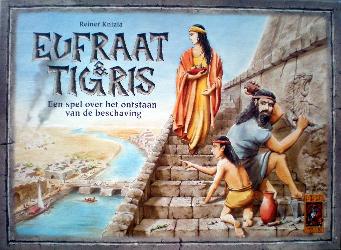
1997 · Gebiedsopbouw
Eufraat & Tigris
Players build civilizations in the ancient Fertile Crescent by placing tiles to create kingdoms and monuments. Each player manages four types of leaders—farming, trade, religion, and government—to collect points in those categories, but the final score is determined by the weakest category, encouraging balanced development. Civilizations expand and collide on the board, producing external conflicts where only one leader of a type survives, and internal conflicts that can replace leaders within a kingdom. An advanced variant adds a multi-tile monument that players can construct by trading in tokens; monuments are permanent and grant additional scoring opportunities.
- Spelers
- 2–4 best met 4
- Speeltijd
- 60–120 min
- Leeftijd
- 14+
- Complexiteit
- 3,5 / 5
Over het spel
- Ontwerp
- Uitgever






Uitbreidingen
Bekijk ze in Ludoya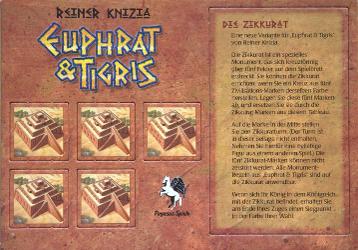
Waar te koop
Winkelprijzen en tweedehands exemplaren, elke dag gecontroleerd.
Aan de tafels van Ludoya
Alle statistieken in Ludoya- 374
- Vastgelegde speelsessies
- 402
- Spelers
- 1h 23m
- Gemiddeld potje
- 122
- In collecties
- 39
- Op verlanglijsten
- 3
- Voorbesteld
6,2/10
uit 80 Ludoya-recensies
Evan0,9 My last, and only other play of this game was in 2011, so I didn't really remember anything about it. This time I absolutely hated the experience. It feet wild, chaotic and random, although end game scoring proved that it wasn't, as each of my three opponents had nine points with me sitting at 5. In this game, you are laying down tiles in a big grid. There are a few placement rules, but the focus is on the fact that when you put a tile down into a chain of tiles, a player who's marker is a part of that chain, with the matching color, gets a cube in that color. When two cities connect, or when a player puts a marker down in the same city as a matching opponent's marker, then players battle by spending randomly drawn tiles from behind their player screen of the color of the conflict, with the most tiles winning. In some cases you also count tiles around your marker, and in some you don't but I found the combat incredibly frustrating. My opponents might win a combat without spending any tiles behind their screen, and then I lost a combat where I had a +5 advantage to someone revealing 5 matching tiles. The winner of the combat gets some cube payout in the matching color as well. When someone loses a combat, parts of the city flay off, which means your positions can get messed up even through no participation of your own. I'm sad to say I hated every minute of this game. I know it's one of the big revered games out there, but I found it completely intolerable. ★ Art, Iconography and components functional ☆ Clever or interesting mechanisms ★ Reasonably low downtime between turns with mildly AP players ☆ Multiple plays stay interesting ☆ Low or mitigatable luck elements ☆☆☆☆☆ Raw enjoyment
Mestremuten6,0 Rating: 3/5 Production value: 3/4 Is the game in my collection/Love to have?: 0/1
Regelvragen
Beantwoord vanuit het spelregelboek door de regelassistent van Ludoya.
Can I place a leader on any empty space—including river spaces—or place one so it unites kingdoms?
No. A leader must be placed on an empty land space adjacent to a temple, cannot be placed on a river space, and may not be placed so as to unite kingdoms (leaders can be repositioned or withdrawn under other rules) (page 6).
What exactly happens when I play a catastrophe tile on an existing tile or an empty space?
A catastrophe permanently blocks that space and may be placed on an empty space or on top of an existing tile (removing that tile), but it cannot be played on a tile bearing a treasure or monument or on a leader; if it removes the last temple adjacent to a leader, that leader is immediately withdrawn (page 7).
How do revolts work—how is strength counted and who wins ties?
In a revolt the attacker and defender count temples adjacent to their conflicting leaders, then attacker then defender may each once commit extra temple tiles from hand; highest total wins and the defender wins ties; the loser withdraws his leader, the winner gains one amulet, and all committed temples are removed from the game (page 8).
How are wars resolved and how do you get victory points from them?
For a war count each side’s supporters (connected tiles of the leader’s color) and then attacker then defender may commit matching-color tiles from hand; the higher total wins and the defender wins ties; the loser removes his leader and all supporters, and the victor gains one victory point for the withdrawn leader plus one for each supporter removed (committed tiles do not score) (pages 9–10).
When can I build a monument and do the flipped tiles still count for conflicts/supporters?
If a tile completes a 2×2 square of like-colored tiles the active player may flip those four tiles facedown and place a monument (one monument color must match the facedown tiles); the facedown tiles still count as part of regions/kingdoms and link leaders but do not count as supporters in conflicts, and monuments cannot be destroyed (page 11).
How is the winner decided at game end and how are treasures used for tiebreaks?
The game ends when only one or two treasures remain or the bag is empty; players then allocate their treasures among the four spheres as they choose and compare players’ weakest sphere—whoever has the highest lowest-sphere wins, with ties decided by comparing next-lowest spheres (if all four spheres are equal, tied players share victory) (page 14).
Vergelijkbare spellen





Gratis, op het web, Android en iOS
Speel Eufraat & Tigris met Ludoya
- Houd het bij in je collectieHoud je exemplaar en de uitbreidingen bij, leen het uit aan vrienden of zet het op je verlanglijst en krijg bericht als de prijs daalt.Voeg het toe aan je collectie
- Leg elke speelsessie vastScores, winnaars, timers en foto's, en dan je statistieken: winpercentage, favoriete spelersaantal, beste score.Speelsessie vastleggen
- Regelvragen beslechtenVraag alles over de regels en krijg een antwoord uit het spelregelboek, met de pagina om het na te lezen.Vraag de regelassistent
- Vind mensen om het mee te spelenClubs, spelavonden en evenementen bij jou in de buurt waar dit spel op tafel komt.Bekijk evenementen
Speldata (spelers, speeltijd, leeftijd, makers) van BoardGameGeek.