
-2200 · Abstract Strategy
Go
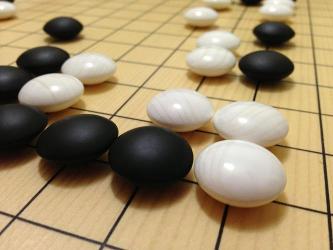
Players alternately place black and white stones on the intersections of a grid to enclose territory and influence the board. Captured stones are removed when they are fully surrounded, and play ends when both players pass; final scoring counts enclosed territory minus prisoners to determine the winner. The rules are simple and focus on spatial control, surrounding, invasion and sacrifice across an empty board that develops into large-scale strategic fights.
- Players
- 2
- Playing time
- 30–180 min
- Age
- 8+
- Complexity
- 3.9 / 5
About the game
- Design
- Publishers





Expansions
See them in Ludoya

Where to buy it
Shop prices and second-hand copies, checked every day.
On Ludoya's tables
Full stats in Ludoya- 440
- Plays logged
- 65
- Players
- 29m 9s
- Average play
- 68
- In collections
- 12
- On wishlists
7.0/10
from 33 Ludoya reviews
FinnTroll10.0 go play go
Rules questions
Answered from the rulebook by Ludoya's rules assistant.
Can I play a stone where it would have no liberties (suicide)?
No — placing a stone that would leave your new stone or chain with zero liberties is not allowed, except for the special case where that play simultaneously captures opposing stones and thereby gains liberties (so your stones remain); see page 1.
What exactly is a chain and how do liberties work for it?
Stones of the same color connected orthogonally form a chain and share their liberties (diagonal connections do not count); if the whole chain has no liberties it is captured and removed; see pages 1 (sections on Liberties and Chains).
If I fill the last liberty of an opponent’s stone or chain, do I remove it immediately?
Yes — playing on the last liberty captures the single stone or entire chain, and the captured stones are taken off the board immediately; see page 1 (Capturing).
Can I immediately recapture to recreate the previous position (ko)?
No — you are not allowed to play a move that recreates a previous position (immediate recapture that would repeat the position is forbidden) to prevent infinite repetition; see page 1 (Repeating positions / ko rule).
How does the game end and what are the passing rules?
A player may pass instead of playing; whenever you pass you give an extra stone to the opponent to add to their captures, and when both players pass consecutively the game ends (white must pass last to equalize moves); see page 1 (When does the game end?).
How is the score calculated and does White get a bonus for going second?
Score is territory plus the number of stones you have captured (captured stones can also be removed from opponent territory); White receives an extra 7 points to compensate for going second; see page 1 (Object of the game).



Free, on web, Android and iOS
Play Go with Ludoya
- Keep it in your collectionTrack your copy and its expansions, lend it to friends, or put it on your wishlist and get told when the price drops.Add it to your collection
- Log every playScores, winners, timers and photos, then your stats: win rate, favourite player count, best score.Log a play
- Settle rules questionsAsk anything about the rules and get an answer from the rulebook, with the page to check it on.Ask the rules assistant
- Find people to play it withClubs, game nights and events near you that bring this game to the table.See events
Game facts (players, playing time, age, credits) from BoardGameGeek.