
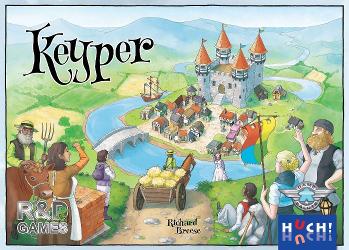
2017 · Városépítés
Keyper
Players manage a village and a team of multi-colored workers over four rounds representing spring, summer, autumn, and winter. Each worker color specializes in an activity (woods, mining, clay, etc.), while white workers act as generalists; players place workers on shared country boards or in their own village to gather resources, upgrade goods, mine gems, and perform actions. Worker placement allows other players to join placements with matching colors, enabling shared benefits and opportunities to play workers twice; players can also play additional workers if they run out before others. Country boards change configuration each season, opening different fields and seasonal actions, so players must decide when to claim boards, when to cooperate, and which strategies to pursue to score the most points.
- Játékosok
- 2–4 legjobb: 3
- Játékidő
- 90–120 perc
- Kor
- 14+
- Bonyolultság
- 3,6 / 5
A játékról
- Tervezés
- Grafika
- Publisher



Kiegészítők
Nézd meg őket a Ludoyában
Hol vásárolhatod meg
Bolti árak és használt példányok, naponta ellenőrizve.
A Ludoya asztalain
Teljes statisztika a Ludoyában- 27
- Rögzített játszmák
- 40
- Játékosok
- 2h 22m
- Átlagos játékidő
- 16
- Gyűjteményekben
- 1
- Kívánságlistákon
5,1/10
7 Ludoya-értékelés alapján
Evan4,6 This is an efficiency game, where your goal is to build and upgrade village tiles. This is done by placing workers in action spots in the central boards. Players can also claim boards with their player color meeple, in order to gain all the meeples placed on that board for the next round, and also they can somewhat configure the action spaces on the tile to their liking, adjusting the options for the next round. Generally the flow is collect things, spend to upgrade, and try to grab new tiles from the fliplucky display that will grant you points based on what you've accumulated. The neat thing about the game is that when a worker goes to a spot that matches his color, you get the action twice. Then someone can follow you in the action giving you both the action three times. This means that players frequently have uneven numbers of workers. When someone is out of workers, and they've already claimed a tile for the next round, they can choose to start knocking over workers to resolve their spaces again which activates them just as before, so up to three times potentially. I think with more plays and better understanding of when you want a guy boom and when you want a guy bust there's a lot you can game the game, but the length of the game and the general equality of all things makes me feel like I'd really need to push to get this to the table enough for me to grow on it, and I don't have that in me compared to the amount the puzzle interests me. By equality of all things I mean, there's no functional difference between the types of gems or animals or anything really. The agricola/caverna magic is that it matters what animals you have and when, for breeding, growing, ect. Veggies grow differently than grain. in Keyper, you get a red gem, or a yellow gem. Then you see if you can get a tile that wants a red gem or a yellow gem. No? Only green? Ok... I mean, ultimately that's fine, but it just means there's a certain dullness to the late game collection of things. Randomness in the tile availability I don't MIND, but if there was a meaningful difference between resources then I think the game would have been a keeper for me, I do think it's an odd decision not to pair this kind of flipluck without a general end of game leftovers scoring. If you aren't going to mandatorily release the tile that gives bonus points for chickens, at least punish me for having no chickens. Make choosing what action spots are available on the tile mean something more. :star: Art, Iconography and components functional :star: Clever or interesting mechanisms :star: Reasonably low downtime between turns with mildly AP players :star: Multiple plays stay interesting :nostar: Low or mitigatable luck elements :star::star::star::nostar::nostar: Raw enjoyment








Ingyenes, weben, Androidon és iOS-en
Játszd a(z) Keyper játékot a Ludoyával
- Tartsd a gyűjteményedbenKövesd a példányodat és a kiegészítőit, add kölcsön a barátaidnak, vagy tedd fel a kívánságlistádra, és szólunk, ha csökken az ára.Add hozzá a gyűjteményedhez
- Rögzíts minden játszmátPontok, győztesek, időzítők és fotók, aztán a statisztikáid: győzelmi arány, kedvenc játékosszám, legjobb pontszám.Játszma rögzítése
- Pontozz papír nélkülHasználd a közösség pontozólapjait és játéksegédeit, és a Ludoya összeadja a pontokat.Pontozólapok keresése
- Találj játszótársakat hozzáKlubok, játékestek és események a közeledben, ahol ez a játék asztalra kerül.Események megtekintése
Játékadatok (játékosok, játékidő, kor, alkotók) forrása: BoardGameGeek.