
2018 · Civilisatie
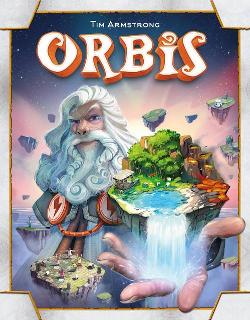
Orbis
Players act as deities drafting region and deity tiles to assemble a personal world and accumulate creation points. On each turn a player takes either one of nine shared region tiles or an available God tile (each player may claim at most one God tile), then places region tiles on their tableau under placement restrictions. Taking a region tile places worshippers of that color onto adjacent tiles, which alters future tile values and influences opponents’ choices. Some lands provide special bonuses or endgame scoring, and players spend worshippers to acquire more powerful regions. After a fixed number of rounds players score creation points, award bonuses, and compare totals to determine the winner.
- Spelers
- 2–4 best met 3
- Speeltijd
- 45 min
- Leeftijd
- 10+
- Complexiteit
- 2 / 5
Over het spel
- Ontwerp
- Illustraties
- Publisher


Waar te koop
Winkelprijzen en tweedehands exemplaren, elke dag gecontroleerd.
- SpellenhuisNiet op voorraad25.99 €
- Juegos de la Mesa RedondaOp voorraad23.96 €
- Dungeon MarvelsVoorbestelling26.5 €
- Games EmpireOp voorraad44.99 $
- Magia de TintaOp voorraad28.5 €
- UplayVoorbestelling29.9 €
- ZacatrusNiet op voorraad29.98 €
- FantasiapelitOp voorraad36.1 €
Aan de tafels van Ludoya
Alle statistieken in Ludoya- 46
- Vastgelegde speelsessies
- 80
- Spelers
- 30m 49s
- Gemiddeld potje
- 38
- In collecties
- 5
- Op verlanglijsten
4,6/10
uit 15 Ludoya-recensies
Garfield3,0 It's way too difficult to match some tiles to score points. So the easiest way to get points are red and yellow tiles I think. [c] Theme: :star::nostar::nostar::nostar::nostar: <!-- size 7]Nope --> Gameplay: :star::star::nostar::nostar::nostar: <!-- size 7]Quite boring --> Interaction: :star::nostar::nostar::nostar::nostar: <!-- size 7]Nope --> Artwork: :star::star::nostar::nostar::nostar: <!-- size 7]Nothing special --> Luck: :star::star::star::nostar::nostar: <!-- size 7]Random tile drawing --> Strategy: :star::star::star::nostar::nostar: <!-- size 7]Obvious ones --> Components: :star::star::star::nostar::nostar: <!-- size 7]Nothing special --> Play duration: :star::star::star::nostar::nostar: <!-- size 7]Good --> Easy to teach: :star::star::star::nostar::nostar: <!-- size 7]Ok --> Rules quality: <!-- size 7]not read --> Setup time: :star::star::star::nostar::nostar: <!-- size 7]Not much to set up --> No downtime: :star::star::star::nostar::nostar: <!-- size 7]Ok --> Replay value: :star::star::nostar::nostar::nostar: <!-- size 7]Not really --> [/c]
Evan4,6 In this game you are building a pyramid of tiles, where tiles on upper levels have to color match one of the two tiles below it. Each color has a certain effect genre, so as you choose colors you are also picking your path to scoring. Tiles are selected from a 3x3 grid, and often cost recipes of colored cubes to take. When a tile gets taken, it drops colored cubes matching the color of the tile on each orthogonality adjacent tile in the selection grid, thereby making them more appealing for other players to take. Managing your cubes is crucial as if you can't pay for or place a tile on your turn, you take one anyway, and flip it over to it's -1 vp side where it becomes a rainbow color for placement rules. Once per game instead of taking a tile, players can take a god tile which is what will sit at the top of the pyramid and give you extra points if you met it's requirements. The game plays quickly, and has that good feeling of tough decisions. You have to watch what your opponents are going for, what they are likely to take, and where they are likely to drop what color of cubes on their turns to optimize your moves. Every choice feels both good, and totally wrong as you wall yourself in. The game does cap out after a few plays. Once you've followed each color path through the game once, there's not a ton left to see. That being said, the core game play is still quite enjoyable. :star: Art, Iconography and components functional :star: Clever or interesting mechanisms :star: Reasonably low downtime between turns with mildly AP players :nostar: Multiple plays stay interesting :star: Low or mitigatable luck elements :star::star::star::nostar::nostar: Raw enjoyment
An abstract puzzly game with nice aesthetics. PROS - The base idea is easy to grasp and works well within its abstract frame. - Iconography, graphic design and art are all quite good. The game is pretty easy to understand for its icons and it has a nice table presence. CONS - The game naturally constrains you, which is not bad in itself but leads to less and less possibilities and therefore decisions towards its end. - The design space seems to be underexplored, leading to some turns with little or not very meaningful decisions to make as many tiles offer kind of the same thing. - It just feels like there is nothing new here, the design doesn't feel innovative nor very exciting.



Gratis, op het web, Android en iOS
Speel Orbis met Ludoya
- Houd het bij in je collectieHoud je exemplaar en de uitbreidingen bij, leen het uit aan vrienden of zet het op je verlanglijst en krijg bericht als de prijs daalt.Voeg het toe aan je collectie
- Leg elke speelsessie vastScores, winnaars, timers en foto's, en dan je statistieken: winpercentage, favoriete spelersaantal, beste score.Speelsessie vastleggen
- Scoor zonder papierGebruik de scoreformulieren en speelhelpers van de community en laat Ludoya de punten optellen.Scoreformulieren zoeken
- Vind mensen om het mee te spelenClubs, spelavonden en evenementen bij jou in de buurt waar dit spel op tafel komt.Bekijk evenementen
Speldata (spelers, speeltijd, leeftijd, makers) van BoardGameGeek.