
2018 · Bybygging
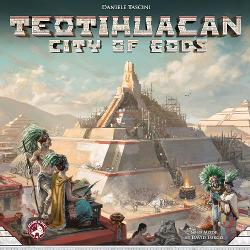
Teotihuacan: City of Gods
Spillerne styrer terningarbeidere som blir sterkere etter hvert som de utfører handlinger. De flytter én terning rundt på et modulært bybrett og utfører handlingen på én av to plasser på hver brikke. På turene sine velger spillerne mellom å utføre en handling og oppgradere arbeideren, eller å ta en umiddelbar bonus uten oppgradering, samtidig som de må håndtere ressurser og behovet for å brødfø arbeidsstyrken. Handlingene lar spillerne utvikle teknologier, bygge boliger, avansere på tre store templer og bidra til den sentrale trappepyramiden gjennom tre påfølgende epoker. Seieren avgjøres av samlet berømmelse etter periodiske poengsummeringer.
- Spillere
- 1–4 best 4
- Spilletid
- 90–120 min
- Alder
- 14+
- Kompleksitet
- 3,8 / 5
Om spillet
- Design
- Illustrasjon
- Utgiver



Utvidelser
Se dem i Ludoya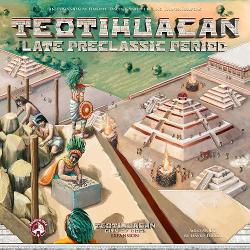 Teotihuacan: Late Preclassic Period2019
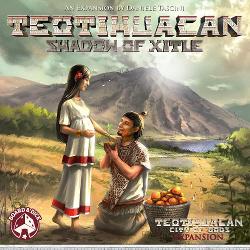 Teotihuacan: Shadow of Xitle2020
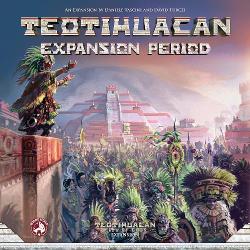 Teotihuacan: Expansion Period2021
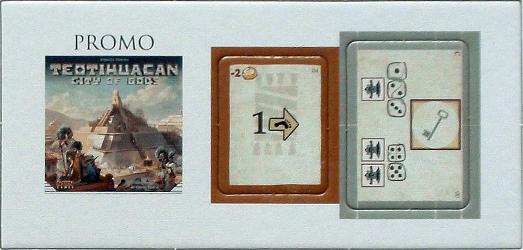 Teotihuacan: Dice Settlers Promo2018
 Teotihuacan: City of Gods – Pyramid Tile Promo, Red Temple2019
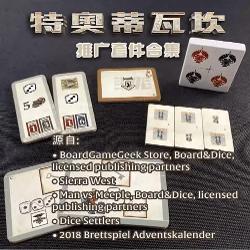 Teotihuacan: City of Gods – Promo Bundle2020
 Teotihuacan: City of Gods – 5th Player Expansion2020
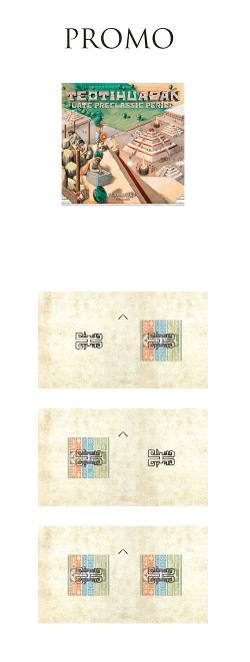 Teotihuacan: City of Gods – Decoration Tiles2019
 Teotihuacan: Brettspiel Adventskalender 2018 Promo2018
 Loot Box #12022
 Teotihuacan: City of Gods – Man vs Meeple Promo2019
 Brettspiel Adventskalender 20182018
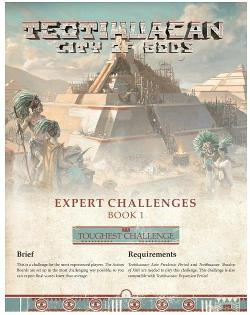 Teotihuacan: Expert Challenges – Book 12021
 Teotihuacan: Expert Challenges – Book 22021
 Teotihuacan: Expert Challenges – Book 32022
 Teotihuacan: New Priests2024
 Teotihuacan: City of Gods – 5th Player Expansion2024
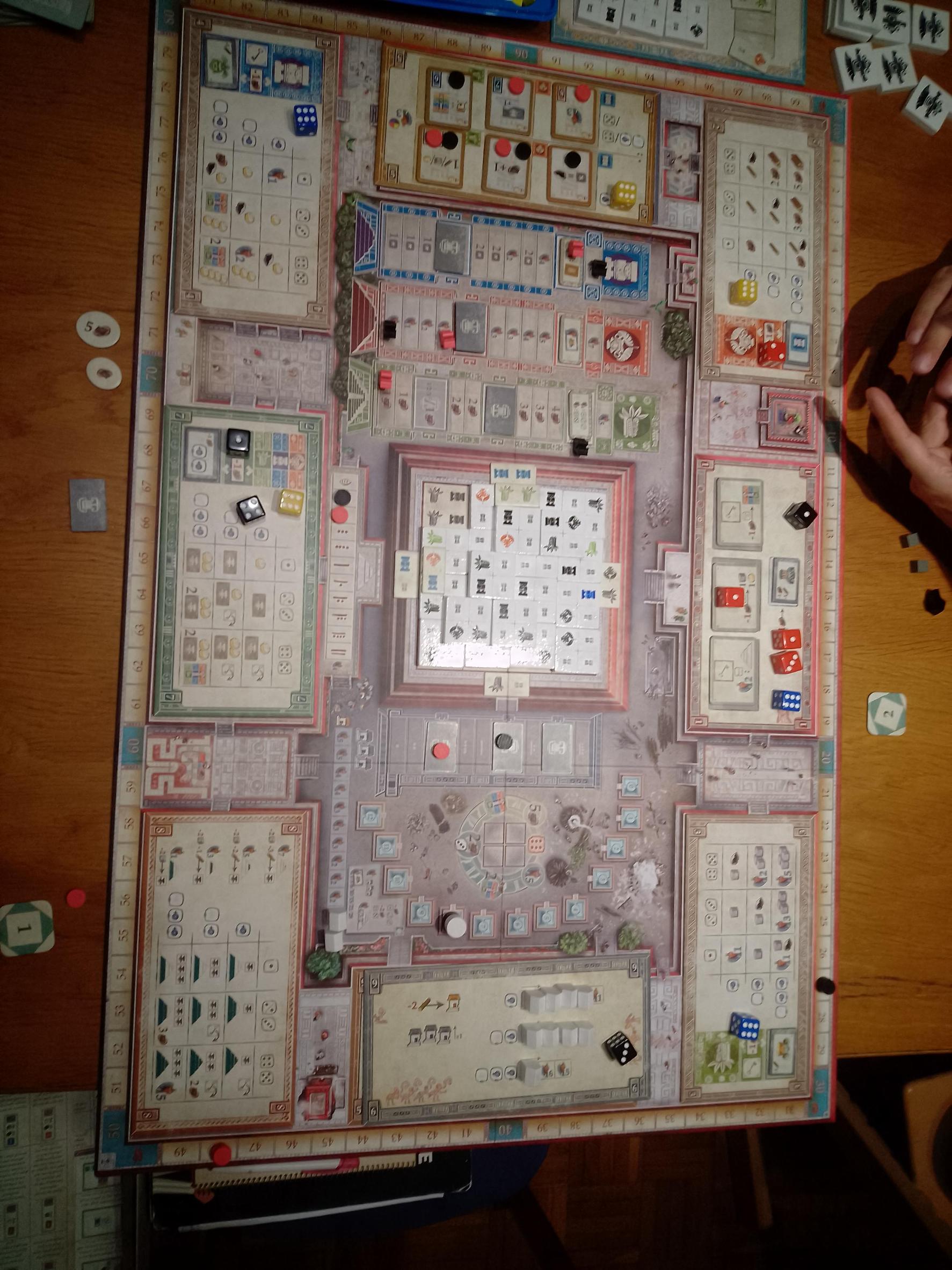
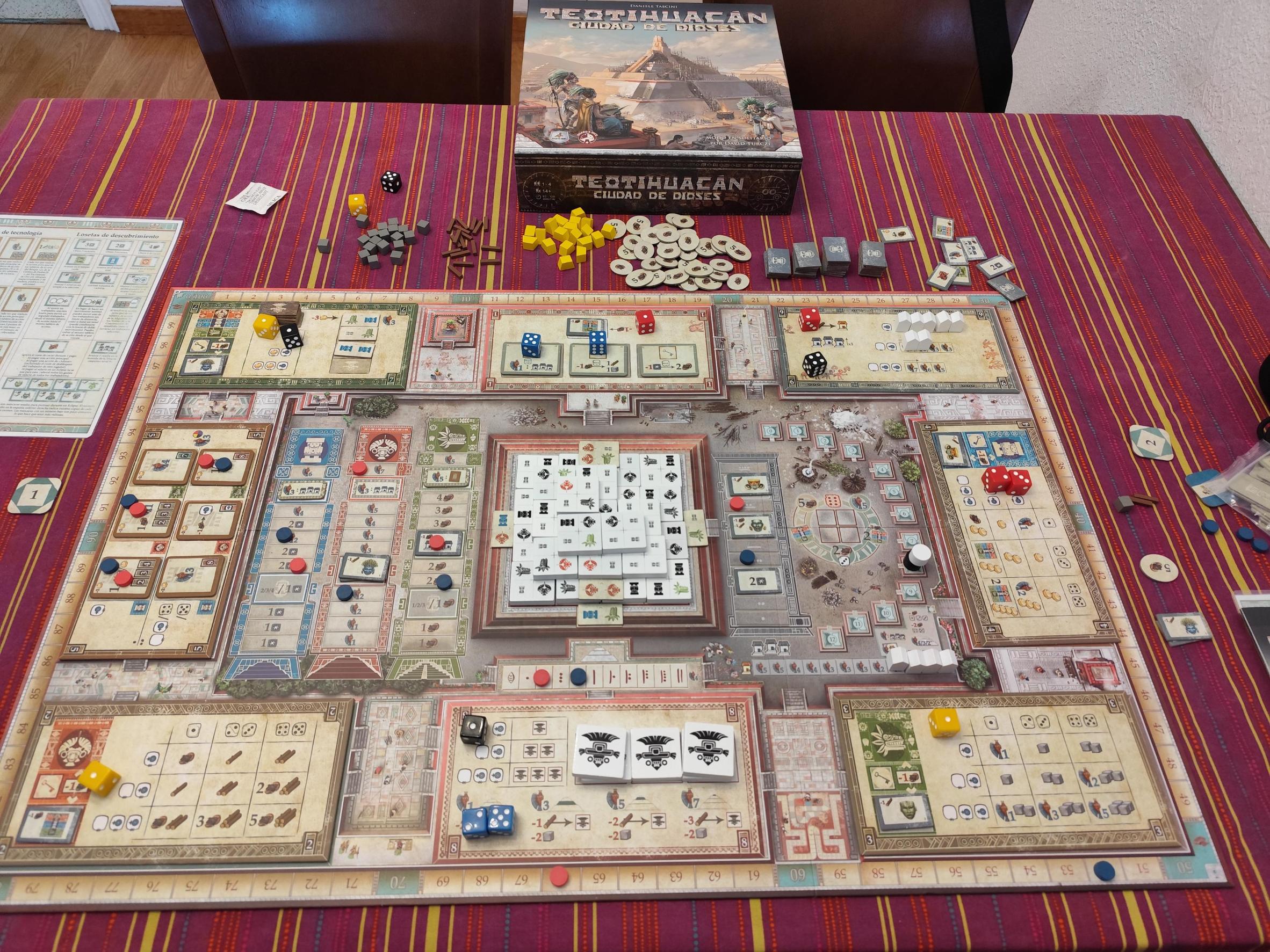
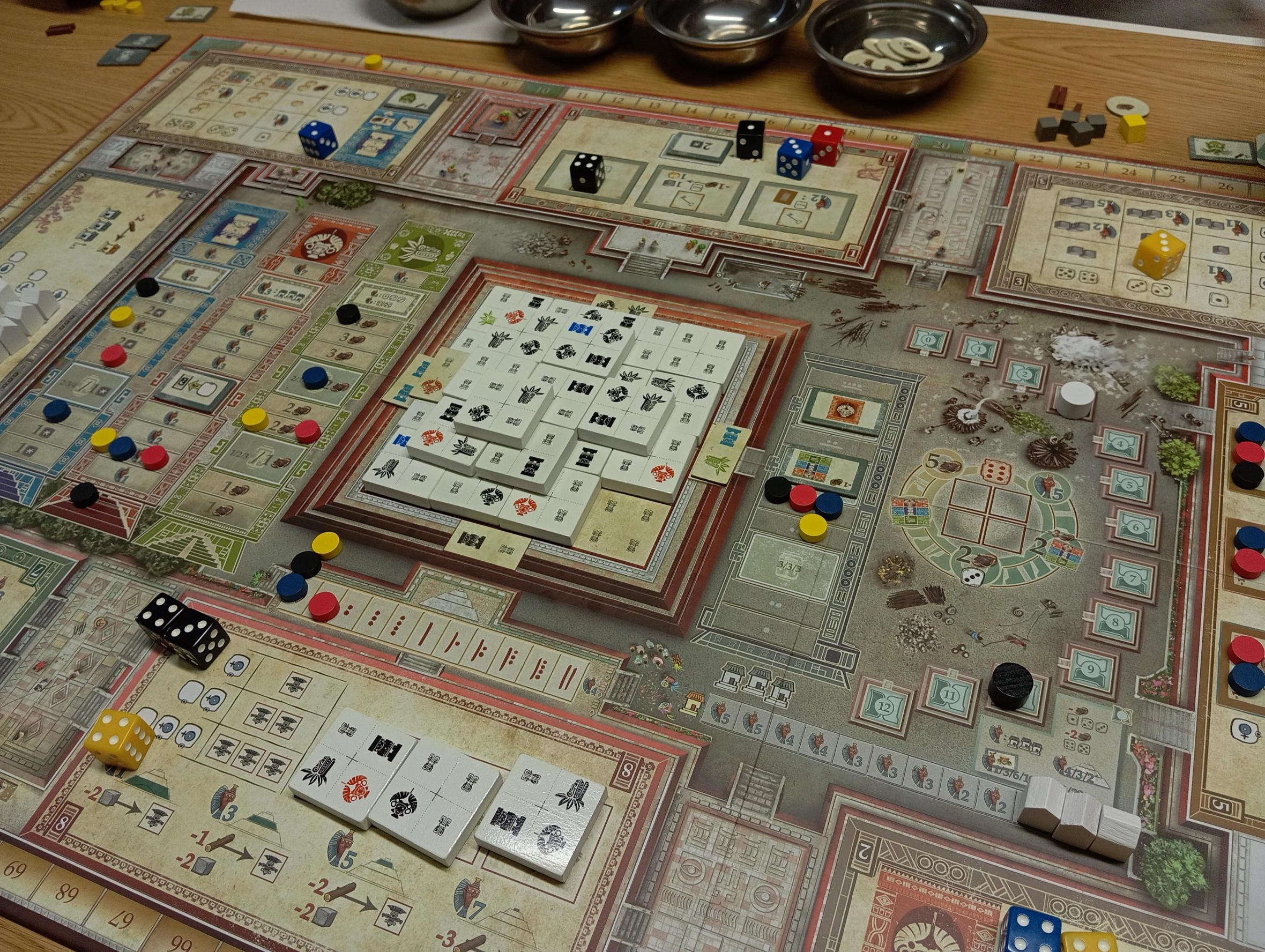
Bilder fra Ludoyas bord
Alle bilder i Ludoya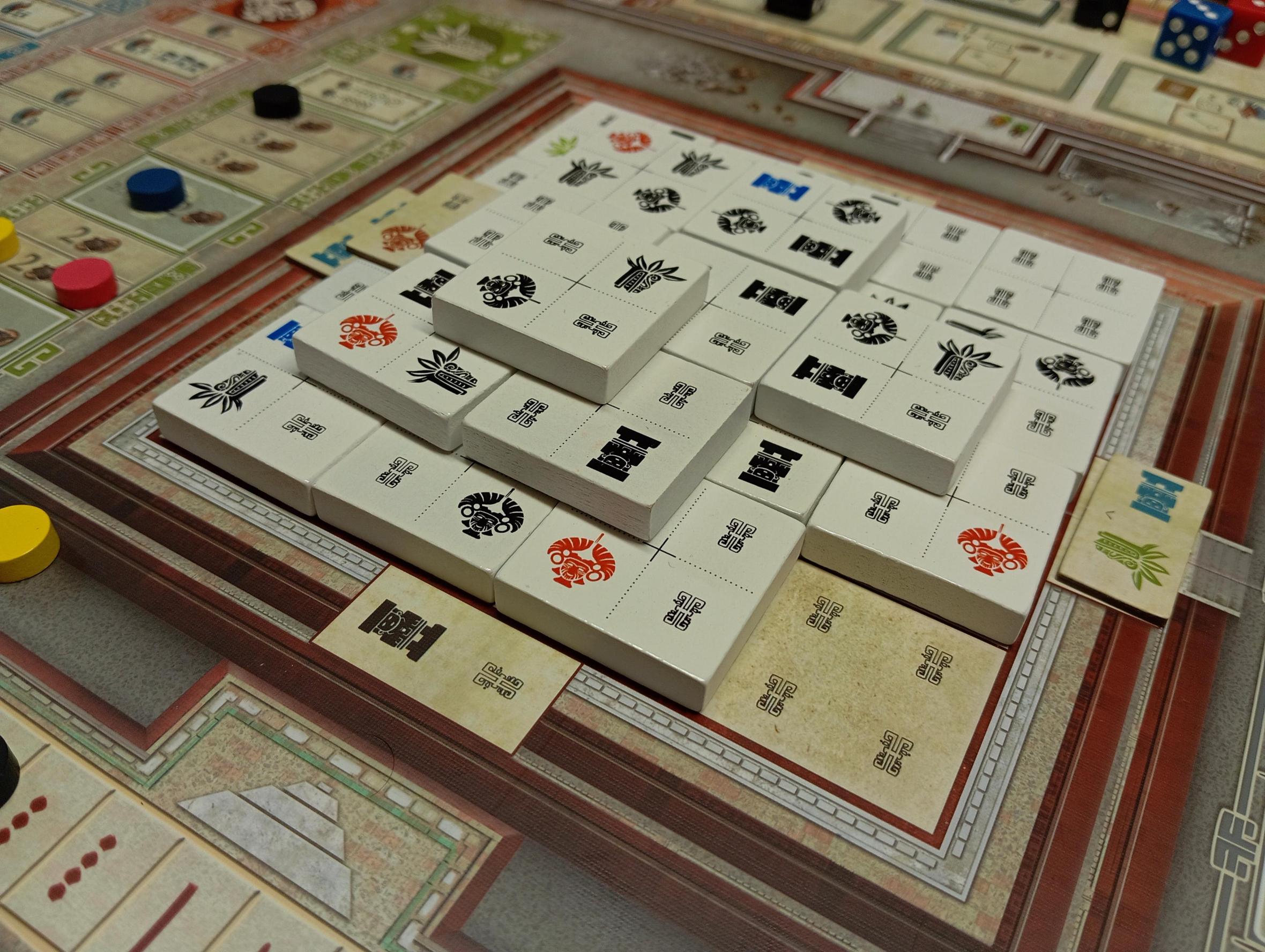
Hvor du kan kjøpe det
Butikkpriser og brukte eksemplarer, sjekket hver dag.
På Ludoyas bord
All statistikk i Ludoya- 823
- Registrerte spilløkter
- 634
- Spillere
- 1h 53m
- Gjennomsnittlig spilletid
- 183
- I samlinger
- 33
- På ønskelister
- 1
- Forhåndsbestilt
6,3/10
fra 117 anmeldelser på Ludoya
Jan Solo8,0 Gran juego de gestión de recursos y construcción de la pirámide. Modo solitario interesante, pero a mi gusto excesivamente farragoso y lento.
Evan2,5 In this game you move one of your player markers around a roundel 1-3 spaces then resolve the action in the space you end at. Your makers are dice, and the effect of the action spaces is based on a table that looks for how many of your dice are in the space, then also what the pip value of your lowest die is. Often the effect of the space will then add pips to one or two of your dice. When a die hits 6, it resets to 1, and you gain a step on a track that produces points at the end of the round per step you have. Then you also gain a reward from a small wheel of options next to that track. Mostly what you are doing is collecting bricks and wood, then spending the bricks and wood to build the structure at the center of the board. There are extremely important technology tiles you can invest in to make your actions better. Another key thing to manage is the need to spend cacao tokens equal to the number of players in an action space to resolve the action. If you can't pay it, then you wind up skipping your action and instead getting the cacao tokens plus 1 instead. You can avoid this by taking gather actions more often, but since there's very little if any engine building in the game, it does feel like a large portion of your actions in the game work out to similar feeling gather then spend cycles. When you take the action to build the central structure, some but not all of the tiles have colored icons that give you a free step on the matching temple track in addition to the large number of points produced by the action normally. Ability to build is dependent on a substantial number of turns setup, getting the resouces and lining your dice up. Temple track steps are somewhat hard to come by and each step produces points, resources or cacao in addition to having high value endgame scoring criteria at the top, so when you are ready to build and all the pieces are totally colorless, and then you flip up colored pieces for the next person so they can spend exactly what you did only they get a substantial additional return doesn't feel great. Temple builds additionally come with steps on a track that gives bonus 4 points each round to the player who built the most. The track rests right next to the building space and is clearly tied to it. The problem here is that there is a second space that adds stair tokens to the temple, with a different cost, and a different place on the roundel, which makes it needlessly hard to see who has the potential to gain a step and when. Additionally, the stair tokens have a pointlessly specific orientation they need to be placed at because there is a tiny hard to see arrow on the tile that has to point inward. This is there to make matching the icons when you place the stair token more luck driven for no reason I can understand. Additionally these tiles can have either one or two bonus colored icon payouts that again, depend on luck of what's available, again rewarding players for lucking into situations they had no control over establishing. There's also a confusing action space that we rarely saw used. It awards some points, gives you a step on the death track, and then reduces the value of being on that track for everyone. Why have a space that invests in a track, and then simultaneously reduces the value of that same track? When a player's marker goes from 1 to 6, you also click ahead the round timer, which additionally moves after each player has had an action. The game has two modes, one where the round ends the moment the marker hits the end of the track producing uneven turns, or when it hits the end of the track each player gets one more turn. Neither of these is great, because if you age out one of your markers in the final round it effectively doesn't change the pace of the game. Why not just have even turns without playing a whole additional round? I suppose it's due to the fact that when a player is about to age out a die is very unpredictable, since when you resolve a space with two age icons, you can age the same die twice, rather than having to spread it across two dice. What this means is that it's vastly more influential to the flow of the game to age out early in the round than later in the round. More unevenness to the feel and flow of the game. I additionally was confused by one special reward tile that you can spend to ignore paying a food cost, even the totality of food required at the end of the round to feed your people. So, spend it now to avoid paying 3 or 4 food for a crowded action space, or spend it at the end of the round to avoid paying up to 8. There's a massive point hit for not feeding your people, it seems like a pretty core 'watch yourself' mechanism, that you can just ignore for a round by virtue of taking this tile. Very odd. I don't know, this is an ok game were everything feels just a little off. A few minor changes and I think this could have been great, it just doesn't feel very interesting or cohesive. Any of the little things I'm complaining about could probably be forgiven if the core mechanism was more interesting. ★ Art, Iconography and components functional ☆ Clever or interesting mechanisms ★ Reasonably low downtime between turns with mildly AP players ★ Multiple plays stay interesting ☆ Low or mitigatable luck elements ★☆☆☆☆ Raw enjoyment
Garfield8,0 #50 [c] Theme: ★★★★☆ <!-- size 7]The pyramide is great --> Gameplay: ★★★★★ <!-- size 7]Lots of meaningful decisions --> Interaction: ★★★☆☆ <!-- size 7]Where are the other dice placed --> Artwork: ★★★☆☆ <!-- size 7]Ok --> Luck: ★★☆☆☆ <!-- size 7]Pyramid tiles available at your turn --> Strategy: ★★★★☆ <!-- size 7]Different strategies possible --> Components: ★★★★☆ <!-- size 7]Pyramide tiles are great --> Play duration: ★★★☆☆ <!-- size 7]Ok --> Easy to teach: ★★★☆☆ <!-- size 7]Ok --> Rules quality: <!-- size 7]not read --> Setup time: ★★☆☆☆ <!-- size 7]A lot to setup --> No downtime: ★★★☆☆ <!-- size 7]Ok --> Replay value: ★★★★★ <!-- size 7]Modular board, different strategies --> [/c]

Regelspørsmål
Besvart fra regelboka av Ludoyas regelassistent.
Når jeg utfører en hovedhandling, hvordan teller jeg arbeidere, og hvor mye kakao må jeg betale? Teller låste arbeidere eller arbeideren jeg nettopp flyttet?
For å fastslå kakaokostnaden teller du først antallet ulåste arbeidere i forskjellige farger som allerede befinner seg på brettet (se bort fra arbeideren som ankommer, og eventuelle låste arbeidere på tilbedelsesplasser), og betaler så mye kakao (s. 7). Når du løser effektene av hovedhandlingen, teller du deretter dine egne ulåste arbeidere på dette brettet, inkludert arbeideren du nettopp plasserte, men aldri mer enn 3 når det gjelder effektene (s. 7).
Når jeg tar Samle kakao, hvilke arbeidere telles med – telles den ankommende arbeideren eller låste arbeidere?
For å samle kakao teller du antallet arbeidere i forskjellige farger som allerede finnes på handlingsbrettet og er låst opp (ikke tell med arbeideren som ankommer, eller arbeidere på låste tilbedelsesplasser), og får dette antallet pluss 1 kakao. Plasser deretter arbeideren du flyttet i det generelle området (s. 6).
Hva skjer egentlig når en arbeider når styrke 6 (oppstigning)? Utløser jeg en formørkelse umiddelbart?
Oppstigning utløses umiddelbart når en arbeider får styrke 6: rykk frem på De dødes aveny, flytt terningen til palassets generelle område og tilbakestill den til styrke 1, velg én oppstigningsbelønning, og flytt deretter lysbrikken frem på kalenderbanen (noe som kan utløse en formørkelse) — gjennomfør hver oppstigning fullstendig, og utløse formørkelsen først etter turen hvis det er aktuelt (s. 9).
Hvordan fungerer begrensningene for plassering av pyramidebrikker og dekorasjoner, og når avslutter det at pyramiden er ferdig spillet?
Dekorbrikker må bare plasseres på tillatte felter når de nødvendige underliggende pyramidelagene og forhåndskravene for Dekorasjoner er oppfylt, og du får poeng for matchende ikoner når du dekker til brikker (s. 8). Når du plasserer den øverste pyramidebrikken (fjerde nivå), må hele tredje nivå være på plass under den. Du får de oppførte seierspoengene, og den hvite kalenderbrikken flyttes umiddelbart til den svarte brikkens posisjon, noe som utløser den siste formørkelsen og avslutter spillet (s. 8).
Når jeg utfører en tilbedelseshandling, kan jeg låse opp en annen spillers arbeider og gjøre både tilbedelsesevnen og ta oppdagelsesbrikken? Må jeg betale noe?
Hvis en annen spillers arbeider opptar Tilbedelsesfeltet, betaler du 1 kakao for å låse opp denne arbeideren (flytt den til det generelle området) før du plasserer din egen; du kan ikke låse opp dine egne arbeidere på denne måten (s. 6). Deretter velger du enten å aktivere Tilbedelsesevnen eller ta Oppdagelsesbrikken, eller betale 1 ekstra kakao for å gjøre begge deler (alle kakaokostnader må betales før noen fordeler løses); hvis du tar en brikke, betaler du kostnaden som står på den (s. 6).
Lignende spill











Gratis, på nett, Android og iOS
Spill Teotihuacan: City of Gods med Ludoya
- Ha det i samlingen dinHold oversikt over eksemplaret ditt og utvidelsene, lån det ut til venner, eller legg det på ønskelisten og få beskjed når prisen faller.Legg det til i samlingen din
- Registrer hver spilløktPoeng, vinnere, tidtakere og bilder, og så statistikken din: vinnerprosent, favorittantall spillere, beste poengsum.Registrer en spilløkt
- Avgjør regelspørsmålSpør om hva som helst i reglene og få svar fra regelboka, med siden du kan sjekke det på.Spør regelassistenten
- Finn folk å spille det medKlubber, spillkvelder og arrangementer nær deg der dette spillet kommer på bordet.Se arrangementer
Spillfakta (spillere, spilletid, alder, bidragsytere) fra BoardGameGeek.