

2016 · Zivilisation
Ave Roma
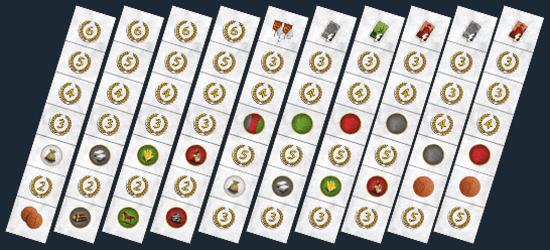
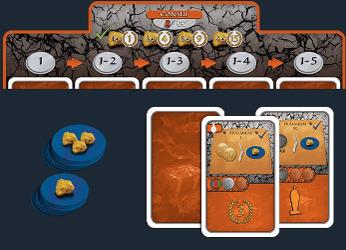
Die Spieler verwalten einen Pool gemeinsamer Arbeiter, die individuelle Werte haben und sich im Laufe der Zeit verändern. Jede Runde setzen die Spieler in einer Aktionsphase fünf Arbeiter ein und holen sie dann in einer anderen Sammelphase zurück, wobei sie oft andere Arbeiter zurückbekommen, als sie geschickt haben. Mit den Aktionen können die Spieler Gebäude errichten, militärische Vorhaben finanzieren, sich bei Gönnern beliebt machen, Einfluss in verschiedenen Gebieten gewinnen und Geld sowie Ressourcen sammeln. Das Spiel legt den Fokus darauf, mit sich entwickelnden Arbeitersets zu planen und über mehrere Wege zum Sieg zu gelangen, etwa durch Gebietskontrolle, wirtschaftliche Entwicklung und politische Unterstützung.
- Spieler
- 2–5 am besten mit 3
- Spielzeit
- 45–120 Min.
- Alter
- 12+
- Komplexität
- 3,7 / 5
Über das Spiel
- Autoren
- Illustration
- Publisher


Erweiterungen
In Ludoya ansehen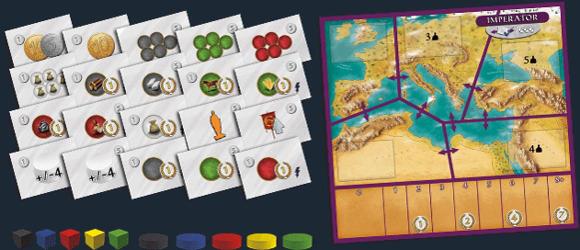
Wo kaufen
Shop-Preise und gebrauchte Exemplare, täglich geprüft.
An Ludoyas Tischen
Alle Statistiken in Ludoya- 11
- Erfasste Partien
- 26
- Spieler
- 2h 10m
- Durchschnittliche Partie
- 6
- In Sammlungen
- 1
- Auf Wunschlisten
1,7/10
aus 6 Ludoya-Rezensionen
Evan0,9 This game has some very poor usability choices. The board is circular, which makes the information disorienting. The icons and text are very tiny. You are looking to collect sets of cards by the same tiny text name of the card that have different pictures. When cards are used for their center ability they get tapped. When they are used to discard for a bonus action they go to the used side of your player mat, where they can still be tapped. Then there are set collection bonuses that can be gotten from combinations of cards in your used and unused piles. There are also icons on the board that sometime mean gain and other times mean pay using the same positioning and iconography. If you get past the graphic design problems, you are met with a very slow moving and restrictive resource management/worker placement/set collection game. Workers have printed numbers that determine what action areas they can be used in. At the end of the round, starting with the player who was last in turn order, players get to select groups of workers to retrieve from the board, so your turn order determines a lot about your numbers spread. It's also often hard to tell how useful a number since cards flush from certain spaces. There's enough normal worker placement tension without adding this hard to control element. Since your worker number spread is a barely controllable symptom of turn order, I don't see how even choosing what numbers to take can be considered a meaningful decision. Buying cards usually takes several turns of setup. This feels like a long process of seeing how each and every game element prevents you from doing what you want for one reason or another. Either the resource card you needed got flipped action slot your numbers won't let you use, or the resource card you need wound up where you were aiming to improve your score marker meaning you now needed two workers of that number, or even another player interacted with the spot earlier in the turn order and now the cost to do anything there is $3 more. Each resource area has a little scoring track. If someone is ahead of you on the track, you have to overtake them in a single move, because if you end on the same space as them, you get bumped back down to the next lowest available space. The tracks are not long, and the cards that take so long to get give anywhere from 0 to 3 track bumps. I found this terribly frustrating, as by the time I could manage to get what I needed to overtake on a track, one of my opponents would invariably have gotten to the top of the track where there's nothing I could do to stop them. :nostar: Art, Iconography and components functional :nostar: Clever or interesting mechanisms :nostar: Reasonably low downtime between turns with mildly AP players :nostar: Multiple plays stay interesting :nostar: Low or mitigatable luck elements :star::star::nostar::nostar::nostar: Raw enjoyment
Garfield2,0 Seriously? About 20 possibilities what you can do? Big down times. And 2 hours with 3 players is way too much! [c] Theme: :star::nostar::nostar::nostar::nostar: <!-- size 7]Not really --> Gameplay: :star::star::nostar::nostar::nostar: <!-- size 7]Too many possibilities --> Interaction: :star::star::nostar::nostar::nostar: <!-- size 7]Not much --> Artwork: :star::nostar::nostar::nostar::nostar: <!-- size 7]Doesn't appeal me --> Luck: :nostar::nostar::nostar::nostar::nostar: <!-- size 7]No --> Strategy: :star::star::star::nostar::nostar: <!-- size 7]Pseudo --> Components: :star::star::nostar::nostar::nostar: <!-- size 7]Average --> Play duration: :star::nostar::nostar::nostar::nostar: <!-- size 7]Far too long --> Easy to teach: :star::star::nostar::nostar::nostar: <!-- size 7]Bazilions of possibilities to explain --> Setup time: :nuclear: <!-- size 7]Play again to rate it --> No downtime: :star::nostar::nostar::nostar::nostar: <!-- size 7]Can be huge --> [/c]
Ähnliche Spiele
 Rise of Empires2009
 Empires: Age of Discovery2015
 Men-Nefer2025
 The Royal Society of Archeology2025
 Argent: The Consortium2015
 Die Ameisen von Amyra2026
 Schichtwechsel: Die Förderung liegt in deiner Hand2021
 Polis: Machtkampf um die Vorherrschaft2013
 Bier Pioniere2023
 Nova Roma2024
 Barbarians: The Invasion2020
 Atlantis Rising (Second Edition)2021
Kostenlos, im Web, für Android und iOS
Spiel Ave Roma mit Ludoya
- Hab es in deiner SammlungVerwalte dein Exemplar und seine Erweiterungen, leih es Freunden oder setz es auf deine Wunschliste und erfahre, wenn der Preis fällt.Zur Sammlung hinzufügen
- Erfasse jede PartiePunkte, Sieger, Timer und Fotos, dann deine Statistiken: Siegquote, liebste Spielerzahl, beste Punktzahl.Partie erfassen
- Werte ohne PapierNutze die Wertungsbögen und Spielhelfer der Community und lass Ludoya die Punkte zusammenzählen.Wertungsbögen finden
- Finde Leute, mit denen du es spielstClubs, Spieleabende und Veranstaltungen in deiner Nähe, bei denen dieses Spiel auf den Tisch kommt.Veranstaltungen ansehen
Spieldaten (Spieler, Spielzeit, Alter, Mitwirkende) von BoardGameGeek.