
2014 · Städtebau
Murano
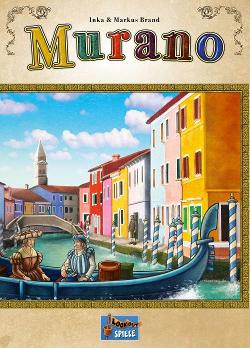
Die Spieler entwickeln eine Glaswirtschaft über einen Verbund von Inseln, die durch Kanäle verbunden sind, und bewegen sich mit Gondeln, um Aktionen auszulösen. In einem Zug bewegt ein Spieler eine Gondel auf der äußeren Aktionsleiste zu einem freien Feld und führt diese Aktion aus; die Bewegung wird durch andere Gondeln blockiert, außer man bezahlt dafür, die dazwischenliegenden zu verschieben. Die Aktionen erlauben das Platzieren verschiedener Ladentypen auf Bauplätzen auf den Inseln, das Bewegen eigener Gondeln auf die Inseln, den Bau von Glasmanufakturen und den Verkauf von Glas gegen Geld. Läden ziehen Touristen je nach Nähe und Angebot an, und die Spieler punkten, indem sie Wertungskarten erwerben und erfüllen, die mit errichteten Gebäuden, Touristenverkäufen und dem Markt zusammenhängen.
- Spieler
- 2–4 am besten mit 4
- Spielzeit
- 60–75 Min.
- Alter
- 10+
- Komplexität
- 2,7 / 5
Über das Spiel
- Autoren
- Illustration



Erweiterungen
In Ludoya ansehen
Wo kaufen
Shop-Preise und gebrauchte Exemplare, täglich geprüft.
An Ludoyas Tischen
Alle Statistiken in Ludoya- 50
- Erfasste Partien
- 57
- Spieler
- 1h 37m
- Durchschnittliche Partie
- 9
- In Sammlungen
- 3
- Auf Wunschlisten
4,9/10
aus 8 Ludoya-Rezensionen
Evan4,6 This game is one of those giant roundel games around the outside of the board. On a player's turn they advance a boat to a spot and resolve an action there. The trick is, you can't move a boat past another boat, although you can pay your precious money to move other boats out of the way. Because this is expensive, you do often wind up with traffic jams that could force you to resolve a less than ideal action. What I find compelling about this game is the tension created from trying to get the actions you want, keeping afloat in money, and knowing when to stop getting new objective cards and focus on completing those objectives. One problem I have with the game is that there are essentially two ways to produce money in the game, which again, you really need not only to mitigate the traffic jams but also to take nearly every action in the game. One way is through tile draws with both the buy a shop action, which gets you a random colored shop, and then the build action with which you can draw two random road tiles and hope the people on those roads match up with your shop. Then later, you can use the single action space where you choose an island to have one of each color of your shops produce a dollar per matching person on the roads. This action always gets clogged up. The other way is through buying and building glass producing buildings. When you take the action in the one spot that produces glass, you loose 2 vp per glass you produce, and you get that many random pulls from a bag and hope the gems you drew are either all the same, in which case they can be sold for lots of money, or that they match up endgame scoring cards you took. Either way, you need to involve yourself in some randomness, and with the glass way, your potential is higher, but knowing when to stop taking those big VP hits is tough. The second issue I have with the game is that many of the endgame victory point cards require islands to be setup in a particular way that relies on your opponents. For example, in one game I had a card that needed an island to have equal red buildings to black customers. I set that up, then paid to get my scoring pawn attached to that island, and from that point on I was at the mercy of other players choosing not to mess that ratio up, without them having any idea they were doing so. This sort of blind blocking troubles me. When someone messes up my plans, I like the to know they are doing it. I like it to be part of their strategy, or a choice they are making. I feel cheated when they proclaim, 'Oh I had no idea I was messing up your secret card, I just chose that spot randomly.' Aside from those problems, I do like the flow of the game, I like the look of the game, and there is a lot of enjoyable tension. I think if either the money engine was a little more enjoyable or reliable, or if the endgame victory cards were generally more self determinable, this would be a keeper for me. :star: Art, Iconography and components functional :star: Clever or interesting mechanisms :star: Reasonably low downtime between turns with mildly AP players :star: Multiple plays stay interesting :nostar: Low or mitigatable luck elements :star::star::nostar::nostar::nostar: Raw enjoyment
Garfield2,0 At the end it's just about getting target cards and hope that the condition is already fulfilled. Way too much luck involved.
Mitchell C5,9 This game plays very smoothly and quickly. Feels like a classic eurogame. The shared rondel mechanic is very interesting and offers just enough interaction.
Kostenlos, im Web, für Android und iOS
Spiel Murano mit Ludoya
- Hab es in deiner SammlungVerwalte dein Exemplar und seine Erweiterungen, leih es Freunden oder setz es auf deine Wunschliste und erfahre, wenn der Preis fällt.Zur Sammlung hinzufügen
- Erfasse jede PartiePunkte, Sieger, Timer und Fotos, dann deine Statistiken: Siegquote, liebste Spielerzahl, beste Punktzahl.Partie erfassen
- Werte ohne PapierNutze die Wertungsbögen und Spielhelfer der Community und lass Ludoya die Punkte zusammenzählen.Wertungsbögen finden
- Finde Leute, mit denen du es spielstClubs, Spieleabende und Veranstaltungen in deiner Nähe, bei denen dieses Spiel auf den Tisch kommt.Veranstaltungen ansehen
Spieldaten (Spieler, Spielzeit, Alter, Mitwirkende) von BoardGameGeek.