
2014 · Construcción de ciudades
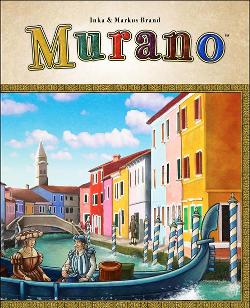
Murano
Los jugadores desarrollan una economía vidriera en un archipiélago de islas conectadas por canales, usando góndolas para desplazarse y activar acciones. En su turno, un jugador mueve una góndola por el circuito exterior de acciones hasta un espacio vacío y resuelve esa acción; el movimiento queda bloqueado por otras góndolas, a menos que pague para mover las que se interpongan. Las acciones permiten colocar distintos tipos de tiendas en los solares de las islas, mover las góndolas personales a las islas, construir fábricas de vidrio y vender vidrio a cambio de dinero. Las tiendas atraen visitas de turistas según su proximidad y oferta, y los jugadores consiguen puntos adquiriendo y cumpliendo cartas de puntos de victoria que interactúan con los edificios construidos, las ventas a turistas y el mercado.
- Jugadores
- 2–4 mejor con 4
- Duración
- 60–75 min
- Edad
- 10+
- Complejidad
- 2,7 / 5
Sobre el juego
- Diseño
- Arte



Expansiones
Verlas en Ludoya
Dónde comprarlo
Precios de tiendas y copias de segunda mano, revisados cada día.
En las mesas de Ludoya
Todas las estadísticas en Ludoya- 50
- Partidas registradas
- 57
- Jugadores
- 1h 37m
- Partida media
- 9
- En colecciones
- 3
- En listas de deseos
4,9/10
de 8 reseñas en Ludoya
Evan4,6 This game is one of those giant roundel games around the outside of the board. On a player's turn they advance a boat to a spot and resolve an action there. The trick is, you can't move a boat past another boat, although you can pay your precious money to move other boats out of the way. Because this is expensive, you do often wind up with traffic jams that could force you to resolve a less than ideal action. What I find compelling about this game is the tension created from trying to get the actions you want, keeping afloat in money, and knowing when to stop getting new objective cards and focus on completing those objectives. One problem I have with the game is that there are essentially two ways to produce money in the game, which again, you really need not only to mitigate the traffic jams but also to take nearly every action in the game. One way is through tile draws with both the buy a shop action, which gets you a random colored shop, and then the build action with which you can draw two random road tiles and hope the people on those roads match up with your shop. Then later, you can use the single action space where you choose an island to have one of each color of your shops produce a dollar per matching person on the roads. This action always gets clogged up. The other way is through buying and building glass producing buildings. When you take the action in the one spot that produces glass, you loose 2 vp per glass you produce, and you get that many random pulls from a bag and hope the gems you drew are either all the same, in which case they can be sold for lots of money, or that they match up endgame scoring cards you took. Either way, you need to involve yourself in some randomness, and with the glass way, your potential is higher, but knowing when to stop taking those big VP hits is tough. The second issue I have with the game is that many of the endgame victory point cards require islands to be setup in a particular way that relies on your opponents. For example, in one game I had a card that needed an island to have equal red buildings to black customers. I set that up, then paid to get my scoring pawn attached to that island, and from that point on I was at the mercy of other players choosing not to mess that ratio up, without them having any idea they were doing so. This sort of blind blocking troubles me. When someone messes up my plans, I like the to know they are doing it. I like it to be part of their strategy, or a choice they are making. I feel cheated when they proclaim, 'Oh I had no idea I was messing up your secret card, I just chose that spot randomly.' Aside from those problems, I do like the flow of the game, I like the look of the game, and there is a lot of enjoyable tension. I think if either the money engine was a little more enjoyable or reliable, or if the endgame victory cards were generally more self determinable, this would be a keeper for me. :star: Art, Iconography and components functional :star: Clever or interesting mechanisms :star: Reasonably low downtime between turns with mildly AP players :star: Multiple plays stay interesting :nostar: Low or mitigatable luck elements :star::star::nostar::nostar::nostar: Raw enjoyment
Garfield2,0 At the end it's just about getting target cards and hope that the condition is already fulfilled. Way too much luck involved.
Mitchell C5,9 This game plays very smoothly and quickly. Feels like a classic eurogame. The shared rondel mechanic is very interesting and offers just enough interaction.

Gratis, en web, Android e iOS
Juega a Murano con Ludoya
- Tenlo en tu colecciónControla tu copia y sus expansiones, préstala a tus amigos o ponla en tu lista de deseos y te avisamos cuando baje de precio.Añadirlo a tu colección
- Registra cada partidaPuntuaciones, ganadores, temporizadores y fotos, y luego tus estadísticas: porcentaje de victorias, número de jugadores favorito, mejor puntuación.Registrar una partida
- Puntúa sin papelUsa las hojas de puntuación y ayudas de juego de la comunidad, y deja que Ludoya sume los puntos.Buscar hojas de puntuación
- Encuentra gente con quien jugarloClubes, noches de juegos y eventos cerca de ti que sacan este juego a la mesa.Ver eventos
Datos del juego (jugadores, duración, edad, créditos) de BoardGameGeek.