

2016 · Antiquité
Ave Roma
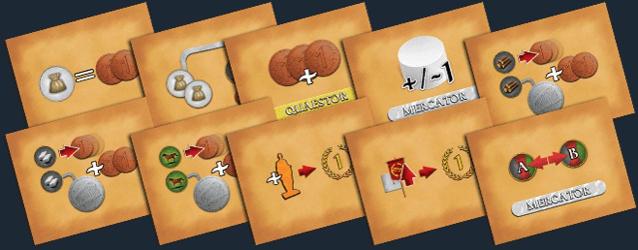
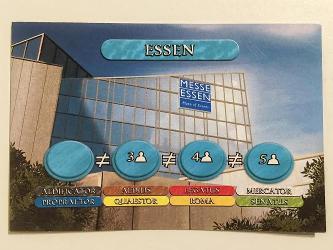
Les joueurs gèrent un groupe d’ouvriers communs, chacun ayant une valeur individuelle qui évolue au fil du temps. À chaque manche, ils affectent cinq ouvriers pendant une phase d’action, puis récupèrent des ouvriers lors d’une phase de collecte différente, recevant souvent des ouvriers différents de ceux qu’ils avaient envoyés. Les actions permettent de construire des bâtiments, de financer des efforts militaires, de s’attirer les faveurs de mécènes, d’accroître son influence dans différents territoires et de réunir de l’argent et des ressources. Le jeu met l’accent sur la planification autour de groupes d’ouvriers en constante évolution et propose plusieurs voies vers la victoire grâce au contrôle de zones, au développement économique et au soutien politique.
- Joueurs
- 2–5 idéal à 3
- Temps de jeu
- 45–120 min
- Âge
- 12+
- Complexité
- 3,7 / 5
À propos du jeu
- Auteurs
- Illustration
- Éditeur

Extensions
Les voir dans Ludoya

Où l'acheter
Prix des boutiques et exemplaires d'occasion, vérifiés chaque jour.
Sur les tables de Ludoya
Toutes les statistiques dans Ludoya- 11
- Parties enregistrées
- 26
- Joueurs
- 2h 10m
- Partie moyenne
- 6
- Dans des collections
- 1
- Dans des listes de souhaits
3,1/10
sur 6 avis Ludoya
Garfield2,0 Seriously? About 20 possibilities what you can do? Big down times. And 2 hours with 3 players is way too much! [c] Theme: ★☆☆☆☆ <!-- size 7]Not really --> Gameplay: ★★☆☆☆ <!-- size 7]Too many possibilities --> Interaction: ★★☆☆☆ <!-- size 7]Not much --> Artwork: ★☆☆☆☆ <!-- size 7]Doesn't appeal me --> Luck: ☆☆☆☆☆ <!-- size 7]No --> Strategy: ★★★☆☆ <!-- size 7]Pseudo --> Components: ★★☆☆☆ <!-- size 7]Average --> Play duration: ★☆☆☆☆ <!-- size 7]Far too long --> Easy to teach: ★★☆☆☆ <!-- size 7]Bazilions of possibilities to explain --> Setup time: :nuclear: <!-- size 7]Play again to rate it --> No downtime: ★☆☆☆☆ <!-- size 7]Can be huge --> [/c]
Aucune partie enregistrée
Evan2,0 This game has some very poor usability choices. The board is circular, which makes the information disorienting. The icons and text are very tiny. You are looking to collect sets of cards by the same tiny text name of the card that have different pictures. When cards are used for their center ability they get tapped. When they are used to discard for a bonus action they go to the used side of your player mat, where they can still be tapped. Then there are set collection bonuses that can be gotten from combinations of cards in your used and unused piles. There are also icons on the board that sometime mean gain and other times mean pay using the same positioning and iconography. If you get past the graphic design problems, you are met with a very slow moving and restrictive resource management/worker placement/set collection game. Workers have printed numbers that determine what action areas they can be used in. At the end of the round, starting with the player who was last in turn order, players get to select groups of workers to retrieve from the board, so your turn order determines a lot about your numbers spread. It's also often hard to tell how useful a number since cards flush from certain spaces. There's enough normal worker placement tension without adding this hard to control element. Since your worker number spread is a barely controllable symptom of turn order, I don't see how even choosing what numbers to take can be considered a meaningful decision. Buying cards usually takes several turns of setup. This feels like a long process of seeing how each and every game element prevents you from doing what you want for one reason or another. Either the resource card you needed got flipped action slot your numbers won't let you use, or the resource card you need wound up where you were aiming to improve your score marker meaning you now needed two workers of that number, or even another player interacted with the spot earlier in the turn order and now the cost to do anything there is $3 more. Each resource area has a little scoring track. If someone is ahead of you on the track, you have to overtake them in a single move, because if you end on the same space as them, you get bumped back down to the next lowest available space. The tracks are not long, and the cards that take so long to get give anywhere from 0 to 3 track bumps. I found this terribly frustrating, as by the time I could manage to get what I needed to overtake on a track, one of my opponents would invariably have gotten to the top of the track where there's nothing I could do to stop them. ☆ Art, Iconography and components functional ☆ Clever or interesting mechanisms ☆ Reasonably low downtime between turns with mildly AP players ☆ Multiple plays stay interesting ☆ Low or mitigatable luck elements ★★☆☆☆ Raw enjoyment
Premières impressions · 1 partie
Jeux similaires
 Naissance et Apogée des Empires2009
 Empires: Age of Discovery2015
 Men-Nefer2026
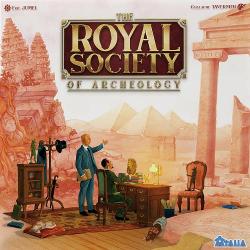 The Royal Society of Archeology2025
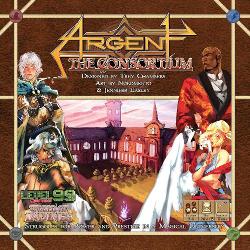 Argent: The Consortium2015
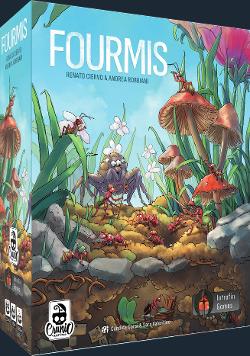 Fourmis2025
 Schichtwechsel: Die Förderung liegt in deiner Hand2021
 Polis: Fight for the Hegemony2012
 Bier Pioniere2023
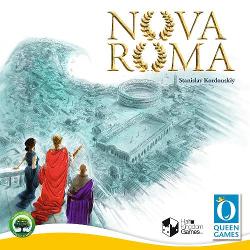 Nova Roma2024
 Barbarians: The Invasion2018
 Atlantis Rising (Second Edition)2024
Gratuit, sur le web, Android et iOS
Jouez à Ave Roma avec Ludoya
- Gardez-le dans votre collectionSuivez votre exemplaire et ses extensions, prêtez-le à vos amis ou ajoutez-le à votre liste de souhaits et soyez prévenu quand le prix baisse.Ajouter à votre collection
- Enregistrez chaque partieScores, gagnants, minuteurs et photos, puis vos statistiques : taux de victoire, nombre de joueurs préféré, meilleur score.Enregistrer une partie
- Comptez les points sans papierUtilisez les feuilles de score et les aides de jeu de la communauté, et laissez Ludoya additionner les points.Trouver des feuilles de score
- Trouvez des gens avec qui y jouerClubs, soirées jeux et événements près de chez vous qui mettent ce jeu sur la table.Voir les événements
Données du jeu (joueurs, durée, âge, crédits) issues de BoardGameGeek.