
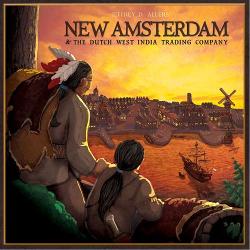
2012 · Renaissance
New Amsterdam
Dans une colonie néerlandaise de l’île de Manhattan, les joueurs incarnent de riches mécènes qui établissent des domaines et des entreprises pour tirer profit du commerce des fourrures. Les joueurs enchérissent chaque manche sur des lots d’actions pour construire des bâtiments, exploiter les terres afin d’obtenir de la nourriture et des matériaux, recruter des serviteurs sous contrat, commercer avec les Lenapes, expédier des peaux vers l’Europe et briguer des fonctions politiques. L’expansion des concessions foncières modifie les actions disponibles et impose des interactions avec les camps autochtones le long du fleuve, tandis que la gestion des ressources et le placement des enchères orientent les choix stratégiques.
- Joueurs
- 2–5 idéal à 5
- Temps de jeu
- 90 min
- Âge
- 12+
- Complexité
- 3,2 / 5
À propos du jeu
- Auteurs
- Illustration
- Éditeur

Où l'acheter
Prix des boutiques et exemplaires d'occasion, vérifiés chaque jour.
Sur les tables de Ludoya
Toutes les statistiques dans Ludoya- 18
- Parties enregistrées
- 32
- Joueurs
- 1h 24m
- Partie moyenne
- 4
- Dans des collections
5,9/10
sur 7 avis Ludoya
Sup8,3 Sleeved
Premières impressions · 1 partie
Evan6,0 This is a very tough game. Players bid at the start of each round for not only turn order, but the actions they are allowed to resolve. The bid is really interesting in that you can spend even resources on the bid, which means you could easily get the actions you need but find you've overspent and then you might not be able to resolve those actions properly. I'm not sure how getting a big early corn production isn't the best move all the time, as it not only fuels your other goals, but since you can bid with it, you can win whichever auctions you want. Of course if several players realize that, then they'll bid more aggressively for it and turn order so maybe that self balances? The game is unique in that I can't easily describe it to someone using the generic terms we have for mechanisms. This to me is a really good thing. The problem with the game is that it feels very feast or famine. Either you have more than you can use of something, or you don't have any. It's extremely punishing for players who make mistakes, and at the end, win or lose, you don't really get the satisfying feeling of having built or accomplished something. It feels close to greatness, but it's just lacking some crucial magic. ★ Art, Iconography and components functional ★ Clever or interesting mechanisms ★ Reasonably low downtime between turns with mildly AP players ★ Multiple plays stay interesting ★ Low or mitigatable luck elements ★★☆☆☆ Raw enjoyment
Premières impressions · 2 parties

Gratuit, sur le web, Android et iOS
Jouez à New Amsterdam avec Ludoya
- Gardez-le dans votre collectionSuivez votre exemplaire et ses extensions, prêtez-le à vos amis ou ajoutez-le à votre liste de souhaits et soyez prévenu quand le prix baisse.Ajouter à votre collection
- Enregistrez chaque partieScores, gagnants, minuteurs et photos, puis vos statistiques : taux de victoire, nombre de joueurs préféré, meilleur score.Enregistrer une partie
- Comptez les points sans papierUtilisez les feuilles de score et les aides de jeu de la communauté, et laissez Ludoya additionner les points.Trouver des feuilles de score
- Trouvez des gens avec qui y jouerClubs, soirées jeux et événements près de chez vous qui mettent ce jeu sur la table.Voir les événements
Données du jeu (joueurs, durée, âge, crédits) issues de BoardGameGeek.