
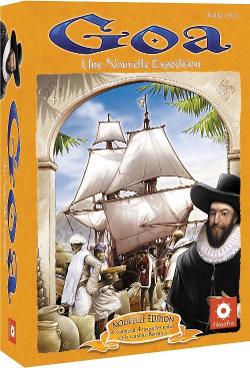
2004 · Économique
Goa: Une Nouvelle Expédition
Gérez une compagnie de commerce d’épices dans l’Inde du début du XVIe siècle, en acquérant des plantations, des navires, des colons et des revenus grâce à des enchères répétées. Chaque manche commence par la mise aux enchères d’objets par les joueurs (le premier joueur en met davantage), puis chacun effectue trois actions pour développer des technologies, produire des épices, agrandir sa flotte ou construire des plantations à l’aide de plateaux individuels qui suivent leur progression. Progresser sur les différentes pistes améliore l’efficacité des actions et le décompte final, tandis que les enchères créent de l’interaction et des liquidités, car les joueurs vendent des objets convoités aux autres. La planification stratégique consiste à trouver l’équilibre entre revenus à court terme et investissements à long terme, ainsi qu’à profiter des bonus de course liés à l’atteinte de niveaux technologiques élevés.
- Joueurs
- 1–4 idéal à 4
- Temps de jeu
- 90 min
- Âge
- 12+
- Complexité
- 3,4 / 5
À propos du jeu
- Auteurs
- Illustration
- Éditeurs





Où l'acheter
Prix des boutiques et exemplaires d'occasion, vérifiés chaque jour.
Sur les tables de Ludoya
Toutes les statistiques dans Ludoya- 205
- Parties enregistrées
- 196
- Joueurs
- 1h 46m
- Partie moyenne
- 56
- Dans des collections
- 9
- Dans des listes de souhaits
5,1/10
sur 40 avis Ludoya
Evan2,5 In this game, the starting player places a token next to the grid of tiles, and then each player in turn order chooses a tile in the grid adjacent to the start, or the last selected tile. These tiles then get auctioned off in a once-around bid where the person who chose the tile doesn't get to bid it up, they can simply pay the highest bid -1 or let the highest bid pay them for the tile. The tiles will increase your resource production capacity in some form, or give you a one time bonus. What you are doing for the most part is upgrading your personal player board. Across the board are representations of the different options you have in each action phase. The more you upgrade that part of your board the better the actions get. The cost to upgrade tends to be sets of different resources, as well as requiring you to spend ship cards. At the end of the game players get points for how many colony tiles they built, points for technologies, and points for sets of the same icon of leftover special ability cards in their hands. The feeling of the game is really unique in the way the auctions are peppy, and it's interesting how often times you want to place your auctioneer tile on something you don't care about, but you know your opponents do care about, so that you can get a money advantage over them. It can get a little frustrating at times, since it might happen that a tile you need simply isn't selected by another player for auction, so there's some give and take to that system. Do not play this with players who act randomly, or unthinkingly, or else you are destined to have a frustrating experience. Additionally, it's easy to run out of boat cards for your upgrade needs without realizing how many actions it will take you to restock. Planning helps, but if the resources you need to upgrade the boat track are in short supply for whatever reason, things can get tight faster than you might see coming. One element I'm not super happy about is the set collection element. There are special cards you can earn that tend to have powerful actions if you spend them. There are exactly five cards in each suite, and so it's fairly unlikely that you'll end the game with a full set of cards. Particularly because you don't retain the symbols when they are spent and when you draw more cards, you have to discard cards to accommodate your hand size before you draw, not after which means you see less cards. This luck element is a little much, as it's possible for one player to stumble into having lots of a set, and have it be extremely unlikely for another player to have the same. It's not the worst luck I've ever seen in a game certainly, but it just seems out of place in this otherwise very player driven experience. The last thing I should mention is the iconography on the special cards isn't great. There are cards where it shows the cost to take an action, with one cost crossed out with a big black X and one crossed out with a small red X, and this is supposed to indicate you pay one and not the other, but which? Well, the rulebook says, but that's super unclear and hard for me to remember. :nostar: Art, Iconography and components functional :star: Clever or interesting mechanisms :star: Reasonably low downtime between turns with mildly AP players :star: Multiple plays stay interesting :star: Low or mitigatable luck elements :nostar::nostar::nostar::nostar::nostar: Raw enjoyment
Mestremuten5,0 Rating: 4/5 Production value: 1/4 Is the game in my collection/Love to have?: 0/1
Sup8,3 Sleeved









Gratuit, sur le web, Android et iOS
Jouez à Goa: Une Nouvelle Expédition avec Ludoya
- Gardez-le dans votre collectionSuivez votre exemplaire et ses extensions, prêtez-le à vos amis ou ajoutez-le à votre liste de souhaits et soyez prévenu quand le prix baisse.Ajouter à votre collection
- Enregistrez chaque partieScores, gagnants, minuteurs et photos, puis vos statistiques : taux de victoire, nombre de joueurs préféré, meilleur score.Enregistrer une partie
- Comptez les points sans papierUtilisez les feuilles de score et les aides de jeu de la communauté, et laissez Ludoya additionner les points.Trouver des feuilles de score
- Trouvez des gens avec qui y jouerClubs, soirées jeux et événements près de chez vous qui mettent ce jeu sur la table.Voir les événements
Données du jeu (joueurs, durée, âge, crédits) issues de BoardGameGeek.