
1999 · Transportation
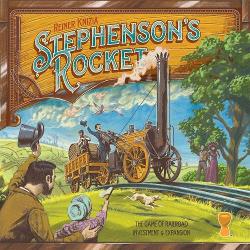
Stephenson's Rocket
It's the dawn of steam, as players expand competing rail companies across early 1800s England. They lay track tiles, manage shares, and may veto other players' extensions at a cost. When railways meet, they merge into a single company. The game ends when one company remains or no rail tiles are left, and the player who earns the most money wins.
- Players
- 2–4 best 4
- Playing time
- 60–90 min
- Age
- 12+
- Complexity
- 3 / 5
About the game
- Design




Expansions
See them in Ludoya
Where to buy it
Shop prices and second-hand copies, checked every day.
On Ludoya's tables
Full stats in Ludoya- 20
- Plays logged
- 35
- Players
- 1h 30m
- Average play
- 12
- In collections
- 6
- On wishlists
3.9/10
from 7 Ludoya reviews
Evan2.5 This game is similar to Chicago Express or American Rails, or any of those games where players are laying track, buying stocks in companies and trying to connect those companies to cities to improve their value for endgame scoring. The things that make this game stand out are the way if one rail line runs into another it scores one last time for the player with the most shares, then it dissolves and becomes a part of the company it ran into, with players trading 2 shares in the dissolving company for 1 in the new one. This creates some odd opportunities as players get large point rewards for having the most of their station markers on a line when the line connects to something new, so expanding a smaller line with lots of your markers, might eventually connect to and cause you to be in the lead for a longer line. General gameplay is a hassle however, as anyone's action to add a rail to a line can be contested by any player who holds shares in that line. They can bid shares to basically take your turn for you. It's interesting in theory, that the player with the most control might give up some of their lead to keep opponents from linking things in bad ways for their position, but I found this to really drag down the flow and fun of the game, at least as compared to this game's cousins. Scoring is also a hassle, as eventually everything connects to nearly everything else, so there's a lot of counting each time something touches something new, as you get credit for each location the line touches. As the train lines blob into each other, the downtime of counting this out grows more and more. Not unplayably bad, but I don't see ever wanting to play this over the other stocks and rails games. :star: Art, Iconography and components functional :nostar: Clever or interesting mechanisms :star: Reasonably low downtime between turns with mildly AP players :star: Multiple plays stay interesting :star: Low or mitigatable luck elements :nostar::nostar::nostar::nostar::nostar: Raw enjoyment
andycted8.3 Convoluted scoring gives this semi-light game quite some complication to raise to a medium weight. The stock/veto mechanics is pretty interesting. For a Knizia, you need more time than usual to grasp it. Nice interaction filled take on Acquire mixed with other Knizia stuff















Free, on web, Android and iOS
Play Stephenson's Rocket with Ludoya
- Keep it in your collectionTrack your copy and its expansions, lend it to friends, or put it on your wishlist and get told when the price drops.Add it to your collection
- Log every playScores, winners, timers and photos, then your stats: win rate, favourite player count, best score.Log a play
- Score it without paperUse the community's score sheets and play helpers, and let Ludoya add up the points.Find score sheets
- Find people to play it withClubs, game nights and events near you that bring this game to the table.See events
Game facts (players, playing time, age, credits) from BoardGameGeek.