

2005 · Kaartspel
Glory to Rome
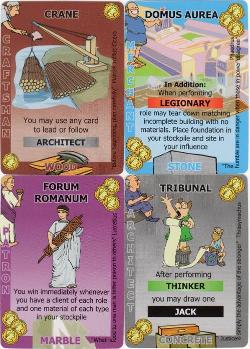
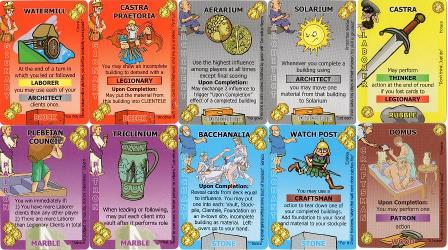
Players act as patricians rebuilding Rome after a devastating fire, reporting to the emperor and funding reconstruction projects. The game uses cards that serve multiple purposes—buildings, clients, raw materials, or resources—forcing players to choose how to deploy each card. Play centers on a card-driven role-selection mechanic: the active player leads a role and others may follow by discarding matching cards to the shared pool or ‘think’ to draw instead. Much play happens from the discard pool, creating tactical control over card availability. Scoring comes from completing buildings and stockpiling resources, with bonuses for a diverse cache; game end is triggered by player actions and game-state conditions.
- Spelers
- 2–5 best met 4
- Speeltijd
- 60 min
- Leeftijd
- 12+
- Complexiteit
- 2,9 / 5




Waar te koop
Winkelprijzen en tweedehands exemplaren, elke dag gecontroleerd.
- ZacatrusNiet op voorraad 17.89 €
Aan de tafels van Ludoya
Alle statistieken in Ludoya- 342
- Vastgelegde speelsessies
- 202
- Spelers
- 1h 17m
- Gemiddeld potje
- 77
- In collecties
- 8
- Op verlanglijsten
- 2
- Voorbesteld
6,7/10
uit 43 Ludoya-recensies
Balleflass8,0 Made my own print&play version of the Micro Edition. Will update this as soon as I've tried it.
Mestremuten4,0 Rating: 3/5 Production value: 1/4 Is the game in my collection/Love to have?: 0/1
Regelvragen
Beantwoord vanuit het spelregelboek door de regelassistent van Ludoya.
If I lead a Role, can multiple players follow and do they all get actions?
Yes — after you lead, each other player in clockwise order may follow or Think; you (the Leader) perform one action for leading plus one extra per Client of that Role, and each follower gets one action plus extras for their Clients (players who Thought still get actions for their Clients). (p.4)
What exactly happens when a player 'Thinks' — can they partially refill their hand or draw only a Jack?
When you Think you immediately take one Thinker option: take one Jack (if available), or draw up to your hand refill size (normally five) — you must draw to full hand and cannot partially refill — or draw one extra if you are already at/above refill size; if the Leader Thinks the turn ends and others do not follow. (p.4)
Can I place a Foundation from my hand on any Site, including Out of Town, and may I start a Foundation with the same name as another player?
You may lay a Foundation from your hand onto a matching Site by performing an Architect or Craftsman action, but not if no matching Site remains or you already have that Foundation/Structure in play; you may, however, lay a Foundation with the same name as an opponent’s, and Out of Town Sites require two consecutive Architect/Craftsman actions on the same turn unless you have a matching Client. (p.6)
When is a Structure completed and who gets the Influence and its Function?
A Structure is completed when it has its Foundation, Site and the required number of Material cards (per its Value); upon completion you immediately take the Site (gain the listed Influence) and gain the Structure’s Function, and you may benefit from both on that same turn. (p.7)
How does the Merchant action and Vault work — are Vault cards public and how are Merchant Bonuses awarded?
A Merchant action moves one Material from your Stockpile face-down into your Vault (which is limited by your current Influence); the number of cards in your Vault is public and the identity of a card is revealed only on the turn you put it in (afterward it is hidden); at game end Vault card values count as Victory Points and a 3‑point Merchant Bonus is awarded for each Material to the player with the most of that Material in their Vault (ties cancel). (p.8)
What immediately ends the game and how are final points calculated?
The game ends immediately if the draw deck runs out, non‑Out‑of‑Town Sites are exhausted, a Catacomb is completed, a Forum victory condition is met, or players surrender; score is 1 VP per Influence + the combined Value of Vault cards + 3 VP per Merchant Bonus + any Structure‑granted VPs, highest total wins (ties: most cards in hand). (Endgame & scoring p.9; Wall scoring example p.16)









Gratis, op het web, Android en iOS
Speel Glory to Rome met Ludoya
- Houd het bij in je collectieHoud je exemplaar en de uitbreidingen bij, leen het uit aan vrienden of zet het op je verlanglijst en krijg bericht als de prijs daalt.Voeg het toe aan je collectie
- Leg elke speelsessie vastScores, winnaars, timers en foto's, en dan je statistieken: winpercentage, favoriete spelersaantal, beste score.Speelsessie vastleggen
- Regelvragen beslechtenVraag alles over de regels en krijg een antwoord uit het spelregelboek, met de pagina om het na te lezen.Vraag de regelassistent
- Vind mensen om het mee te spelenClubs, spelavonden en evenementen bij jou in de buurt waar dit spel op tafel komt.Bekijk evenementen
Speldata (spelers, speeltijd, leeftijd, makers) van BoardGameGeek.