
2016 · 数字
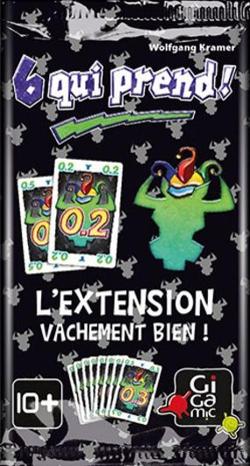
6 qui prend!: L'extension vachement bien
新增十张卡牌,为基础版《6 nimmt!》的玩法加入胆怯机制和各种变化。 玩家仍然同时打出数字牌来避免拿走牌列,但新卡牌会改变平局、出牌顺序和特殊情况的结算方式,带来不同结果并迫使玩家作出不同选择。 包含两种规则变体,可调整计分和卡牌互动;在继续使用原版组件的同时,带来更高的不确定性和更多战术选择。
- 人数
- 2–10 最佳 4 人
- 游戏时长
- 30 分钟
- 年龄
- 10+
- 复杂性
- 1 / 5

在 Ludoya 的牌桌上
在 Ludoya 中查看完整统计- 2
- 收藏数
规则问题
由 Ludoya 的规则助手根据规则书回答。
How does a Joker work, and where can I put it?
A Joker is always treated as the lowest card played that turn, so you may choose any row for it. It adds its decimal value to the last card in that row—for example, a 0.4 after a 17 makes that card’s value 17.4 (p. 1).
Can I put a Joker next to another Joker?
No. Jokers cannot be placed next to each other; if every row ends in a Joker, you must take a row and start a new one with your Joker (p. 2).
What if more than one Joker is played in the same turn?
Place the Joker with the lowest value first in a row—for example, 0.4 before 0.6 (pp. 1–2).
In “Pass It On!”, when do I look at the card passed to me?
First pass one card face down to the player on your left; only after you have passed your card may you look at the card you received. Then choose a card to play as usual. Don’t pass your last card—play it directly into a row (p. 2).
In the variable-length rows variant, what happens when a card with several bullheads is added to a row?
The first card with multiple bullheads placed in a row sets how many more cards can go after it: for example, after a 3-bullhead card, two more cards may be added, and the player adding the second must take the row. Only the first such card in a row has this effect; the other rules stay the same (pp. 3–4).
Does a bullhead card’s row-length effect still apply if it starts a new row?
Yes. If a card with an effect becomes the first card in a new row, its effect applies there; the player placing the specified final additional card must take the row (p. 4).
免费,支持网页、Android 和 iOS
用 Ludoya 玩 6 qui prend!: L'extension vachement bien
游戏信息(人数、游戏时长、年龄、制作人员)来自 BoardGameGeek。