
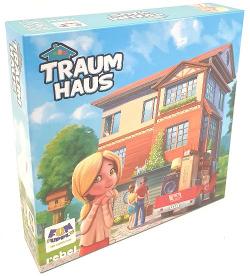
2016 · Kartenspiel
Traumhaus
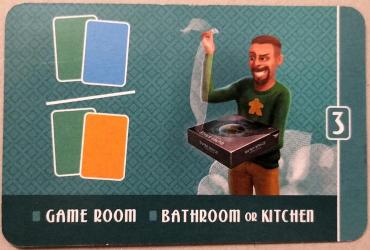
Die Spieler schlüpfen in die Rolle von Hausdesignern, die über zwölf Runden ein Haus planen und erweitern, indem sie Kartenpaare draften. Jeder Zug bringt eine Zimmerkarte plus ein Zubehörteil (Dach, Helfer, Einrichtung oder Werkzeug), das die Spieler auf ihren persönlichen Spielbrettern platzieren, um ihre Grundrisse zu bauen und einzurichten. Der Fokus des Spiels liegt darauf, Räume geschickt anzuordnen und funktionale wie dekorative Elemente hinzuzufügen; die Wertung bewertet die Verbindung der Räume und deren Nützlichkeit sowie die Qualität von Dach und Einrichtung. Am Ende des Spiels vergleichen die Spieler ihre fertigen Häuser und die Gesamtpunktzahl, um das bestbewertete Design zu ermitteln.
- Spieler
- 2–4 am besten mit 4
- Spielzeit
- 30 Min.
- Alter
- 7+
- Komplexität
- 1,7 / 5
Über das Spiel
- Autoren
- Illustration
- Publisher



Erweiterungen
In Ludoya ansehen


Wo kaufen
Shop-Preise und gebrauchte Exemplare, täglich geprüft.
An Ludoyas Tischen
Alle Statistiken in Ludoya- 246
- Erfasste Partien
- 153
- Spieler
- 32m 9s
- Durchschnittliche Partie
- 52
- In Sammlungen
- 6
- Auf Wunschlisten
- 1
- Vorbestellt
6,5/10
aus 33 Ludoya-Rezensionen
Great Family Card Drafting House Building game! Seems simpler than it really is, and has some cool mechanics. Beautiful artwork, and easy to play and to learn.
SrCornelius7,0 Local-(312)


Regelfragen
Aus der Spielanleitung beantwortet von Ludoyas Regelassistenten.
If I take the leftmost column, do I automatically become first player next round?
Yes — if you choose the leftmost column you take the bottom card and the first-player marker; if nobody chooses the leftmost column, the current first player keeps the marker for the next round. (p.4)
Can I place room cards anywhere on my home board?
No — rooms cannot have an empty space directly below them, basement cards must go on the two basement spaces, and normal/unique rooms must be placed on the top two floors. (p.6)
Does placing a décor token finish a room, and can finished rooms be expanded?
Normally placing a décor token finishes that room and it cannot be expanded further, and a room that has reached its maximum card size is also finished. The Interior Designer helper is an exception: while you have it the décor token does not finish the room during the game (though it still limits to one décor), and each décor is worth extra points at the end. (p.5, p.7, p.13)
What should I do if I can't or don't want to place a room card I took?
Place the card facedown on an empty space of your home board as an empty room (worth 0 points); empty rooms still must obey placement rules (e.g., no empty space directly below) and cannot be expanded. (p.6)
How do roof cards score, and what about roof windows and the Roofer helper?
You place roof cards facedown as you take them, then at the end reveal and choose four to form your roof: a uniform four-of-a-kind is 8 points, a mismatched full roof is 3 points, incomplete roofs score 0, and each window on a complete roof adds +1 point. The Roofer helper lets you add one discarded roof card to your stack at the end, but you must use it before looking at your facedown roof cards. (p.10, p.11, p.12)
When and how can I use tool cards like Drill and Jackhammer, and do they cost me my turn?
Tool cards are used during your turn unless specified otherwise: Drill is discarded at the start of your turn (before choosing a column) to swap a room on the game board with one on your board, while Jackhammer is discarded at the start of a round (before the first player chooses) to immediately take one room from the board and then you skip your normal turn that round. (p.13)



















Kostenlos, im Web, für Android und iOS
Spiel Traumhaus mit Ludoya
- Hab es in deiner SammlungVerwalte dein Exemplar und seine Erweiterungen, leih es Freunden oder setz es auf deine Wunschliste und erfahre, wenn der Preis fällt.Zur Sammlung hinzufügen
- Erfasse jede PartiePunkte, Sieger, Timer und Fotos, dann deine Statistiken: Siegquote, liebste Spielerzahl, beste Punktzahl.Partie erfassen
- Regelfragen klärenFrag alles zu den Regeln und erhalte eine Antwort aus der Spielanleitung, mit der Seite zum Nachprüfen.Den Regelassistenten fragen
- Finde Leute, mit denen du es spielstClubs, Spieleabende und Veranstaltungen in deiner Nähe, bei denen dieses Spiel auf den Tisch kommt.Veranstaltungen ansehen
Spieldaten (Spieler, Spielzeit, Alter, Mitwirkende) von BoardGameGeek.