
2008 · Religiös
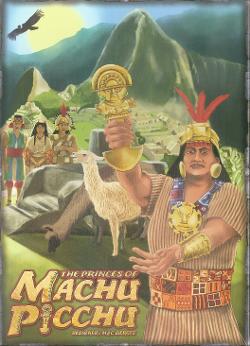
The Princes of Machu Picchu
Inka-Prinzen verstecken sich in den Bergen von Machu Picchu, während die Spanier nach der verlorenen Stadt suchen. Einer der Prinzen könnte ein Verräter sein, der bereit ist, ihren Standort zu verraten. Die Spieler bewegen ihre Prinzen über den Stadtplan, um Arbeiter zu lenken, Mais anzubauen, Lamas zu füttern, Koka zu pflanzen sowie Keramik und Stoffe herzustellen. Außerdem versuchen sie, durch Opfergaben die Gunst von Priestern und Jungfrauen zu erlangen. Die Inka gewinnen, indem sie sie alle rechtzeitig aktivieren; andernfalls entdecken die Spanier Machu Picchu. Nach einem Sieg der Inka entscheiden die klügsten Opfergaben über den Gewinner, während bei einem spanischen Sieg die Prinzen mit dem meisten Gold belohnt werden.
- Spieler
- 2–5 am besten mit 4
- Spielzeit
- 90 Min.
- Alter
- 12+
- Komplexität
- 3,1 / 5
Über das Spiel
- Autoren
- Illustration

Wo kaufen
Shop-Preise und gebrauchte Exemplare, täglich geprüft.
- Milan SpieleAuf Lager49.9 €
- Dungeon MarvelsAusverkauft43.95 €
- SpielezarAuf Lager47.9 Fr.
- Nordisk SpilAusverkauft529.95 kr
An Ludoyas Tischen
Alle Statistiken in Ludoya- 4
- Erfasste Partien
- 6
- Spieler
- 3
- In Sammlungen
4,3/10
aus 2 Ludoya-Rezensionen
Evan4,6 PoMP is a Gertz pseudo roundel game. Essentially you have a central map with two sets of differently behaving regions. One set allows you to buy things which might be priest tiles or interacting with the market box or buying discs into production regions. The other set collects a token at the start of the round and the first player to walk their meeple there, activates the region, collects the token, and then each player with a disc there can pay to use the ability of that region. Production spaces where players have discs let them pay per disc to take a good token matching the region type, while temple spaces let you pay llama tokens per matching priest tile you've bought to get bumps on a central temple track. The temple track is the heart of the game's scoring method. Each time you cross the top of the track you draw three endgame scoring cards and then discard any two from your hand to the bottom. Then you reset your pawn to the bottom of the track again so you can climb it again. The scoring cards have three features on them. One feature is some number of golden icons at the top of the card. The other two indicate what things you'll earn points for. These will be either discs in a particular production region or owning priest tiles of a specific type. Ideally you want a hand of bonus cards that reflect your positions on the board. Taking these cards early and often is important, as they are not all equally valuable, and knowing what to go for early is better than later. The place the game falls apart a bit is how the game ends. The game can end one of two ways. Either all the priest tiles get bought, in which case you score as you'd expect. Cards times board state matching cards. However, if not all the tiles have been bought by the time the round marker would move off the end of the track, then the game ends, and you score the same way, only the player who in their secret hand of endgame cards had the greatest sum of gold icons at the top, gets their points multiplied by 3, and second place multiplied by 2. What I've found is that when this happens, the player with the most generally will win, which is disappointing because it renders nearly all in game choices irrelevant. The spread on the top of the cards runs from 7 to 3, with very few 7s. Scores run tight, and VPs are kept secret until the end so it's impossible to really know how you stack up against other players during the process of the game, so it's difficult to see how when push comes to shove, a player who thinks they have a gold advantage will just skimp on buying the priest tiles, the game ends, and nobody can even come close to their score. I really wanted to like this game as it hits a lot of sweet spots for me. I even like the idea of the secret gold reveal at the end, it's just that the point spread is too high for it to be interesting in practicality, and even then I think I might be fine with it if the variance on the cards wasn't so high. Instead of 7 to 3 I'd be happier if it was 2 to 3. More predictable but not fully predicable perhaps. For example in one of our games I had one more endgame card than the player who won, but he came in something like 14 gold ahead of me. ☆ Art, Iconography and components functional ★ Clever or interesting mechanisms ★ Reasonably low downtime between turns with mildly AP players ☆ Multiple plays stay interesting ★ Low or mitigatable luck elements ★★★☆☆ Raw enjoyment
Tom1,6 THIS, this, THIS, is what happens when you marry a neat theme to a decent game, but without really matching the game and mechanics. Ugh. I understood the game after reading the rules several times, and playing through it, but even though I did fairly well - I despised it. NOT FUN.
Ähnliche Spiele


Kostenlos, im Web, für Android und iOS
Spiel The Princes of Machu Picchu mit Ludoya
- Hab es in deiner SammlungVerwalte dein Exemplar und seine Erweiterungen, leih es Freunden oder setz es auf deine Wunschliste und erfahre, wenn der Preis fällt.Zur Sammlung hinzufügen
- Erfasse jede PartiePunkte, Sieger, Timer und Fotos, dann deine Statistiken: Siegquote, liebste Spielerzahl, beste Punktzahl.Partie erfassen
- Werte ohne PapierNutze die Wertungsbögen und Spielhelfer der Community und lass Ludoya die Punkte zusammenzählen.Wertungsbögen finden
- Finde Leute, mit denen du es spielstClubs, Spieleabende und Veranstaltungen in deiner Nähe, bei denen dieses Spiel auf den Tisch kommt.Veranstaltungen ansehen
Spieldaten (Spieler, Spielzeit, Alter, Mitwirkende) von BoardGameGeek.