
2014 · Économique
Murano
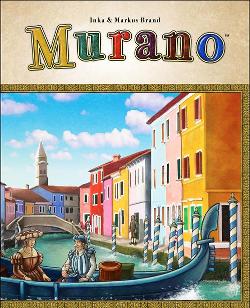
Les joueurs développent une économie de la verrerie à travers un archipel d’îles reliées par des canaux, en utilisant des gondoles pour se déplacer et activer des actions. À son tour, un joueur déplace une gondole le long de la piste d’actions extérieure jusqu’à un emplacement vide, puis réalise l’action correspondante ; le déplacement est bloqué par les autres gondoles, à moins de payer pour déplacer celles qui se trouvent sur le chemin. Les actions permettent d’installer différents types de boutiques sur les emplacements de construction des îles, de déplacer ses gondoles personnelles vers les îles, de construire des verreries et de vendre du verre contre de l’argent. Les boutiques attirent les visites de touristes en fonction de leur proximité et de leurs offres. Les joueurs marquent des points en acquérant et en réalisant des cartes de points de victoire, qui interagissent avec les bâtiments construits, les ventes aux touristes et le marché.
- Joueurs
- 2–4 idéal à 4
- Temps de jeu
- 60–75 min
- Âge
- 10+
- Complexité
- 2,7 / 5
À propos du jeu
- Auteurs
- Illustration



Extensions
Les voir dans Ludoya
Où l'acheter
Prix des boutiques et exemplaires d'occasion, vérifiés chaque jour.
Sur les tables de Ludoya
Toutes les statistiques dans Ludoya- 40
- Parties enregistrées
- 55
- Joueurs
- 1h 37m
- Partie moyenne
- 10
- Dans des collections
- 3
- Dans des listes de souhaits
6,1/10
sur 8 avis Ludoya
Garfield2,0 At the end it's just about getting target cards and hope that the condition is already fulfilled. Way too much luck involved.
Aucune partie enregistrée
Evan6,0 This game is one of those giant roundel games around the outside of the board. On a player's turn they advance a boat to a spot and resolve an action there. The trick is, you can't move a boat past another boat, although you can pay your precious money to move other boats out of the way. Because this is expensive, you do often wind up with traffic jams that could force you to resolve a less than ideal action. What I find compelling about this game is the tension created from trying to get the actions you want, keeping afloat in money, and knowing when to stop getting new objective cards and focus on completing those objectives. One problem I have with the game is that there are essentially two ways to produce money in the game, which again, you really need not only to mitigate the traffic jams but also to take nearly every action in the game. One way is through tile draws with both the buy a shop action, which gets you a random colored shop, and then the build action with which you can draw two random road tiles and hope the people on those roads match up with your shop. Then later, you can use the single action space where you choose an island to have one of each color of your shops produce a dollar per matching person on the roads. This action always gets clogged up. The other way is through buying and building glass producing buildings. When you take the action in the one spot that produces glass, you loose 2 vp per glass you produce, and you get that many random pulls from a bag and hope the gems you drew are either all the same, in which case they can be sold for lots of money, or that they match up endgame scoring cards you took. Either way, you need to involve yourself in some randomness, and with the glass way, your potential is higher, but knowing when to stop taking those big VP hits is tough. The second issue I have with the game is that many of the endgame victory point cards require islands to be setup in a particular way that relies on your opponents. For example, in one game I had a card that needed an island to have equal red buildings to black customers. I set that up, then paid to get my scoring pawn attached to that island, and from that point on I was at the mercy of other players choosing not to mess that ratio up, without them having any idea they were doing so. This sort of blind blocking troubles me. When someone messes up my plans, I like the to know they are doing it. I like it to be part of their strategy, or a choice they are making. I feel cheated when they proclaim, 'Oh I had no idea I was messing up your secret card, I just chose that spot randomly.' Aside from those problems, I do like the flow of the game, I like the look of the game, and there is a lot of enjoyable tension. I think if either the money engine was a little more enjoyable or reliable, or if the endgame victory cards were generally more self determinable, this would be a keeper for me. ★ Art, Iconography and components functional ★ Clever or interesting mechanisms ★ Reasonably low downtime between turns with mildly AP players ★ Multiple plays stay interesting ☆ Low or mitigatable luck elements ★★☆☆☆ Raw enjoyment
Y a joué 4 fois
Mitchell C7,0 This game plays very smoothly and quickly. Feels like a classic eurogame. The shared rondel mechanic is very interesting and offers just enough interaction.
Y a joué 3 fois



Gratuit, sur le web, Android et iOS
Jouez à Murano avec Ludoya
- Gardez-le dans votre collectionSuivez votre exemplaire et ses extensions, prêtez-le à vos amis ou ajoutez-le à votre liste de souhaits et soyez prévenu quand le prix baisse.Ajouter à votre collection
- Enregistrez chaque partieScores, gagnants, minuteurs et photos, puis vos statistiques : taux de victoire, nombre de joueurs préféré, meilleur score.Enregistrer une partie
- Comptez les points sans papierUtilisez les feuilles de score et les aides de jeu de la communauté, et laissez Ludoya additionner les points.Trouver des feuilles de score
- Trouvez des gens avec qui y jouerClubs, soirées jeux et événements près de chez vous qui mettent ce jeu sur la table.Voir les événements
Données du jeu (joueurs, durée, âge, crédits) issues de BoardGameGeek.