
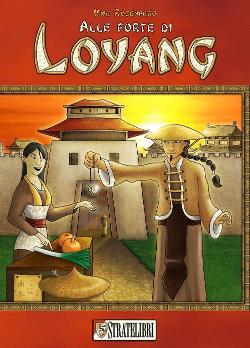
2009 · Economico
Alle Porte di Loyang
I giocatori coltivano campi per produrre merci, poi le vendono per soddisfare gli ordini dei clienti e guadagnare denaro. Le carte rappresentano campi, clienti, aiutanti e bancarelle del mercato; a ogni round i giocatori ottengono carte tramite un meccanismo di scelta/asta e ricevono anche un campo gratuito. Un singolo piazzamento riempie un campo con un tipo di merce, e ogni campo produce un’unità per round. I giocatori possono giocare aiutanti e usare le bancarelle del mercato per modificare la produzione, le entrate o le vendite, e possono compiere tante azioni quante ne consentono le loro carte e merci. I guadagni vengono investiti su un tracciato del punteggio, dove gli investimenti effettuati prima valgono di più; alla fine della partita vince il giocatore in testa su quel tracciato.
- Giocatori
- 1–4 ideale in 2
- Tempo di gioco
- 60–120 min
- Età
- 10+
- Complessità
- 3,1 / 5
Il gioco
- Autori
- Illustrazioni





Dove comprarlo
Prezzi dei negozi e copie usate, controllati ogni giorno.
Sui tavoli di Ludoya
Tutte le statistiche in Ludoya- 285
- Partite registrate
- 211
- Giocatori
- 1h 25m
- Partita media
- 87
- Nelle ludoteche
- 17
- Nelle liste dei desideri
5,5/10
da 42 recensioni Ludoya
Juego del maestro de refritos que me ha dado sopor jugarlo...lo jugaría alguna vez si me da por quitarme la vida.
Evan2,5 This game has an interesting core. You get a hand of cards, and then there's a push your luck mechanism, where each player takes a turn placing a card from their hand into a common central pool. Once someone plays a card to the center you want, you can grab it, along with a single card from your hand, and add them to your tableau, but then all the other cards from your hand go into the pool, and you are done taking cards for that round. Some of the cards are fields, and when you take a field card, you can as an action plant a veggie in that field, and then populate every space in the field with that veggie. At the start of each round, you pull one thing off each field. What you do with the veggies is spend them on various types of customer cards you are also trying to grab. Some customers only want one deliver, others want several, and will punish you if you fail them more than once. Ultimately, you are trying to get lots of money, and then buy steps on your score track. The steps are sequentially numbered, and your first step in a turn always costs 1, but then any additional steps you have to pay the face value for. So far I'm totally on board, and having a great time. The problem shows up with the special action cards. They are full of mean take-that effects that can't really be planned for nor responded to. At times they can totally shut down a player's engine by stealing someone's customer that they've set up their fields across multiple turns to accommodate. It also has a ton of downtime between turns, with not much to think about in the meanwhile, since you don't know your options until your turn actually arrives. It also handles four player incredibly poorly, having players choosing partners they can attack so that two players can take their turns simultaneously. ★ Art, Iconography and components functional ★ Clever or interesting mechanisms ☆ Reasonably low downtime between turns with mildly AP players ☆ Multiple plays stay interesting ★ Low or mitigatable luck elements ★☆☆☆☆ Raw enjoyment
Mestremuten8,0 Rating: 4/5 Production value: 3/4 Is the game in my collection/Love to have?: 1/1



















Gratis, sul web, Android e iOS
Gioca a Alle Porte di Loyang con Ludoya
- Tienilo nella tua ludotecaTieni traccia della tua copia e delle sue espansioni, prestala agli amici o mettila nella lista dei desideri e ricevi un avviso quando il prezzo scende.Aggiungilo alla tua ludoteca
- Registra ogni partitaPunteggi, vincitori, timer e foto, poi le tue statistiche: percentuale di vittorie, numero di giocatori preferito, miglior punteggio.Registra una partita
- Segna i punti senza cartaUsa i fogli punteggio e gli assistenti di gioco della community e lascia che Ludoya sommi i punti.Trova fogli punteggio
- Trova persone con cui giocarloClub, serate di gioco ed eventi vicino a te che portano questo gioco in tavola.Vedi gli eventi
Dati del gioco (giocatori, durata, età, crediti) da BoardGameGeek.