
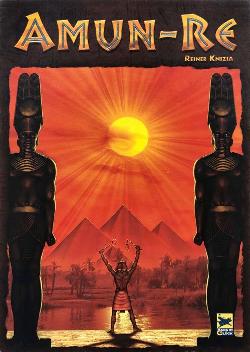
2003 · Wirtschaft
Amun-Re
Die Spieler übernehmen die Rolle von Oberhäuptern königlicher ägyptischer Familien, die Provinzen entlang des Nils erwerben, sie für Landwirtschaft und Handel entwickeln und Ressourcen nutzen, um Pyramiden für Prestige zu errichten. Das Gameplay dreht sich um Gebote in einer saisonalen Auktion, das Verwalten von Provinzeinkommen, den Kauf von Bausteinen und das Zuweisen von Machtkarten, um Aktionen zu beeinflussen. Außerdem bringen die Spieler dem Gott Amun-Re regelmäßig Opfer dar, was sich auf die Wertung und die Zugreihenfolge auswirkt. Das strategische Timing von Käufen, Provinzerweiterungen und Ressourcenzuteilung entscheidet darüber, wer die meisten Pyramiden baut und die höchste Punktzahl erreicht.
- Spieler
- 3–5 am besten mit 5
- Spielzeit
- 90 Min.
- Alter
- 12+
- Komplexität
- 3 / 5
Über das Spiel
- Autoren
- Illustration
- Verlage





Wo kaufen
Shop-Preise und gebrauchte Exemplare, täglich geprüft.
An Ludoyas Tischen
Alle Statistiken in Ludoya- 73
- Erfasste Partien
- 162
- Spieler
- 1h 39m
- Durchschnittliche Partie
- 43
- In Sammlungen
- 7
- Auf Wunschlisten
6,3/10
aus 26 Ludoya-Rezensionen
Mestremuten5,0 Rating: 3/5 Production value: 2/4 Is the game in my collection/Love to have?: 0/1
Evan4,6 Each round you flip a number of region cards equal to the number of players. Then players bid on the regions with the high bidder taking control of it with their claim marker. Then, players can buy farmers to put into the region, special action cards, and bricks that form pyramids. Then players secretly select some amount of money to throw away, the sum of which determines how much the farmers will produce that round in new money for their owners. This process gets tricky, as players not invested in farms can put a negative value card in the mix which leeches money from the total and gives it to the player. You play this way for a few rounds, and then once the board is full, you do a scoring awarding points to players for pyramids, majorities on either side of the nile river, and for holding spaces with printed temples. Then you do a big reset leaving only the point scoring temples on the board, and begin the bidding process again. The valuation process round to round is wild. Like most good games of this nature, players are valuing things differently from each other depending on their strategy going in. Ultimately plays don't vary much from one another. Either you are doing farms or going for raw income spots and bidding accordingly. Saving money from round 1 to try and win built up spaces in round 2. It's solid for a few plays, but I'm not finding the player interaction nor the game systems enough to be interesting enough for this to have much staying power.
andycted8,8 4-5 players. Classic Knizia but in a more complete/complex package than other simple auction games. One of his best, surely his best at 5 players and, at this weight, one of the best 5-player game of all time







Kostenlos, im Web, für Android und iOS
Spiel Amun-Re mit Ludoya
- Hab es in deiner SammlungVerwalte dein Exemplar und seine Erweiterungen, leih es Freunden oder setz es auf deine Wunschliste und erfahre, wenn der Preis fällt.Zur Sammlung hinzufügen
- Erfasse jede PartiePunkte, Sieger, Timer und Fotos, dann deine Statistiken: Siegquote, liebste Spielerzahl, beste Punktzahl.Partie erfassen
- Werte ohne PapierNutze die Wertungsbögen und Spielhelfer der Community und lass Ludoya die Punkte zusammenzählen.Wertungsbögen finden
- Finde Leute, mit denen du es spielstClubs, Spieleabende und Veranstaltungen in deiner Nähe, bei denen dieses Spiel auf den Tisch kommt.Veranstaltungen ansehen
Spieldaten (Spieler, Spielzeit, Alter, Mitwirkende) von BoardGameGeek.