
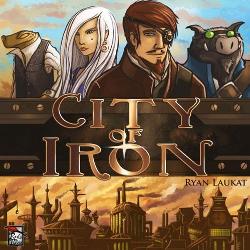
2013 · Fantasy
City of Iron
Die Spieler führen eine von vier rivalisierenden Nationen in einer Steampunk-Welt aus Maschinen, Magie und Handel an und entwickeln Städte, Flotten und Technologien auf einem gemeinsamen Kontinent und schwebenden Inseln. Das Gameplay kombiniert kartengetriebenen Engine-Building- und Area-Control-Ansatz: Die Spieler stellen zwei Decks individuell zusammen, produzieren und verkaufen Waren wie Maschinenteile oder eingesperrte Dämonen, erforschen Technologien aus dem Dampfzeitalter, heuern Söldner an und bauen oder reißen Stadtgebäude ab, um die begrenzte Kapazität zu verwalten. Schiffe und Luftschiffe ermöglichen die Expansion in ferne Länder und Inseln, während sowohl wirtschaftliche als auch militärische Wege zur nationalen Vorherrschaft führen können.
- Spieler
- 2–4 am besten mit 4
- Spielzeit
- 120 Min.
- Alter
- 13+
- Komplexität
- 3,2 / 5
Über das Spiel
- Autoren
- Illustration
- Verlag


Erweiterungen
In Ludoya ansehen
Wo kaufen
Shop-Preise und gebrauchte Exemplare, täglich geprüft.
- Cardhaus GamesAuf Lager59.99 $
- AlphaspelAuf Lager649 kr
- Gamers Guild AZAuf Lager49.94 $
- SpelexpertenAuf Lager649 kr
An Ludoyas Tischen
Alle Statistiken in Ludoya- 4
- Erfasste Partien
- 3
- Spieler
- 1
- In Sammlungen
- 1
- Auf Wunschlisten
4,7/10
aus 2 Ludoya-Rezensionen
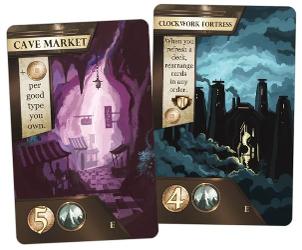
Evan4,6 In this game, players build two different decks of cards simultaneously with the purpose of collecting money to spend on building cards, and attacking neutral town cards, which is all in service of collecting resource symbols which bump your cube on the matching track in the central board. The player with the highest position in each resource will be granted extra money as well as victor points at the end of each of the three scoring rounds. The abstracted map-less area majority game here used to really excite me. The innovation of having these floating provinces distilled down to only needing a single cube to represent your presence there, fueled by card pulls. I also used to be very excited by the two deck element, where one deck is focused more on buildings and the other more on attacking neutral cards, with the neural cards being slightly stronger than the buildings, but the downside is that other players can then attack the cards you defeated to steal them from you, so there's a risk reward thing going on. All that being said, I'm much less into deckbuilders these days than I was when I first was enamored of it. In particular, the way you buy new cards is you can spend whatever money you have left at the end of the round on any card from a fairly large personal supply of cards. Looking through and reading everything at the end of round one is a lot of information to frontload onto players. Then having to manage two draw piles, and make sure you unlock ways to automatically draw from both decks just feels like a pain now where once It was an exciting new challenge. Additionally, the way that military players need to self balance each other is also troublesome. If you wind up with one player going heavy military, and everyone else either doesn't push into military or they do so ineffectively you'll have a run away player and nobody who has even built into the option to slow them down. I still think this is a good game for an ameritrash / euro hybrid enthusiast, but I think it's just not for me anymore. ★ Art, Iconography and components functional ★ Clever or interesting mechanisms ☆ Reasonably low downtime between turns with mildly AP players ★ Multiple plays stay interesting ★ Low or mitigatable luck elements ★★☆☆☆ Raw enjoyment
Ähnliche Spiele
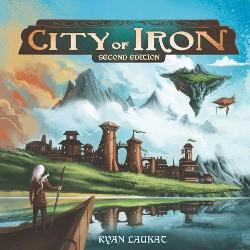 City of Iron: Second Edition2016
 Uprising: Curse of the Last Emperor2023
 London2010
 Epochen: Lauf der Kulturen2025
 Path of Light and Shadow2017
 Pillars of Heracles2025
 Imperium: Horizonte2025
 Cerebria: The Inside World – Origin Box2018
 Feudalia2011
 Skytear2020
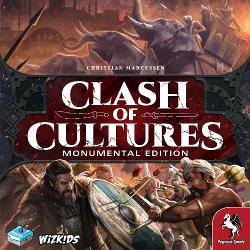 Clash of Cultures: Monumental Edition2021
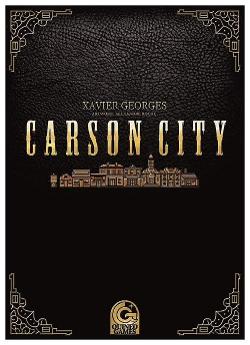 Carson City: Big Box2015
Kostenlos, im Web, für Android und iOS
Spiel City of Iron mit Ludoya
- Hab es in deiner SammlungVerwalte dein Exemplar und seine Erweiterungen, leih es Freunden oder setz es auf deine Wunschliste und erfahre, wenn der Preis fällt.Zur Sammlung hinzufügen
- Erfasse jede PartiePunkte, Sieger, Timer und Fotos, dann deine Statistiken: Siegquote, liebste Spielerzahl, beste Punktzahl.Partie erfassen
- Werte ohne PapierNutze die Wertungsbögen und Spielhelfer der Community und lass Ludoya die Punkte zusammenzählen.Wertungsbögen finden
- Finde Leute, mit denen du es spielstClubs, Spieleabende und Veranstaltungen in deiner Nähe, bei denen dieses Spiel auf den Tisch kommt.Veranstaltungen ansehen
Spieldaten (Spieler, Spielzeit, Alter, Mitwirkende) von BoardGameGeek.