
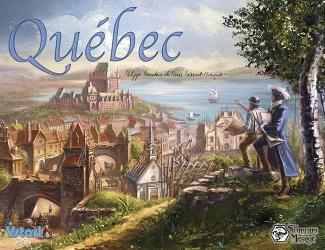
2011 · Städtebau
Québec
Die Spieler führen eine einflussreiche Familie über vier Jahrhunderte hinweg und konkurrieren darum, die wachsende Stadt zu prägen und Einfluss auf sie zu beanspruchen. In jedem Zug wählen die Spieler, ob sie mit einem Architekten ein Gebäude beginnen, Gebäudeteile fertigstellen, Arbeiter in eine von fünf Einflusszonen schicken (Religion, Politik, Handel, Kultur und die Citadelle) oder eine Anführerkarte nehmen. Beiträge zu Gebäuden und das Platzieren von Arbeitern bringen Einfluss und lösen eine Kettenreaktion durch das Mehrheiten-System aus: Die Mehrheit in einer Zone zieht die Hälfte ihrer Arbeiter in die nächste Zone weiter, was potenziell Wellenbewegungen und zusätzliche Wertungen auslösen kann. Das Spiel wird am Ende jedes Jahrhunderts für Mehrheiten in den Zonen gewertet, und nach dem vierten Jahrhundert gibt es abschließende Punkte für fertiggestellte Gebäude.
- Spieler
- 2–5 am besten mit 4
- Spielzeit
- 75 Min.
- Alter
- 13+
- Komplexität
- 3 / 5
Über das Spiel
- Illustration
- Publisher




Erweiterungen
In Ludoya ansehen
Wo kaufen
Shop-Preise und gebrauchte Exemplare, täglich geprüft.
An Ludoyas Tischen
Alle Statistiken in Ludoya- 20
- Erfasste Partien
- 29
- Spieler
- 2h 30m
- Durchschnittliche Partie
- 5
- In Sammlungen
- 1
- Auf Wunschlisten
5,9/10
aus 3 Ludoya-Rezensionen
Evan5,9 The central board in this game is made up of a bunch of these interconnected, single colored, four circle blobs. The center circle of each blob has a special ability, whereas the three connected circles have spaces for players to put cubes. The way things work is like this. On your turn, you either place your pawn onto one of the available circles for the round, which gets you three cubes into your active supply from your passive supply, or you contribute cubes to a circle that has a player's pawn. If it's your pawn, you get no cool extra benefit, but if you contribute to someone else's pawn, you get to do the effect of the center circle connected to where you placed. Each contribution space costs 1-3 cubes. Alternately to all that there are powerful role cards you can select, which give you a special asymmetric ability for that round. Ultimately what happens is when the player with the pawn wants to start a new building, they move the pawn which puts all the cubes that were on it's space into the bin at the corner of the map that matches the color of the circle. The benefit is that the player moving their pawn gets to place a stars token of their color in the completed space. The value of the token is larger depending on how many of the three contribution spaces were occupied, so players want to be mindful of which bonus actions other people might want to take that round. For the players who contributed cubes, at the end of the round each corner of the board gets scored, where you get 1 point per cube, and then the player with the most moves half clockwise into the next corner for them to score again, and if planned well potentially get majority again. This can be a lot of points for proper planning, but there's also a bonus for having large connected chains of buildings with your star token on it, so while all this is happening clever players are engaged in a route building process as well. Despite a complicated explanation, turns flow well, and there are good decision points and trade-offs to be made. Do you complete that building now, which would put the cubes in the building on the corners, or try to wait until next round. Which of the powerful ability cards will you draft? Do you draft one at the start of the round to get the one you want, or wait and get one that comes with more free cubes as compensation for taking the least desired one? When is it good to help someone else's building vs helping your own position. I absolutely love this game, and wish I could get it to the table more. While the iconography in the game is great, the colors are a bit hard on the eyes, and the art could definitely use a facelift. :star: Art, Iconography and components functional :star: Clever or interesting mechanisms :star: Reasonably low downtime between turns with mildly AP players :star: Multiple plays stay interesting :star: Low or mitigatable luck elements :star::star::nostar::nostar::nostar: Raw enjoyment




Kostenlos, im Web, für Android und iOS
Spiel Québec mit Ludoya
- Hab es in deiner SammlungVerwalte dein Exemplar und seine Erweiterungen, leih es Freunden oder setz es auf deine Wunschliste und erfahre, wenn der Preis fällt.Zur Sammlung hinzufügen
- Erfasse jede PartiePunkte, Sieger, Timer und Fotos, dann deine Statistiken: Siegquote, liebste Spielerzahl, beste Punktzahl.Partie erfassen
- Werte ohne PapierNutze die Wertungsbögen und Spielhelfer der Community und lass Ludoya die Punkte zusammenzählen.Wertungsbögen finden
- Finde Leute, mit denen du es spielstClubs, Spieleabende und Veranstaltungen in deiner Nähe, bei denen dieses Spiel auf den Tisch kommt.Veranstaltungen ansehen
Spieldaten (Spieler, Spielzeit, Alter, Mitwirkende) von BoardGameGeek.