
2007 · Costruzione di territori
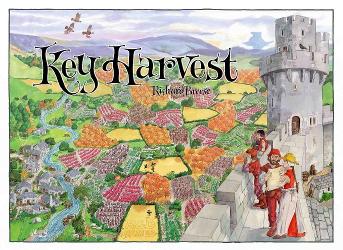
Key Harvest
I giocatori costruiscono una plancia personale del proprio paese acquisendo e posizionando tessere campo, poi ottengono punti per i gruppi collegati di campi e per le tessere lavoratore posizionate sulla loro plancia. In un turno, un giocatore compie due azioni distinte tra quattro opzioni: posizionare sulla propria plancia i campi dalla propria riserva, prendere campi dal registro e metterli nella propria riserva facendo un'offerta in gettoni raccolto (gli altri giocatori possono pareggiare l'offerta per acquistare la tessera), posizionare un lavoratore (bracciante) adiacente al numero richiesto di campi per attivare la sua azione speciale, oppure raccogliere i raccolti girando le tessere campo non ancora raccolte. Le tessere campo pescate dal sacchetto riforniscono il registro e possono includere tessere evento che influenzano tutti i giocatori; la partita termina dopo il decimo evento, più altri due round. Il punteggio finale assegna inoltre punti per la maggioranza di ogni tipo di raccolto.
- Giocatori
- 2–4 ideale in 3
- Tempo di gioco
- 90 min
- Età
- 10+
- Complessità
- 3 / 5
Il gioco
- Autori
- Illustrazioni
- Editore



Sui tavoli di Ludoya
Tutte le statistiche in Ludoya- 8
- Partite registrate
- 5
- Giocatori
- 7
- Nelle ludoteche
5,7/10
da 5 recensioni Ludoya
Mestremuten4,5 Rating: 2/5 Production value: 2/4 Is the game in my collection/Love to have?: 0.5/1
Prime impressioni · 1 partita
Evan6,0 This is a tile laying game where each player has a symmetrical player board full of spaces that each have a unique unique row and column designation. Tiles get mixed in a bag and then six are placed on the central board. On each player's turn, they can do 2 actions, which could be place a worker tile and use it's special ability so long as the worker goes next to a number of other tiles at least equal to his printed victory point value, or take tiles from the central display placing them up for sale on your market area by setting their price with goods tokens, getting resource tokens from a connected blob of tiles on your player board thereby depleting the tiles, or buying tiles from player's market spaces which could be your own, or someone elses. The game ends when ten event tiles from the bag get drawn and resolved. Then, players score the printed values of the workers they have remaining on their board, plus 1 point for every tile in their largest blob, and 2 points for every tile in their second largest blob. Then there are a few mini points for having the most remaining of each type of good token. The game is very tight, with difficult decisions throughout. The mechanism where tiles taken from the central board need to go into your market where someone else might buy it from you is interesting but at times difficult to manage. You need to have an eye on the tiles you need, but also the tiles other people need so you can set them up to have to pay you, but then setting the price is tricky. Tiles can only go in the specific grid spot printed on them, which makes it tough if someone buys out a tile you needed to connect your stuff. On the other hand if you want someone to pay you for a tile, you have to set the price at a level they can afford using colors they have, and resources in hand are kept secret, so tracking who spent what when is another mental effort in addition to tracking what tile is good for who. Under-price the tile and you feel like a chump. Overprice the tile, and it just sits there until someone buys it, and your resources you used to set the price stay with the tile, and you again feel like a chump. The graphic design is very busy. The player workers are clear to see, but the neutral workers players are in competition for look very similar in color and pattern to the farm tiles, which makes being able to clearly see other player's board states more difficult than it needs to be. The tiles also can be a little misleading as to what their effects are. You really have to check the book before the game to clarify how they work. With some graphic design improvements, this could be a fantastic game. As it stands, I very much enjoy the puzzle. Particularly the mechanism where you can get extra activations from your workers if you place a field tile on them and bump them to another space they can legally go. It's irritating that while the worker and event tiles have english text on them, the text is misleading and you have to check the rulebook to see what they do each time. It would be better if all they had was a letter on them and then you reply entirely on a player aid to look up their ability. It would also be good if they included some kind of marker that would visually track who had which tiles so you aren't waiting for something that will never be available as each tile is unique. When I play I often use a sets of colored glass counters for this purpose
L'ha giocato 4 volte
Tom5,5 The game works well, but it feels too "gamey" to be fun. I don't know how to put it better, but it doesn't have the sheer fun that Reef Encounter and Keythedral have.
Nessuna partita registrata

Gratis, sul web, Android e iOS
Gioca a Key Harvest con Ludoya
- Tienilo nella tua ludotecaTieni traccia della tua copia e delle sue espansioni, prestala agli amici o mettila nella lista dei desideri e ricevi un avviso quando il prezzo scende.Aggiungilo alla tua ludoteca
- Registra ogni partitaPunteggi, vincitori, timer e foto, poi le tue statistiche: percentuale di vittorie, numero di giocatori preferito, miglior punteggio.Registra una partita
- Segna i punti senza cartaUsa i fogli punteggio e gli assistenti di gioco della community e lascia che Ludoya sommi i punti.Trova fogli punteggio
- Trova persone con cui giocarloClub, serate di gioco ed eventi vicino a te che portano questo gioco in tavola.Vedi gli eventi
Dati del gioco (giocatori, durata, età, crediti) da BoardGameGeek.