
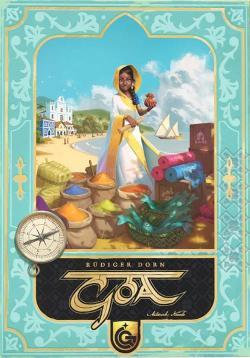
2004 · 経済
Goa
Manage a spice-trading company in early 16th-century India, acquiring plantations, ships, colonists and income through repeated auctions. Each round begins with players putting items up for auction (the starter sells extra), then everyone takes three actions to develop technologies, produce spices, expand fleets or build plantations using personal player boards that track advancement. Advancing on different tracks improves action efficiency and endgame scoring, while auctions create interaction and cash flow as players sell desirable items to others. Strategic planning balances short-term income with long-term investment and race incentives for reaching high tech levels.
- プレイ人数
- 1–4 ベスト4人
- プレイ時間
- 90分
- 対象年齢
- 12+
- 複雑さ
- 3.4 / 5





購入先
ショップ価格と中古品を毎日チェックしています。
Ludoyaのテーブルでは
Ludoyaで詳しい統計を見る- 205
- 記録されたプレイ
- 196
- プレイヤー
- 1h 46m
- 平均プレイ時間
- 56
- コレクション登録
- 9
- ウィッシュリスト登録
5.1/10
Ludoyaのレビュー40件より
Evan2.5 In this game, the starting player places a token next to the grid of tiles, and then each player in turn order chooses a tile in the grid adjacent to the start, or the last selected tile. These tiles then get auctioned off in a once-around bid where the person who chose the tile doesn't get to bid it up, they can simply pay the highest bid -1 or let the highest bid pay them for the tile. The tiles will increase your resource production capacity in some form, or give you a one time bonus. What you are doing for the most part is upgrading your personal player board. Across the board are representations of the different options you have in each action phase. The more you upgrade that part of your board the better the actions get. The cost to upgrade tends to be sets of different resources, as well as requiring you to spend ship cards. At the end of the game players get points for how many colony tiles they built, points for technologies, and points for sets of the same icon of leftover special ability cards in their hands. The feeling of the game is really unique in the way the auctions are peppy, and it's interesting how often times you want to place your auctioneer tile on something you don't care about, but you know your opponents do care about, so that you can get a money advantage over them. It can get a little frustrating at times, since it might happen that a tile you need simply isn't selected by another player for auction, so there's some give and take to that system. Do not play this with players who act randomly, or unthinkingly, or else you are destined to have a frustrating experience. Additionally, it's easy to run out of boat cards for your upgrade needs without realizing how many actions it will take you to restock. Planning helps, but if the resources you need to upgrade the boat track are in short supply for whatever reason, things can get tight faster than you might see coming. One element I'm not super happy about is the set collection element. There are special cards you can earn that tend to have powerful actions if you spend them. There are exactly five cards in each suite, and so it's fairly unlikely that you'll end the game with a full set of cards. Particularly because you don't retain the symbols when they are spent and when you draw more cards, you have to discard cards to accommodate your hand size before you draw, not after which means you see less cards. This luck element is a little much, as it's possible for one player to stumble into having lots of a set, and have it be extremely unlikely for another player to have the same. It's not the worst luck I've ever seen in a game certainly, but it just seems out of place in this otherwise very player driven experience. The last thing I should mention is the iconography on the special cards isn't great. There are cards where it shows the cost to take an action, with one cost crossed out with a big black X and one crossed out with a small red X, and this is supposed to indicate you pay one and not the other, but which? Well, the rulebook says, but that's super unclear and hard for me to remember. :nostar: Art, Iconography and components functional :star: Clever or interesting mechanisms :star: Reasonably low downtime between turns with mildly AP players :star: Multiple plays stay interesting :star: Low or mitigatable luck elements :nostar::nostar::nostar::nostar::nostar: Raw enjoyment
Mestremuten5.0 Rating: 4/5 Production value: 1/4 Is the game in my collection/Love to have?: 0/1
Sup8.3 Sleeved









ゲーム情報(人数、プレイ時間、対象年齢、クレジット)の出典:BoardGameGeek。