

2016 · Antiguidade
Ave Roma
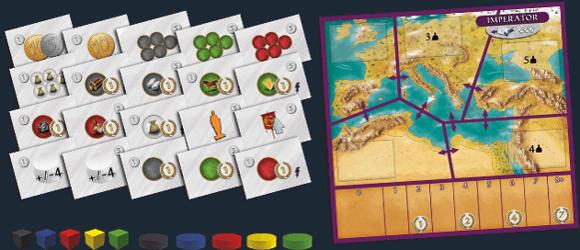
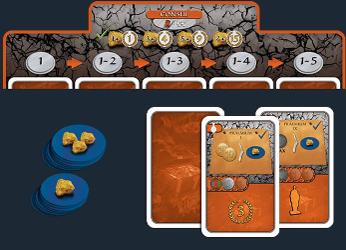
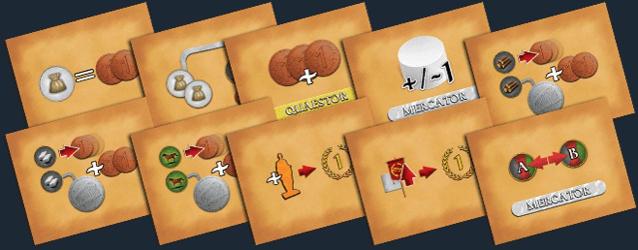
Os jogadores gerenciam um conjunto de trabalhadores comuns, cada um com valores individuais que mudam com o tempo. A cada rodada, os jogadores designam cinco trabalhadores durante uma fase de ações e depois recuperam trabalhadores em uma fase de coleta diferente, frequentemente recebendo trabalhadores diferentes dos que enviaram. As ações permitem construir edifícios, financiar esforços militares, conquistar o favor de patronos, ganhar influência em vários territórios e reunir dinheiro e recursos. O jogo enfatiza o planejamento em torno de conjuntos de trabalhadores em constante evolução e oferece vários caminhos para a vitória por meio do controle de áreas, do desenvolvimento econômico e do apoio político.
- Jogadores
- 2–5 melhor com 3
- Tempo de jogo
- 45–120 min
- Idade
- 12+
- Complexidade
- 3,7 / 5


Onde comprar
Preços das lojas e cópias usadas, verificados todos os dias.
Nas mesas da Ludoya
Todas as estatísticas na Ludoya- 11
- Partidas registradas
- 26
- Jogadores
- 2h 10m
- Partida média
- 6
- Em ludotecas
- 1
- Em listas de desejos
3,1/10
de 6 avaliações na Ludoya
Garfield2,0 Seriously? About 20 possibilities what you can do? Big down times. And 2 hours with 3 players is way too much! [c] Theme: ★☆☆☆☆ <!-- size 7]Not really --> Gameplay: ★★☆☆☆ <!-- size 7]Too many possibilities --> Interaction: ★★☆☆☆ <!-- size 7]Not much --> Artwork: ★☆☆☆☆ <!-- size 7]Doesn't appeal me --> Luck: ☆☆☆☆☆ <!-- size 7]No --> Strategy: ★★★☆☆ <!-- size 7]Pseudo --> Components: ★★☆☆☆ <!-- size 7]Average --> Play duration: ★☆☆☆☆ <!-- size 7]Far too long --> Easy to teach: ★★☆☆☆ <!-- size 7]Bazilions of possibilities to explain --> Setup time: :nuclear: <!-- size 7]Play again to rate it --> No downtime: ★☆☆☆☆ <!-- size 7]Can be huge --> [/c]
Nenhuma partida registrada
Evan2,0 This game has some very poor usability choices. The board is circular, which makes the information disorienting. The icons and text are very tiny. You are looking to collect sets of cards by the same tiny text name of the card that have different pictures. When cards are used for their center ability they get tapped. When they are used to discard for a bonus action they go to the used side of your player mat, where they can still be tapped. Then there are set collection bonuses that can be gotten from combinations of cards in your used and unused piles. There are also icons on the board that sometime mean gain and other times mean pay using the same positioning and iconography. If you get past the graphic design problems, you are met with a very slow moving and restrictive resource management/worker placement/set collection game. Workers have printed numbers that determine what action areas they can be used in. At the end of the round, starting with the player who was last in turn order, players get to select groups of workers to retrieve from the board, so your turn order determines a lot about your numbers spread. It's also often hard to tell how useful a number since cards flush from certain spaces. There's enough normal worker placement tension without adding this hard to control element. Since your worker number spread is a barely controllable symptom of turn order, I don't see how even choosing what numbers to take can be considered a meaningful decision. Buying cards usually takes several turns of setup. This feels like a long process of seeing how each and every game element prevents you from doing what you want for one reason or another. Either the resource card you needed got flipped action slot your numbers won't let you use, or the resource card you need wound up where you were aiming to improve your score marker meaning you now needed two workers of that number, or even another player interacted with the spot earlier in the turn order and now the cost to do anything there is $3 more. Each resource area has a little scoring track. If someone is ahead of you on the track, you have to overtake them in a single move, because if you end on the same space as them, you get bumped back down to the next lowest available space. The tracks are not long, and the cards that take so long to get give anywhere from 0 to 3 track bumps. I found this terribly frustrating, as by the time I could manage to get what I needed to overtake on a track, one of my opponents would invariably have gotten to the top of the track where there's nothing I could do to stop them. ☆ Art, Iconography and components functional ☆ Clever or interesting mechanisms ☆ Reasonably low downtime between turns with mildly AP players ☆ Multiple plays stay interesting ☆ Low or mitigatable luck elements ★★☆☆☆ Raw enjoyment
Primeiras impressões · 1 partida
Jogos semelhantes
 Rise of Empires2009
 Empires: Age of Discovery2015
 Men-Nefer2025
 The Royal Society of Archeology2025
 Argent: The Consortium2015
 Ants2025
 Schichtwechsel: Die Förderung liegt in deiner Hand2021
 Polis: Fight for the Hegemony2012
 Bier Pioniere2023
 Nova Roma2024
 Barbarians: The Invasion2018
 Atlantis Rising (Second Edition)2019
Grátis, na web, Android e iOS
Jogue Ave Roma com a Ludoya
- Tenha na sua ludotecaAcompanhe sua cópia e suas expansões, empreste para os amigos ou coloque na lista de desejos e seja avisado quando o preço cair.Adicionar à sua ludoteca
- Registre cada partidaPontuações, vencedores, cronômetros e fotos, e depois suas estatísticas: taxa de vitórias, número de jogadores favorito, melhor pontuação.Registrar uma partida
- Marque os pontos sem papelUse as folhas de pontuação e os ajudantes de jogo da comunidade e deixe a Ludoya somar os pontos.Encontrar folhas de pontuação
- Encontre gente para jogarClubes, noites de jogos e eventos perto de você que levam este jogo para a mesa.Ver eventos
Dados do jogo (jogadores, tempo de jogo, idade, créditos) do BoardGameGeek.