

2024 · Econômico
Shinjuku
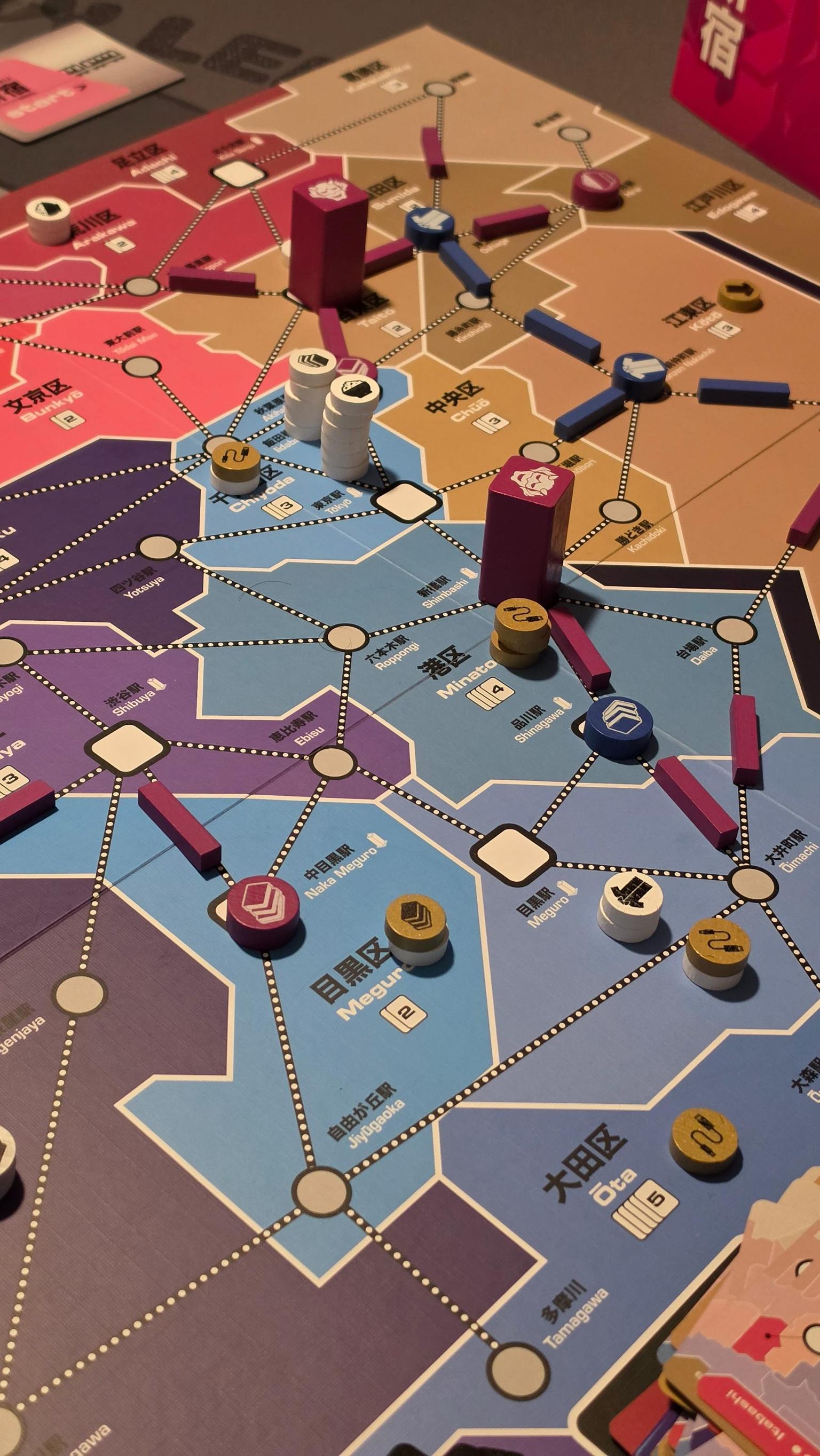
Players develop a retail-and-rail network across Tokyo, building stores and laying rail lines to connect them while competing to satisfy arriving customers. Each turn a new set of customers appears demanding one of four goods; players then take two different actions such as building a store, expanding rail, upgrading to a department store, drawing income cards, or moving customers along the rails to stores. Actions that place or upgrade locations require playing a matching location card from hand; cards matching existing store locations act as wilds. The game ends after the final customer round, and scoring awards points for collected customer sets.
- Jogadores
- 2–4 melhor com 4
- Tempo de jogo
- 60 min
- Idade
- 10+
- Complexidade
- 2,5 / 5
Sobre o jogo
- Design
- Editoras



Fotos das mesas da Ludoya
Todas as fotos na Ludoya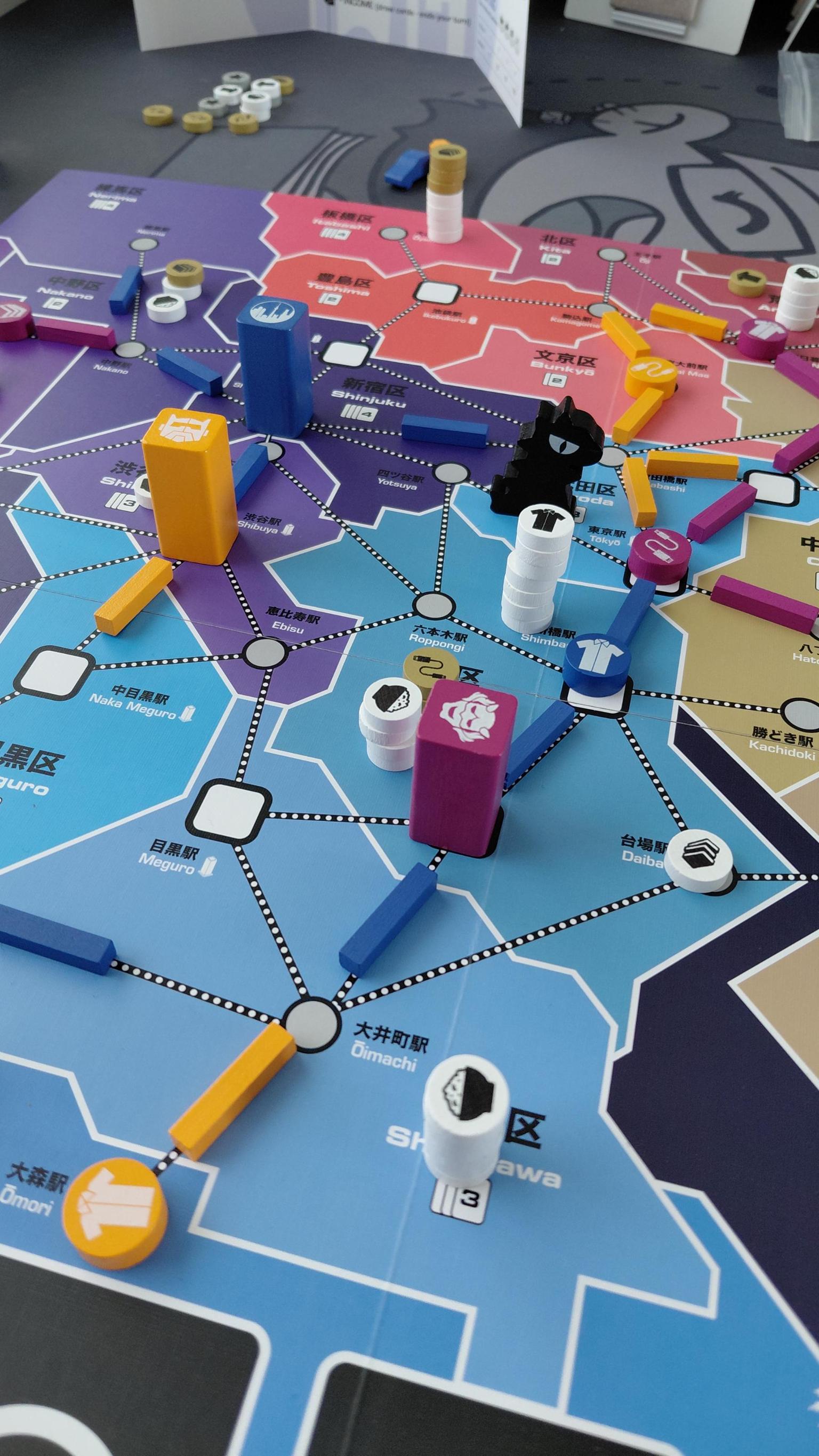
Onde comprar
Preços das lojas e cópias usadas, verificados todos os dias.
Nas mesas da Ludoya
Todas as estatísticas na Ludoya- 13
- Partidas registradas
- 27
- Jogadores
- 1h 39m
- Partida média
- 7
- Em ludotecas
- 2
- Em listas de desejos
6,0/10
de 6 avaliações na Ludoya
andycted6,0 After playing at 4p, our head hurt from parsing nightmare due to cards randomness, the stacking of 4-5 dynamics interacting with each other on the board and in perpetual change and finally the heavy player interaction and balancing. No thanks. Too much stuff and obstacles and randomness tossed over a relatively good and semi-original concept. Which is actually good for today's standards Way better with 3 players, but still has too much fiddliness and effort for the little satisfaction it gives and this is due to randomness and parsing hell. For example: I never got a Shinjuku card last game and I got tons of light blue cards. Nobody else built there and not many customers came in in that area. Could I prevent it ? No. Could I play it differently ? Of course, if I saw the future. You really need to fit where the other players go, and leader bashing can be extreme. But you're so limited by cards that you can't do any of these most of the time. Here is a rundown of your strategic choices. Leaving aside the store upgrade mechanic, which is nice but plays like a secondary attached mechanic, the core decisions will be split in two: A: build rails -1 : where there's already infrastructure -2 : where you expect infrastructures to be built And B: build shops -1: where there's already infrastructure -2 : where you expect infrastructures to be built In both cases, n.1 can suffer from players moving to build in other places/players choosing other routes And n.2 in just people not building there Then there's the very heavy randomness of cards impacting your and the table play, that will dictate where to play and what to move, hence ruin any 1 or 2 Then there's the complete randomness of where people will spawn, which can further hurt and invalidate the A and B choices made above. Finally, were it not enough, there's the semi blind choice of what kind of shop to open, given the total randomness of which token will end where on the map. Add to this that players can basically cut you off, move all customers away from you, and decide each turn who to give points to, and you understand why trying to play this game strategically can induce hopeless and probably useless AP. You are better off playing so rapidly that the game ends in half an hour and you enjoy the map growth and emerging story Just like Rise & Fall, an inelegant optimisation euro which looks elegant at first sight because of rules simplicity, however the stacking of many interacting, but jarring, mechanics make it for an overwrought game. And just like R&F the game lets you perceive there's a great mechanic, idea and game somewhere, waiting to come out, but it's buried deep down
Xavi Torras6,0 És simple i senzill. No hi ha dependència de l’idioma, ja que està en anglès o italià. El joc original és en japonès (una altra versió més antiga). Hi ha un factor de sort elevat, tot i que es pot reduir incorporant les dues variants que venen de sèrie, fet que fa que el joc sigui una mica més esbojarrat, però alhora també més senzill i amb una mica més d’estratègia al darrere. A grans trets, és una mena de Ticket to Ride en què t’has d’anar expandint pel tauler tan ràpid com sigui possible. Aquest representa la ciutat de Tokio i les seves estacions de metro. Hauràs de construir botigues o fins i tot centres comercials amb l’objectiu d’atraure clients als teus establiments a través de la xarxa de vies de metro que anireu construint entre tots els participants. L’objectiu és aconseguir més punts mitjançant una col·lecció de conjunts (set collection), que completaràs gràcies als diferents clients que hagin entrat a les teves botigues. És un joc que escala bé tant a 2 com a 4 participants. Per a mi, el nombre ideal de participants és 3. Les persones més experimentades probablement se’ls quedarà una mica curt, mentre que als que s’hi inicien els pot semblar una mica complicat, fins al punt de fer-los explotar el cervell. En conclusió, és un joc correcte i funciona bé, però no té una gran profunditat. Té un cert component estratègic, però també un factor de sort força elevat. La meva recomanació és que, si ets una persona experimentada i amb molta trajectòria en els jocs de taula, aquest se’t quedarà curt. És el típic joc que pots gaudir com a pare o mare juntament amb els teus fills o filles: tu t’ho passes bé i ells també






Grátis, na web, Android e iOS
Jogue Shinjuku com a Ludoya
- Tenha na sua ludotecaAcompanhe sua cópia e suas expansões, empreste para os amigos ou coloque na lista de desejos e seja avisado quando o preço cair.Adicionar à sua ludoteca
- Registre cada partidaPontuações, vencedores, cronômetros e fotos, e depois suas estatísticas: taxa de vitórias, número de jogadores favorito, melhor pontuação.Registrar uma partida
- Marque os pontos sem papelUse as folhas de pontuação e os ajudantes de jogo da comunidade e deixe a Ludoya somar os pontos.Encontrar folhas de pontuação
- Encontre gente para jogarClubes, noites de jogos e eventos perto de você que levam este jogo para a mesa.Ver eventos
Dados do jogo (jogadores, tempo de jogo, idade, créditos) do BoardGameGeek.