
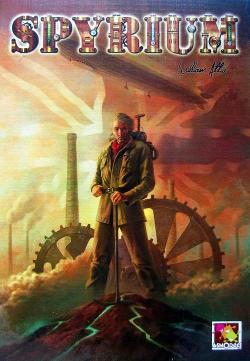
2013 · 科幻
Spyrium
A steampunk alternate-England where players develop industrial operations to extract and process a scarce resource called Spyrium. Players place workers on a shared board to perform actions: hire permanent workers, raise income, buy cards, build factories, extract Spyrium and activate production chains to convert raw Spyrium into processed goods that score victory points. Worker placement and activation phases overlap as players choose when to leave placement and trigger their constructed buildings. Resource management and engine-building drive play: balancing money, worker availability, and access to Spyrium determines who can acquire high-value buildings and generate the most points by game end.
- 人数
- 2–5 最佳 4 人
- 游戏时长
- 75 分钟
- 年龄
- 12+
- 复杂性
- 2.9 / 5
关于这款游戏
- Publisher

在哪里买
商店价格和二手货源,每天检查。
- Svet deskovych her查看库存 695 Kč
在 Ludoya 的牌桌上
在 Ludoya 中查看完整统计- 71
- 已记录对局
- 68
- 玩家
- 1h 15m
- 平均时长
- 22
- 收藏数
- 6
- 愿望清单数
5.9/10
基于 21 条 Ludoya 评测
andycted6.8 The usual resource/money conversion to victory points, around an interesting mechanic of worker placement and removal. Nothing to phone home about, tends to be an optimisation workout. Fun to play, small package, but not elegant enough for what it proposes.
规则问题
由 Ludoya 的规则助手根据规则书回答。
If I place a worker next to a card during Phase I, can I activate that card immediately?
No — placing a worker is a Placement (Phase I) action and does not itself activate the card; you must be in the Activation (Phase II) to activate cards, although you may move to Phase II during Placement and immediately take an Activation action (pages 4–5).
When I activate a card, how do I calculate what I must pay? Do other players' workers add to the price?
You pay the card's printed price plus £1 for each other worker adjacent to that card (regardless of owner); the chosen worker is then removed from the market and placed inactive by your Start card (page 5).
When I construct a building, do I have to pay to add it to my neighborhood and are there discounts?
You pay the card cost (plus £1 per other adjacent worker) and then either place it in a new space (cost £1 per building you already own), replace an existing building for free, or replace a building that shares a symbol to both replace for free and reduce the new building's price by £3 (pages 5–6).
If I use a building's effect, can I use it again later that same turn?
No — when you use a building you incline (turn) it and it cannot be used again that turn; all inclined buildings are straightened at the end of the turn (page 6).
How do the numbered tokens on characters/buildings/events work when they are placed and when they are used?
Tokens (values 1–3) are placed on certain market cards face-up; for buildings like Mines/University you discard the token when you construct it and take the indicated resources/points, while for characters a limited number of tokens are placed and you discard a chosen token when calling the character to gain its value/effect (and the Commerce technique can let you keep tokens instead of discarding up to 7) (page 7).
Can I pass even if I still have workers in the market?
No — you may only take the Pass action if you have no workers left in the market; if you still have workers you must first take Gain money or Activate a card actions (page 6).





游戏信息(人数、游戏时长、年龄、制作人员)来自 BoardGameGeek。