
2014 · Städtebau
Medina (Second Edition)
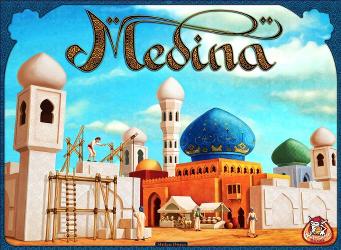
Die Spieler bauen im Jahr 1822 eine nordafrikanische Medina wieder auf, indem sie Holzteile platzieren, um Paläste zu errichten, den Markt zu erweitern und die Stadtmauern zu reparieren. In jeder Runde setzt ein Spieler zwei Teile (oder verzichtet mit einer Tee-Kachel auf das Platzieren), ergänzt bestehende farbige Gebäude oder beginnt neue und erweitert gemeinsame Elemente wie den Brunnen und die Mauern, die von den Ecken des Spielbretts aus wachsen. Bei der Wertung gibt es Punkte für beanspruchte Gebäude (ein Punkt pro angeschlossenem Teil), Mehrheitsboni für das größte Gebäude jeder Farbe, Belohnungen für Paläste rund um den Brunnen und einen Bonus für den Spieler, der zuletzt ein Gebäude mit den Mauern verbunden hat. Das Spiel verwendet viele detailreiche Holzteile und ein beidseitiges Spielbrett für unterschiedliche Spielerzahlen.
- Spieler
- 2–4 am besten mit 4
- Spielzeit
- 60 Min.
- Alter
- 10+
- Komplexität
- 2,4 / 5
Über das Spiel
- Autoren
- Illustration


Erweiterungen
In Ludoya ansehen
An Ludoyas Tischen
Alle Statistiken in Ludoya- 38
- Erfasste Partien
- 47
- Spieler
- 1h 12m
- Durchschnittliche Partie
- 12
- In Sammlungen
- 8
- Auf Wunschlisten
5,0/10
aus 13 Ludoya-Rezensionen
Garfield7,0 #31 Beautiful looking game with interesting decisions to make. [c] Theme: ★☆☆☆☆ <!-- size 7]Very little, very abstract --> Gameplay: ★★★☆☆ <!-- size 7]Playing different tiles --> Interaction: ★★★★★ <!-- size 7]Who plays where and claims a palace --> Artwork: ★★★☆☆ <!-- size 7]Only the board has artwork --> Luck: ★☆☆☆☆ <!-- size 7]No luck involved --> Strategy: ★★★★☆ <!-- size 7]When and where to claim --> Components: ★★★★☆ <!-- size 7]Beautiful wooden (but cheap wood) components --> Play duration: ★★★★★ <!-- size 7]Perfect (78min) --> Easy to teach: ★★★★☆ <!-- size 7]Quite easy (15min) --> Rules quality: ★★★★☆ <!-- size 7]Very good --> Setup time: ★★★★☆ <!-- size 7]Fast --> No downtime: ★★★☆☆ <!-- size 7]Little Downtime --> Replay value: ★★☆☆☆ <!-- size 7]Not much variety --> [/c]
Evan2,5 In this game everyone gets an even share of bricks in each of the four colors, and an even share of the neutral colored pieces and a set of four player colored claim markers. On your turn you place 2 of your pieces. Once a player uses one of their two placements to put down a claim marker on a contiguous blob of colored bricks, the structure can no longer be added to by any player and that player can no longer claim a structure of that color. In this way players slowly build the board up. Essentially, it's an abstract push your luck game. Do you money up an area or claim it for yourself? There are some interesting placement rules such as two blobs of bricks can never touch each other, even via diagonals, which means the first few rounds things feel uselessly empty, and in the last few rounds things are claustrophobicly tight. The neutral pieces are also interesting because they too have specific placement rules, and they essentially money up bricks they are next to. So, claim things too early, and someone will beat you out for the 'most bricks of X color' tile, and make sure your stuff isn't near the neutral scoring pieces. Claim things too late, and you'll be severely limited by space and other players aggressive moves to clog your area. This game winds up being fairly AP heavy since it's both mathy and players don't get much to go on in terms of how to value things. It also doesn't feel very satisfying since it's going to usually be other people claiming your work, and you claiming their work. It's a game where it seems like it feels like things just happen and you hope for the best and your success or failure relies heavily on the player to your right setting you up more than the player to their right set them up. ★ Art, Iconography and components functional ★ Clever or interesting mechanisms ☆ Reasonably low downtime between turns with mildly AP players ☆ Multiple plays stay interesting ☆ Low or mitigatable luck elements ★★☆☆☆ Raw enjoyment




Kostenlos, im Web, für Android und iOS
Spiel Medina (Second Edition) mit Ludoya
- Hab es in deiner SammlungVerwalte dein Exemplar und seine Erweiterungen, leih es Freunden oder setz es auf deine Wunschliste und erfahre, wenn der Preis fällt.Zur Sammlung hinzufügen
- Erfasse jede PartiePunkte, Sieger, Timer und Fotos, dann deine Statistiken: Siegquote, liebste Spielerzahl, beste Punktzahl.Partie erfassen
- Werte ohne PapierNutze die Wertungsbögen und Spielhelfer der Community und lass Ludoya die Punkte zusammenzählen.Wertungsbögen finden
- Finde Leute, mit denen du es spielstClubs, Spieleabende und Veranstaltungen in deiner Nähe, bei denen dieses Spiel auf den Tisch kommt.Veranstaltungen ansehen
Spieldaten (Spieler, Spielzeit, Alter, Mitwirkende) von BoardGameGeek.