
2017 · Medievale
Merlin
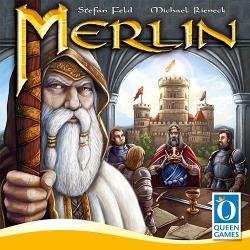
I giocatori assumono il ruolo di cavalieri e di Merlino mentre si muovono lungo un anello delle azioni usando i dadi per attivare le azioni desiderate. I cavalieri possono essere mossi solo dal giocatore che li controlla, mentre Merlino può essere mosso da qualsiasi giocatore: servono quindi tempismo e coordinazione. I punti si ottengono in diversi modi: sconfiggendo i barbari, costruendo manieri nelle aree circostanti, aumentando la propria influenza nelle sei contee e completando le carte obiettivo durante i turni. Il gioco premia una pianificazione efficiente e la corretta sequenza delle azioni, per accumulare più punti vittoria possibile ed essere scelti come successori di Re Artù.
- Giocatori
- 2–4 ideale in 3
- Tempo di gioco
- 75 min
- Età
- 14+
- Complessità
- 3,1 / 5




Sui tavoli di Ludoya
Tutte le statistiche in Ludoya- 91
- Partite registrate
- 110
- Giocatori
- 1h 38m
- Partita media
- 32
- Nelle ludoteche
- 5
- Nelle liste dei desideri
5,0/10
da 27 recensioni Ludoya
Evan4,6 In this game, each player rolls their dice and on their turn chooses one, moves a pawn of the matching color on the action selection wheel a number of spaces equal to the pips on that die and resolves the effect of the space. Since you everyone rolls their dice at the start of each round, the interesting puzzle of the game if figuring out the order you want to use your dice. This gets more interesting when you consider one pawn is shared among all players, so predicting where you think your opponents will move it is crucial to your success. Essentially what you do in the game is collect different types of tokens, or place a piece to compete for one of many different majority scorings. The core spaces do do this are the six colored castles that live four spaces away from each other on the action selection wheel. When you go to a castle, you can place one of your circle pawns there and then get a thing pictures on the pawn. This could be a cube which you need to build houses on the hex map, a flag which you could discard later to use it's powerful ability, a shield token you might need to fend off randomly assigned -3VP invader tokens of the matching color, or you could place an influence marker in the region to attempt to compete for that castle's majority scoring. Other action spaces involve actually building a house on the hex map, or scoring points for each of a specific type of token you've collected, or getting a benefit from a castle you have an influence marker in. The core of everything that's happening is very solid. The game just feels a bit unedited and unfocused. The external hex map as a mechanism feels disjointed from the rest of what's happening in the game. There are a few action spaces that aren't very compelling, but because of your dice you might get stuck with. Some of the flag abilities are better than others as well. A lot of this is addressed with the Arthur expansion. This expansion replaces two of the flags, adds an extra shared pawn to the game and removes a lot of the less desirable action spaces. Unfortunately, it comes with it's own problems. It adds extra spaces that allow for the movement of the shared pawns, which eliminates much of your ability to plan out your turn which is really the core appeal of the game. It also adds a mechanism where you need to collect a new type of tile only available from the new shared pawn's inner action wheel. Having the lowest sum of those tiles at the end of the round means a -3VP penalty and the player with the highest gets +3VP. The numbers and rewards on these tiles is highly subject to the flip luck of what's available, and of course having the shared pawn in a position such that you are capable of taking a tile. The expansion does add significantly more luck mitigation for your dice, which was something present in the base game, but not quite to the same extent. Of course, the issue with giving players more flexibility is you again lose some more of your ability to plan your turns properly. All in all, the game stands very close to being great, but it gets in it's own way a little too much. The same game with a few details refined and a few superfluous mechanisms shaved off would be an incredible experience. :star: Art, Iconography and components functional :star: Clever or interesting mechanisms :nostar: Reasonably low downtime between turns with mildly AP players :nostar: Multiple plays stay interesting :star: Low or mitigatable luck elements :star::star::star::nostar::nostar: Raw enjoyment
Garfield2,0 I wanted to like it, but I can't. Why? Because a lot depends on your dice rolls. You can mitigate it with your flags, but of course you have to collect them which is also like wasting an action. I just won because in the last round I was very lucky with my dice roll and I overtook all others. One pip less on a die can mean you can't score 7 points, instead you score 0 points. [c] Theme: :star::star::nostar::nostar::nostar: <!-- size 7]I don't feel it --> Gameplay: :star::star::star::star::nostar: <!-- size 7]Good amount of choices --> Interaction: :star::star::nostar::nostar::nostar: <!-- size 7]A little bit area control --> Artwork: :star::star::star::nostar::nostar: <!-- size 7]Ok --> Luck: :star::star::star::star::nostar: <!-- size 7]Dice rolling --> Strategy: :star::star::nostar::nostar::nostar: <!-- size 7]Mostly driven by your dice rolls --> Components: :star::star::star::nostar::nostar: <!-- size 7]Ok, nothing special --> Play duration: :star::star::star::star::nostar: <!-- size 7]Good for such a game --> Easy to teach: :star::star::nostar::nostar::nostar: <!-- size 7]A lot to teach (45min) --> Rules quality: <!-- size 7]not read --> Setup time: :star::star::nostar::nostar::nostar: <!-- size 7]It takes a little bit --> No downtime: :star::star::star::nostar::nostar: <!-- size 7]Ok --> Replay value: :star::star::nostar::nostar::nostar: <!-- size 7]Nothing changes that much --> [/c]
Mestremuten6,0 Rating: 3/5 Production value: 3/4 Is the game in my collection/Love to have?: 0/1






Gratis, sul web, Android e iOS
Gioca a Merlin con Ludoya
- Tienilo nella tua ludotecaTieni traccia della tua copia e delle sue espansioni, prestala agli amici o mettila nella lista dei desideri e ricevi un avviso quando il prezzo scende.Aggiungilo alla tua ludoteca
- Registra ogni partitaPunteggi, vincitori, timer e foto, poi le tue statistiche: percentuale di vittorie, numero di giocatori preferito, miglior punteggio.Registra una partita
- Segna i punti senza cartaUsa i fogli punteggio e gli assistenti di gioco della community e lascia che Ludoya sommi i punti.Trova fogli punteggio
- Trova persone con cui giocarloClub, serate di gioco ed eventi vicino a te che portano questo gioco in tavola.Vedi gli eventi
Dati del gioco (giocatori, durata, età, crediti) da BoardGameGeek.