
2017 · Postnapoleonisch
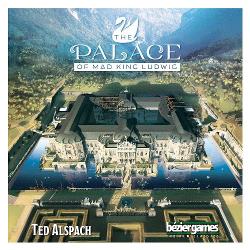
The Palace of Mad King Ludwig
Platziert Räume, um gemeinsam einen prachtvollen Fantasy-Palast für König Ludwig zu erbauen. Die Spieler fügen dem gemeinsamen Palast Raumplättchen hinzu, erhalten Belohnungen und verwenden mehrfarbige Schwanmarker als Währung, Punkte und Schlüssel für besondere Fähigkeiten. Während der Bau voranschreitet, bildet sich ein Wassergraben um den Palast; sobald er geschlossen ist, endet das Spiel und der Spieler, der am meisten beigetragen hat, gewinnt.
- Spieler
- 2–4 am besten mit 2
- Spielzeit
- 75 Min.
- Alter
- 13+
- Komplexität
- 2,8 / 5
Über das Spiel
- Autoren
- Illustration


Wo kaufen
Shop-Preise und gebrauchte Exemplare, täglich geprüft.
An Ludoyas Tischen
Alle Statistiken in Ludoya- 14
- Erfasste Partien
- 27
- Spieler
- 1h 36m
- Durchschnittliche Partie
- 9
- In Sammlungen
- 1
- Auf Wunschlisten
3,7/10
aus 3 Ludoya-Rezensionen
Evan3,5 On your turn you select and pay for a tile in the display, and add it to the central board. If you connect two doors of the same color, you get a bonus swan token, as does the owner of the building you connect to. Then you place one of your tiny claim tokens on the tile, and advance the tiny marker on your player board one space up on the track matching the type of your building. Rather than take a tile, you can spend three swan tokens to take a tile and click it into the sides of your player board, which either gives you a new endgame scoring objective or an ongoing ability. As piles of tiles run out, you begin to wall of areas with water tiles. The game ends when the water on one side meets the water on the other. Much of this game is about trying to line up completion bonuses on tiles you own. If every door on a tile leads to another door, you get a special effect, similar to the way it works in the plural game "Castles of Mad King Ludwig". Here, since multiple players are working on the same map, you do have a lot of blocking of other player's rooms, either with room placements, or more often with aggressive water expansion. I enjoy a similar mechanism to closing things off with a border in Carcassonne: The City, but in Carc: the City, walls finish areas, and also you can stand meeples on the walls which opens up new scoring opportunities. Here, the water wall just cruds things up, which feels a little bad. Particularly later in the game when each player is adding 3-4 water pieces with each room completion. Let's say a player has a hallway with one open end that leads to an orange room with no open ends. Late in the game that means as much as 8 water tiles will be placed in that single turn, so an area you were working on that you felt was pretty far from the danger of getting watered out of completion potential is suddenly ruined in terms of completion bonuses. Another oddity of the game is that many of the objectives in the game seem to want 'fewest' criteria. Fewest swans of a particular color, fewest rooms of a particular type. The game rewards you for sets of different swans and sets of different buildings, so it feels quite negative to push for scoring those criteria. Additionally, since swans can be spent, and some swan tokens are taken and held face down, the randomness of this feels quite punitive. Most or fewest buildings of a type feels overly dependent on flip luck, and most or fewest swans of a type fees overly dependent on turn order and hidden information. To add to this problem, the orange tiles all provide additional scoring criteria for the player who claims them. The tiles are small, and the icons on the tiles even smaller, and the claim tokens even smaller, and since the claim tokens never wipe, the board has an incredibly cluttered look by the point you are worried about who is scoring for what. I think overall, this isn't a bad game. I'd say, play it with 2 or 3 players to reduce the chaos a little. I do think you really have to give up worrying about score, since it's too difficult to track during the course of the game. Even at the end of the game, tallying the scores is a frustrating experience. Maybe just go play Carcassonne: The City and then also Castles of Mad King Ludwig and leave this one be. ☆ Art, Iconography and components functional ★ Clever or interesting mechanisms ★ Reasonably low downtime between turns with mildly AP players ★ Multiple plays stay interesting ☆ Low or mitigatable luck elements ★★☆☆☆ Raw enjoyment
Ähnliche Spiele
 Castles of Mad King Ludwig: Collector's Edition2022
 Die Schlösser des König Ludwig2014
 Blueprints of Mad King Ludwig2024
 The Castles of Burgundy: Special Edition2023
 Zwischen zwei Schlössern2018
 Paris2020
 The Castles of Burgundy2020
 Die Burgen von Burgund2011
 The Palaces of Carrara2022
 Alhambra: Mega Box2019
 Die Paläste von Carrara2012
 Architekten des Westfrankenreichs2018
Wer es hat, hat auch


Kostenlos, im Web, für Android und iOS
Spiel The Palace of Mad King Ludwig mit Ludoya
- Hab es in deiner SammlungVerwalte dein Exemplar und seine Erweiterungen, leih es Freunden oder setz es auf deine Wunschliste und erfahre, wenn der Preis fällt.Zur Sammlung hinzufügen
- Erfasse jede PartiePunkte, Sieger, Timer und Fotos, dann deine Statistiken: Siegquote, liebste Spielerzahl, beste Punktzahl.Partie erfassen
- Werte ohne PapierNutze die Wertungsbögen und Spielhelfer der Community und lass Ludoya die Punkte zusammenzählen.Wertungsbögen finden
- Finde Leute, mit denen du es spielstClubs, Spieleabende und Veranstaltungen in deiner Nähe, bei denen dieses Spiel auf den Tisch kommt.Veranstaltungen ansehen
Spieldaten (Spieler, Spielzeit, Alter, Mitwirkende) von BoardGameGeek.