
2019 · Rompecabezas
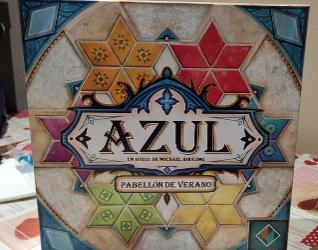
Azul: Pabellón de verano
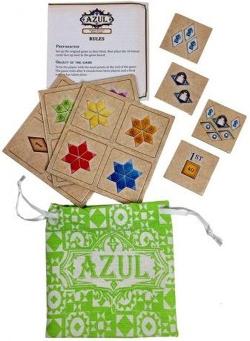
Los jugadores actúan como maestros artesanos encargados de construir un pabellón de verano real usando losetas de colores tomadas de un suministro compartido. La partida transcurre en seis rondas de selección: las losetas se revelan en las fábricas y en el centro de la mesa, los jugadores toman conjuntos de un solo color (con comodines obligatorios en algunas elecciones) y los añaden a su tablero personal como pago para colocar losetas en patrones con forma de estrella. Colocar una loseta cuesta descartar un número de losetas iguales o comodín equivalente al valor del espacio objetivo, y puntúa por la loseta colocada más cualquier loseta conectada en esa estrella. Las características que rodean el tablero otorgan bonificaciones inmediatas de losetas, las losetas sin usar conllevan penalizaciones y los límites de ronda afectan lo que se arrastra a la siguiente. La puntuación final recompensa las estrellas completas y las columnas de valores completas; gana quien tenga el total más alto.
- Jugadores
- 2–4 mejor con 2
- Duración
- 30–45 min
- Edad
- 8+
- Complejidad
- 2,1 / 5
Sobre el juego
- Diseño
- Arte
- Publisher



Expansiones
Verlas en Ludoya
Dónde comprarlo
Precios de tiendas y copias de segunda mano, revisados cada día.
En las mesas de Ludoya
Todas las estadísticas en Ludoya- 694
- Partidas registradas
- 556
- Jugadores
- 44m 41s
- Partida media
- 203
- En colecciones
- 20
- En listas de deseos
7,1/10
de 90 reseñas en Ludoya
Juli8,0 - Standard box - Quick game: under 45 mins - Solo mode (fan made) - Digital version (BGA) - Try digital version - Not interested in buying physical version - Playing by turns online drags the games

Dudas de reglas
Respondidas a partir del reglamento por el asistente de reglas de Ludoya.
Can I take wild tiles as my pick from a Factory display or the center like any other color?
You may only pick all tiles of one non‑wild color from a Factory or the center; if wild tiles are present on that display/center you must also take exactly one wild tile, and if only wild tiles are present you may take only one wild tile (page 3).
How do wild tiles work when I place tiles — can I use them by themselves to place on a different colored space?
Wild tiles may replace other colors but you must include at least one tile of the color you want to place; a wild tile cannot itself be used to replace its own color on a space (it may be placed on a matching colored space or combined with a matching color) (page 4; examples C–E on page 5).
When I place tiles in Phase 2, do I have to place all the tiles I collected at once or can I keep some for later turns?
You place exactly one tile on the target space when you have the required number and keep any tiles you do not place next to your player board for later turns; the other tiles that were needed to play on that space are discarded into the tower (page 4).
If I decide to stop playing for the round, what happens to my leftover tiles and score?
If you pass you may keep up to four tiles by placing them on the corner storage spaces for the next round, but any other leftover tiles are discarded into the tower and cost you 1 point each; after passing you take no more turns that round (page 5).
How is scoring calculated when I place a tile — do I get points for adjacent tiles or across different stars?
You score 1 point for the tile you place plus 1 point for each connected tile adjacent to it on the same star; only spaces next to one another on a star count as connected (page 4).
If I take tiles from the center, do I automatically become the start player and lose points?
The first player to take tiles from the center takes the start player token and moves their scoring marker backwards a number of spaces equal to the number of tiles they picked (but not past space 1); the start player then goes first in Phase 2 and starts the next round (page 3).



















Gratis, en web, Android e iOS
Juega a Azul: Pabellón de verano con Ludoya
- Tenlo en tu colecciónControla tu copia y sus expansiones, préstala a tus amigos o ponla en tu lista de deseos y te avisamos cuando baje de precio.Añadirlo a tu colección
- Registra cada partidaPuntuaciones, ganadores, temporizadores y fotos, y luego tus estadísticas: porcentaje de victorias, número de jugadores favorito, mejor puntuación.Registrar una partida
- Resuelve dudas de reglasPregunta lo que quieras sobre las reglas y obtén una respuesta sacada del reglamento, con la página donde comprobarla.Preguntar al asistente de reglas
- Encuentra gente con quien jugarloClubes, noches de juegos y eventos cerca de ti que sacan este juego a la mesa.Ver eventos
Datos del juego (jugadores, duración, edad, créditos) de BoardGameGeek.