
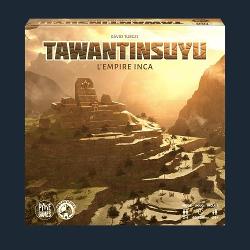
2020 · Económico
Tawantinsuyu: El Imperio Inca
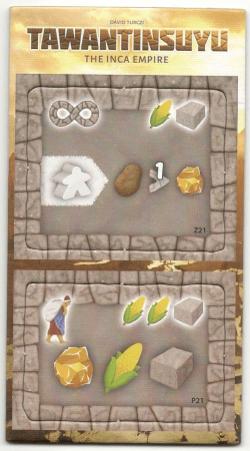
Los jugadores asumen el papel de herederos rivales en la capital inca, reclutando aldeanos con cinco tipos distintos de trabajadores y colocándolos en ubicaciones escalonadas bajo el Templo del Sol para realizar acciones. Los trabajadores permanecen en el tablero y activan acciones encadenadas; los trabajadores adyacentes que coinciden otorgan acciones extra, mientras que algunos tipos dan bonificaciones de colocación o habilidades de retirada. Gestiona recursos (papas, maíz, piedra, oro), descarta cartas de dios o paga oro para colocar trabajadores, construye edificios de producción y escaleras por la colina del templo, esculpe estatuas y reúne ejércitos para conquistar aldeas en cuatro regiones. Mueve a un Sumo Sacerdote alrededor del Coricancha para acceder a poderosas acciones del templo, reducir los costes de colocación y sumar puntos por las escaleras, las estatuas, los avances en el templo, el control militar y los tapices terminados.
- Jugadores
- 1–4 mejor con 3
- Duración
- 60–120 min
- Edad
- 14+
- Complejidad
- 4,1 / 5
Sobre el juego
- Diseño



Expansiones
Verlas en Ludoya

Dónde comprarlo
Precios de tiendas y copias de segunda mano, revisados cada día.
- Goblin Trader BarcelonaEn stock 33 €
- Juegos de la Mesa RedondaSin stock 46.71 €
- Dungeon MarvelsPreventa 49.5 €
- ZacatrusSin stock 49.5 €
- Va de jocsSin stock 49.95 €
- Miniature MarketEn stock 42 $
- Cardhaus GamesEn stock 44.99 $
- Zatu GamesEn stock 41.95 £
En las mesas de Ludoya
Todas las estadísticas en Ludoya- 70
- Partidas registradas
- 102
- Jugadores
- 2h 26m
- Partida media
- 71
- En colecciones
- 5
- En listas de deseos
- 2
- En preventa
6,5/10
de 15 reseñas en Ludoya
Dudas de reglas
Respondidas a partir del reglamento por el asistente de reglas de Ludoya.
Do roaming and descending movement cost food, and how do Steps reduce those costs?
Yes — Roaming and Descending require you to pay the food cost shown, and each built Step reduces those food costs as specified; Steps also grant VP when built (p.9).
Can I place multiple workers on the same space/task, and how does adjacency affect task results?
You can place more than one worker and adjacent workers increase the number of tasks/resources gained (adjacency bonuses apply); follow the space’s icons for any stacking limits or special distribution rules (pp.9–10).
What's the difference between Passive and Production buildings — when do Production buildings trigger and flip?
Passive buildings provide their listed effects when you use their placement/action and remain as passive effects, while a Production building’s “Produce One” action gives its benefit and the production building is then resolved/flipped as described (pp.12,16,19).
How does Conquest work in 2-player games — do I flip and discard Soldiers and what rewards do I get?
In 2‑player Conquest you play Army cards and follow the flip/discard soldier steps, place the conquest marker, and immediately receive the VP and region rewards listed for that conquest (p.15).
What happens at the Festival — how are potatoes penalized and how is VP scored?
Festival scoring awards VP in the listed tiers (1/2/4), resolves merchant/Temple/Conquest scoring and other festival effects, and applies potato penalties (negative VP for leftover potatoes) as specified during the Festival resolution (p.17).
If I buy a worker during my turn, can I use it immediately or exceed the 2-worker placement limit?
You cannot exceed the 2‑worker placement limit and worker purchases occur at end of turn (subject to the recruit cap), so newly bought workers are not available for actions until after purchase resolution (pp.16,8).
Juegos similares
 Teotihuacán: Ciudad de Dioses – Edición completa2025
 Ejército de Terracota2022
 Galileo Galilei2025
 Orloj: The Prague Astronomical Clock2025
 Pillars of Heracles2025
 Nippon: Zaibatsu2026
 Empires: Age of Discovery2015
 Imperium: Legendarios2022
 Imperium: Horizontes2025
 Hormigas
 Teotihuacán: Ciudad de Dioses2018
 Amritsar: The Golden Temple2023






Gratis, en web, Android e iOS
Juega a Tawantinsuyu: El Imperio Inca con Ludoya
- Tenlo en tu colecciónControla tu copia y sus expansiones, préstala a tus amigos o ponla en tu lista de deseos y te avisamos cuando baje de precio.Añadirlo a tu colección
- Registra cada partidaPuntuaciones, ganadores, temporizadores y fotos, y luego tus estadísticas: porcentaje de victorias, número de jugadores favorito, mejor puntuación.Registrar una partida
- Resuelve dudas de reglasPregunta lo que quieras sobre las reglas y obtén una respuesta sacada del reglamento, con la página donde comprobarla.Preguntar al asistente de reglas
- Encuentra gente con quien jugarloClubes, noches de juegos y eventos cerca de ti que sacan este juego a la mesa.Ver eventos
Datos del juego (jugadores, duración, edad, créditos) de BoardGameGeek.