
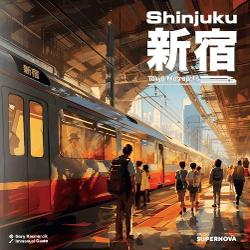
2024 · Transport
Shinjuku
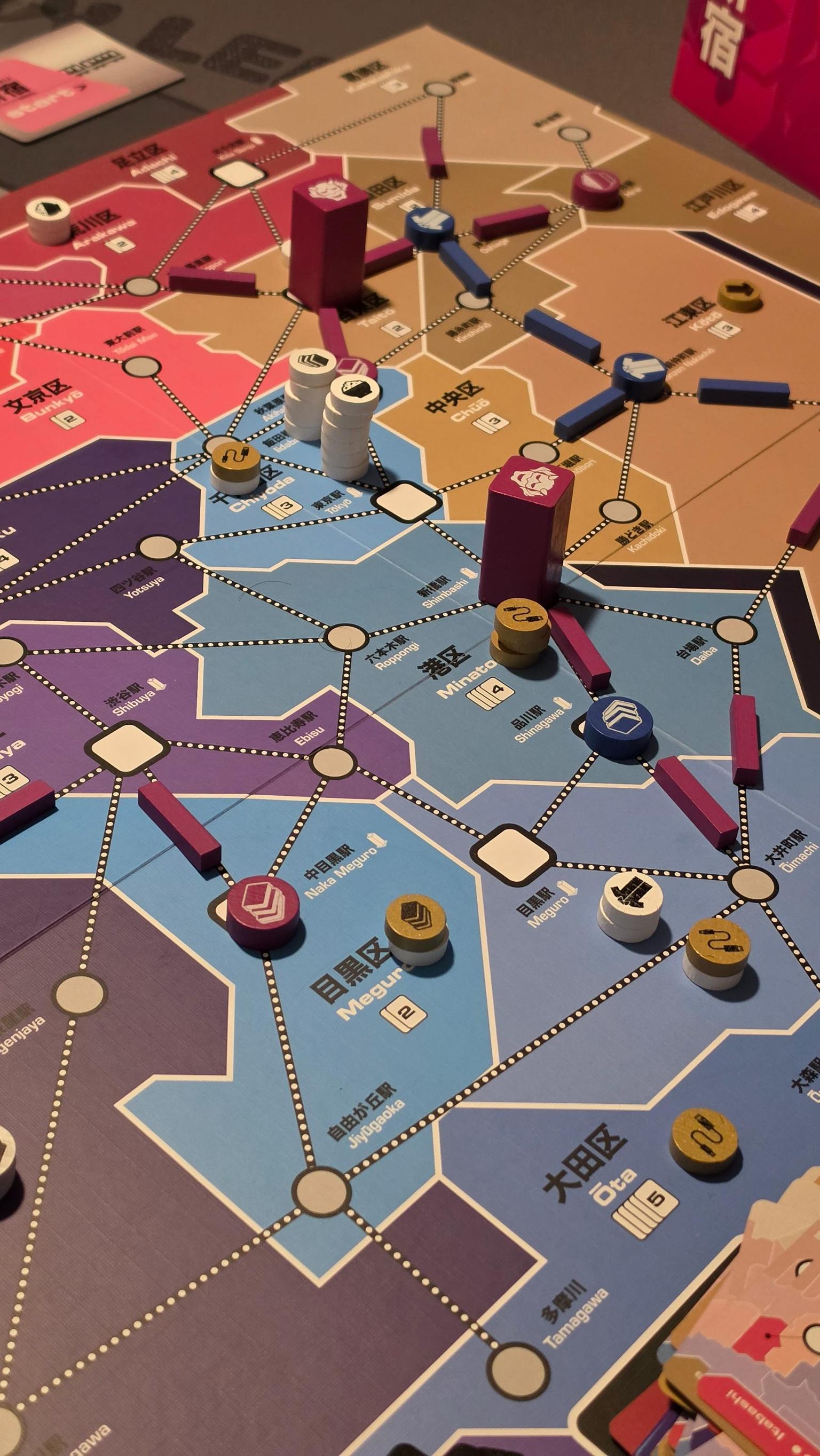
Les joueurs développent un réseau de commerces et de voies ferrées à travers Tokyo, construisant des magasins et posant des voies pour les relier tout en rivalisant pour satisfaire les clients qui arrivent. À chaque tour, un nouvel ensemble de clients apparaît et réclame l’un des quatre produits ; les joueurs effectuent ensuite deux actions différentes, comme construire un magasin, étendre le réseau ferré, transformer un magasin en grand magasin, piocher des cartes de revenus ou déplacer des clients le long des voies jusqu’aux magasins. Les actions qui consistent à placer ou améliorer des lieux nécessitent de jouer une carte de lieu correspondante depuis sa main ; les cartes correspondant aux lieux où se trouvent déjà des magasins servent de jokers. La partie se termine après la dernière manche de clients, et le décompte rapporte des points pour les ensembles de clients collectés.
- Joueurs
- 2–4 idéal à 4
- Temps de jeu
- 60 min
- Âge
- 10+
- Complexité
- 2,5 / 5
À propos du jeu
- Auteurs
- Éditeurs



Photos des tables de Ludoya
Toutes les photos dans Ludoya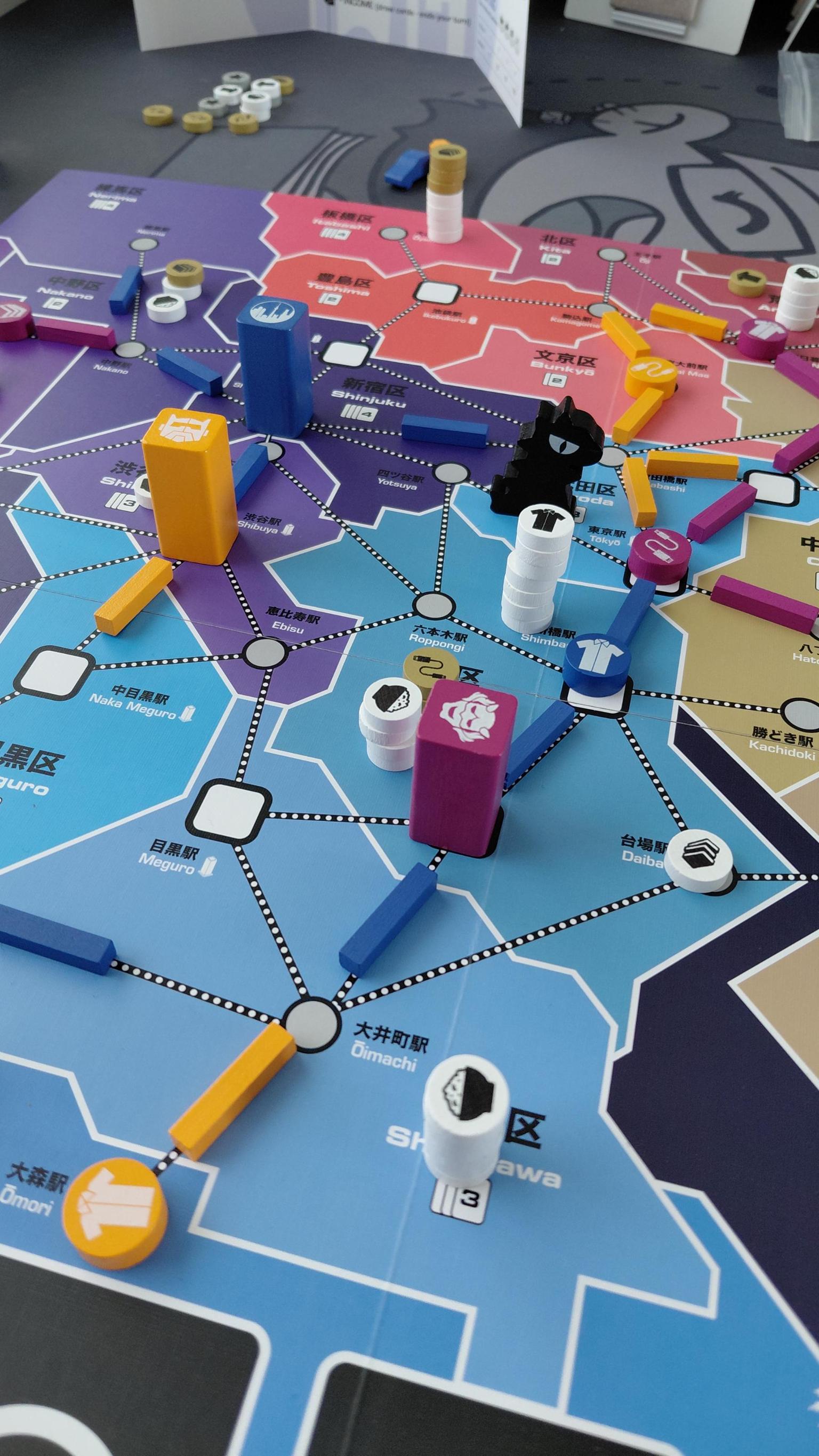
Où l'acheter
Prix des boutiques et exemplaires d'occasion, vérifiés chaque jour.
- 4DadosPrécommande45 €
- Get Your FunEn stock49.99 €
- Milan SpieleRupture de stock39.9 €
- SpielezarEn stock57.9 Fr.
Sur les tables de Ludoya
Toutes les statistiques dans Ludoya- 13
- Parties enregistrées
- 27
- Joueurs
- 1h 39m
- Partie moyenne
- 7
- Dans des collections
- 2
- Dans des listes de souhaits
6,0/10
sur 6 avis Ludoya
andycted6,0 After playing at 4p, our head hurt from parsing nightmare due to cards randomness, the stacking of 4-5 dynamics interacting with each other on the board and in perpetual change and finally the heavy player interaction and balancing. No thanks. Too much stuff and obstacles and randomness tossed over a relatively good and semi-original concept. Which is actually good for today's standards Way better with 3 players, but still has too much fiddliness and effort for the little satisfaction it gives and this is due to randomness and parsing hell. For example: I never got a Shinjuku card last game and I got tons of light blue cards. Nobody else built there and not many customers came in in that area. Could I prevent it ? No. Could I play it differently ? Of course, if I saw the future. You really need to fit where the other players go, and leader bashing can be extreme. But you're so limited by cards that you can't do any of these most of the time. Here is a rundown of your strategic choices. Leaving aside the store upgrade mechanic, which is nice but plays like a secondary attached mechanic, the core decisions will be split in two: A: build rails -1 : where there's already infrastructure -2 : where you expect infrastructures to be built And B: build shops -1: where there's already infrastructure -2 : where you expect infrastructures to be built In both cases, n.1 can suffer from players moving to build in other places/players choosing other routes And n.2 in just people not building there Then there's the very heavy randomness of cards impacting your and the table play, that will dictate where to play and what to move, hence ruin any 1 or 2 Then there's the complete randomness of where people will spawn, which can further hurt and invalidate the A and B choices made above. Finally, were it not enough, there's the semi blind choice of what kind of shop to open, given the total randomness of which token will end where on the map. Add to this that players can basically cut you off, move all customers away from you, and decide each turn who to give points to, and you understand why trying to play this game strategically can induce hopeless and probably useless AP. You are better off playing so rapidly that the game ends in half an hour and you enjoy the map growth and emerging story Just like Rise & Fall, an inelegant optimisation euro which looks elegant at first sight because of rules simplicity, however the stacking of many interacting, but jarring, mechanics make it for an overwrought game. And just like R&F the game lets you perceive there's a great mechanic, idea and game somewhere, waiting to come out, but it's buried deep down
Xavi Torras6,0 És simple i senzill. No hi ha dependència de l’idioma, ja que està en anglès o italià. El joc original és en japonès (una altra versió més antiga). Hi ha un factor de sort elevat, tot i que es pot reduir incorporant les dues variants que venen de sèrie, fet que fa que el joc sigui una mica més esbojarrat, però alhora també més senzill i amb una mica més d’estratègia al darrere. A grans trets, és una mena de Ticket to Ride en què t’has d’anar expandint pel tauler tan ràpid com sigui possible. Aquest representa la ciutat de Tokio i les seves estacions de metro. Hauràs de construir botigues o fins i tot centres comercials amb l’objectiu d’atraure clients als teus establiments a través de la xarxa de vies de metro que anireu construint entre tots els participants. L’objectiu és aconseguir més punts mitjançant una col·lecció de conjunts (set collection), que completaràs gràcies als diferents clients que hagin entrat a les teves botigues. És un joc que escala bé tant a 2 com a 4 participants. Per a mi, el nombre ideal de participants és 3. Les persones més experimentades probablement se’ls quedarà una mica curt, mentre que als que s’hi inicien els pot semblar una mica complicat, fins al punt de fer-los explotar el cervell. En conclusió, és un joc correcte i funciona bé, però no té una gran profunditat. Té un cert component estratègic, però també un factor de sort força elevat. La meva recomanació és que, si ets una persona experimentada i amb molta trajectòria en els jocs de taula, aquest se’t quedarà curt. És el típic joc que pots gaudir com a pare o mare juntament amb els teus fills o filles: tu t’ho passes bé i ells també

Jeux similaires
 Convoi Express2022
 Les Aventuriers du Rail: Édition Märklin2006
 On the Underground: Paris / New York2024
 Railways of Nippon2018
 Trains: Rising Sun2014
 Trains2014
 Maglev Metro2021
 Les aventuriers du Rail: Allemagne2017
 Ride the Rails2020
 On the Underground: London / Berlin2019
 The Grand Trunk Journey2020
 Dual Gauge2020

Gratuit, sur le web, Android et iOS
Jouez à Shinjuku avec Ludoya
- Gardez-le dans votre collectionSuivez votre exemplaire et ses extensions, prêtez-le à vos amis ou ajoutez-le à votre liste de souhaits et soyez prévenu quand le prix baisse.Ajouter à votre collection
- Enregistrez chaque partieScores, gagnants, minuteurs et photos, puis vos statistiques : taux de victoire, nombre de joueurs préféré, meilleur score.Enregistrer une partie
- Comptez les points sans papierUtilisez les feuilles de score et les aides de jeu de la communauté, et laissez Ludoya additionner les points.Trouver des feuilles de score
- Trouvez des gens avec qui y jouerClubs, soirées jeux et événements près de chez vous qui mettent ce jeu sur la table.Voir les événements
Données du jeu (joueurs, durée, âge, crédits) issues de BoardGameGeek.