
2014 · Árabe
Medina (Second Edition)
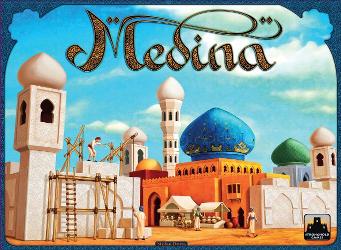
Os jogadores reconstroem uma medina norte-africana em 1822, colocando peças de madeira para erguer palácios, expandir o mercado e reparar as muralhas da cidade. A cada turno, o jogador coloca duas peças (ou não coloca nenhuma, usando uma ficha de chá), adicionando-as a edifícios coloridos já existentes ou começando novos, além de expandir elementos compartilhados, como o poço e as muralhas, que crescem a partir dos cantos do tabuleiro. A pontuação atribui pontos pelos edifícios reivindicados (um ponto por peça anexada), bônus de maioria pelo maior edifício de cada cor, recompensas por palácios ao redor do poço e um bônus para o jogador que conectou um edifício às muralhas mais recentemente. O jogo inclui muitos componentes detalhados de madeira e um tabuleiro dupla face para acomodar diferentes quantidades de jogadores.
- Jogadores
- 2–4 melhor com 4
- Tempo de jogo
- 60 min
- Idade
- 10+
- Complexidade
- 2,4 / 5
Sobre o jogo
- Design


Expansões
Ver na Ludoya
Nas mesas da Ludoya
Todas as estatísticas na Ludoya- 32
- Partidas registradas
- 43
- Jogadores
- 1h 23m
- Partida média
- 13
- Em ludotecas
- 9
- Em listas de desejos
6,2/10
de 13 avaliações na Ludoya
Garfield7,0 #31 Beautiful looking game with interesting decisions to make. [c] Theme: ★☆☆☆☆ <!-- size 7]Very little, very abstract --> Gameplay: ★★★☆☆ <!-- size 7]Playing different tiles --> Interaction: ★★★★★ <!-- size 7]Who plays where and claims a palace --> Artwork: ★★★☆☆ <!-- size 7]Only the board has artwork --> Luck: ★☆☆☆☆ <!-- size 7]No luck involved --> Strategy: ★★★★☆ <!-- size 7]When and where to claim --> Components: ★★★★☆ <!-- size 7]Beautiful wooden (but cheap wood) components --> Play duration: ★★★★★ <!-- size 7]Perfect (78min) --> Easy to teach: ★★★★☆ <!-- size 7]Quite easy (15min) --> Rules quality: ★★★★☆ <!-- size 7]Very good --> Setup time: ★★★★☆ <!-- size 7]Fast --> No downtime: ★★★☆☆ <!-- size 7]Little Downtime --> Replay value: ★★☆☆☆ <!-- size 7]Not much variety --> [/c]
Nenhuma partida registrada
Evan4,0 In this game everyone gets an even share of bricks in each of the four colors, and an even share of the neutral colored pieces and a set of four player colored claim markers. On your turn you place 2 of your pieces. Once a player uses one of their two placements to put down a claim marker on a contiguous blob of colored bricks, the structure can no longer be added to by any player and that player can no longer claim a structure of that color. In this way players slowly build the board up. Essentially, it's an abstract push your luck game. Do you money up an area or claim it for yourself? There are some interesting placement rules such as two blobs of bricks can never touch each other, even via diagonals, which means the first few rounds things feel uselessly empty, and in the last few rounds things are claustrophobicly tight. The neutral pieces are also interesting because they too have specific placement rules, and they essentially money up bricks they are next to. So, claim things too early, and someone will beat you out for the 'most bricks of X color' tile, and make sure your stuff isn't near the neutral scoring pieces. Claim things too late, and you'll be severely limited by space and other players aggressive moves to clog your area. This game winds up being fairly AP heavy since it's both mathy and players don't get much to go on in terms of how to value things. It also doesn't feel very satisfying since it's going to usually be other people claiming your work, and you claiming their work. It's a game where it seems like it feels like things just happen and you hope for the best and your success or failure relies heavily on the player to your right setting you up more than the player to their right set them up. ★ Art, Iconography and components functional ★ Clever or interesting mechanisms ☆ Reasonably low downtime between turns with mildly AP players ☆ Multiple plays stay interesting ☆ Low or mitigatable luck elements ★★☆☆☆ Raw enjoyment
Primeiras impressões · 2 partidas






Grátis, na web, Android e iOS
Jogue Medina (Second Edition) com a Ludoya
- Tenha na sua ludotecaAcompanhe sua cópia e suas expansões, empreste para os amigos ou coloque na lista de desejos e seja avisado quando o preço cair.Adicionar à sua ludoteca
- Registre cada partidaPontuações, vencedores, cronômetros e fotos, e depois suas estatísticas: taxa de vitórias, número de jogadores favorito, melhor pontuação.Registrar uma partida
- Marque os pontos sem papelUse as folhas de pontuação e os ajudantes de jogo da comunidade e deixe a Ludoya somar os pontos.Encontrar folhas de pontuação
- Encontre gente para jogarClubes, noites de jogos e eventos perto de você que levam este jogo para a mesa.Ver eventos
Dados do jogo (jogadores, tempo de jogo, idade, créditos) do BoardGameGeek.