
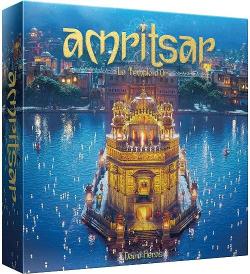
2023 · Construction de territoires
Amritsar: Le Temple d'Or
Players act as advisors and patrons helping the Maharaja rebuild a sacred temple in historical Amritsar. Gameplay revolves around a mancala-style sowing mechanic: move workers and an elephant to perform 1–3 actions per turn, such as gathering stone and market resources, advancing on knowledge tracks, upgrading a personal board, and calling on the mahout for special help. Donations to the temple convert resources into prestige, which determines the winner at game end. Strategic coordination of workers and timing of actions drives efficiency and point scoring.
- Joueurs
- 1–4 idéal à 3
- Temps de jeu
- 60–120 min
- Âge
- 14+
- Complexité
- 3,3 / 5
À propos du jeu
- Auteurs
- Illustration
- Publisher


Photos des tables de Ludoya
Toutes les photos dans Ludoya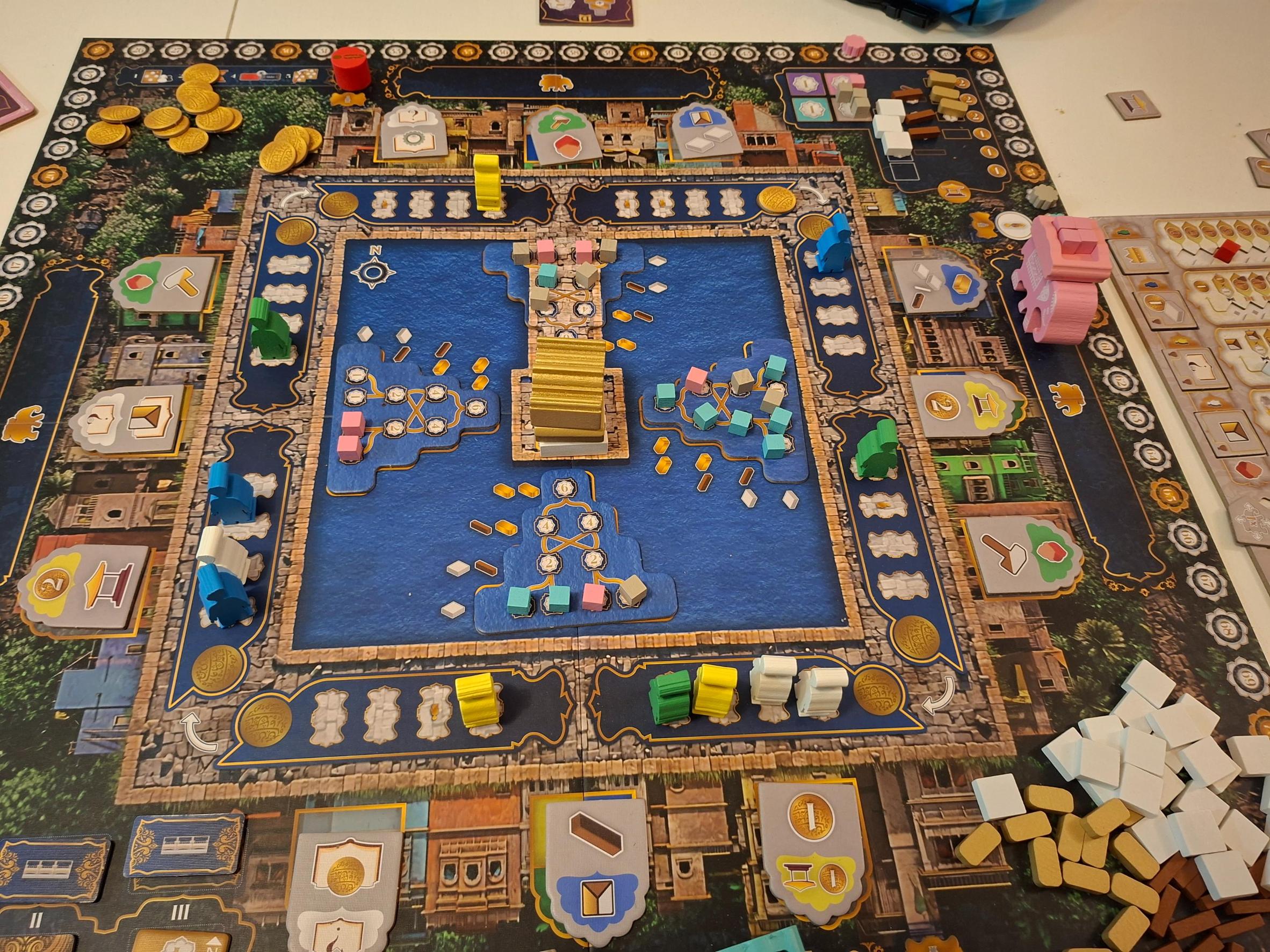
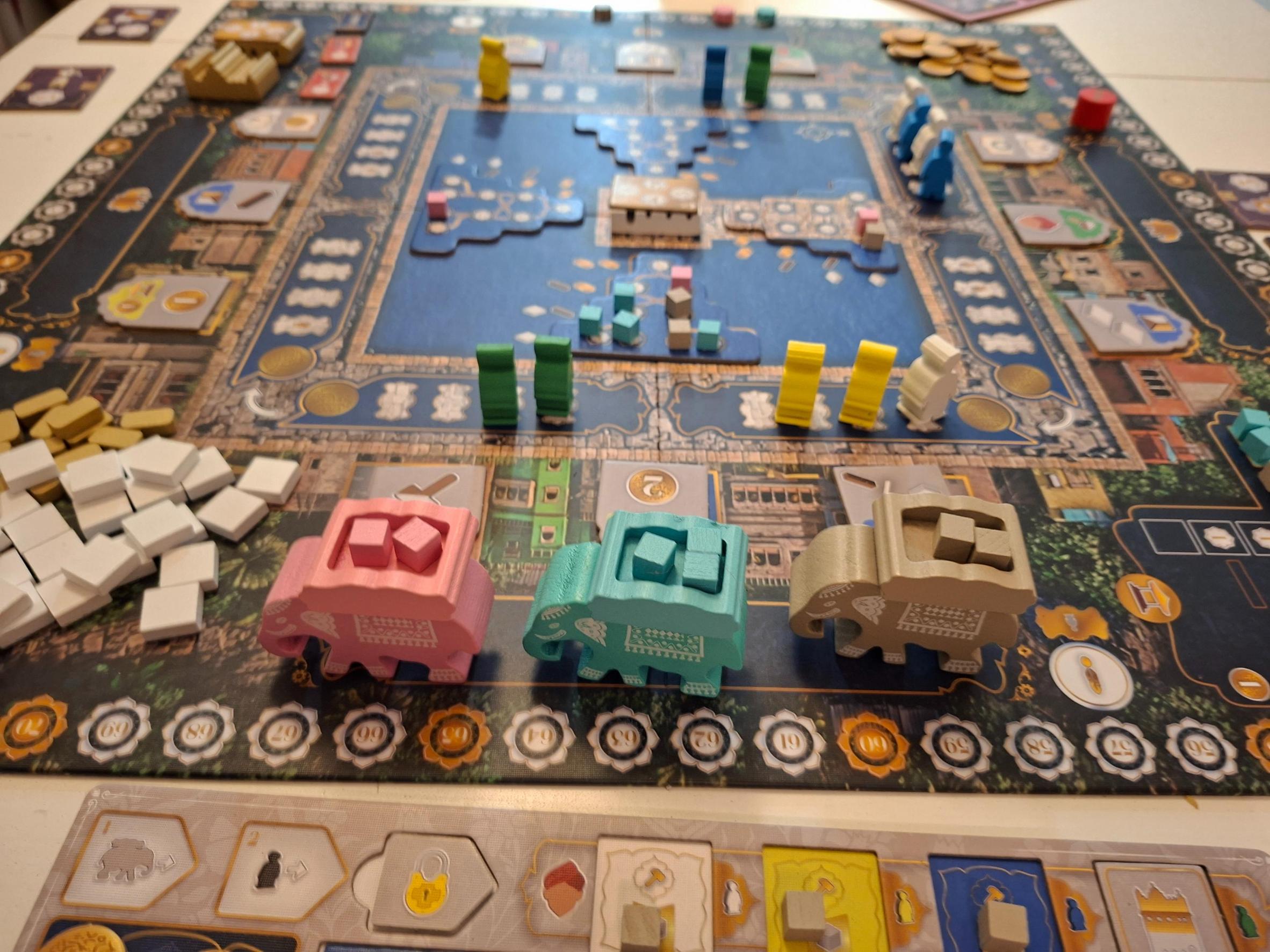
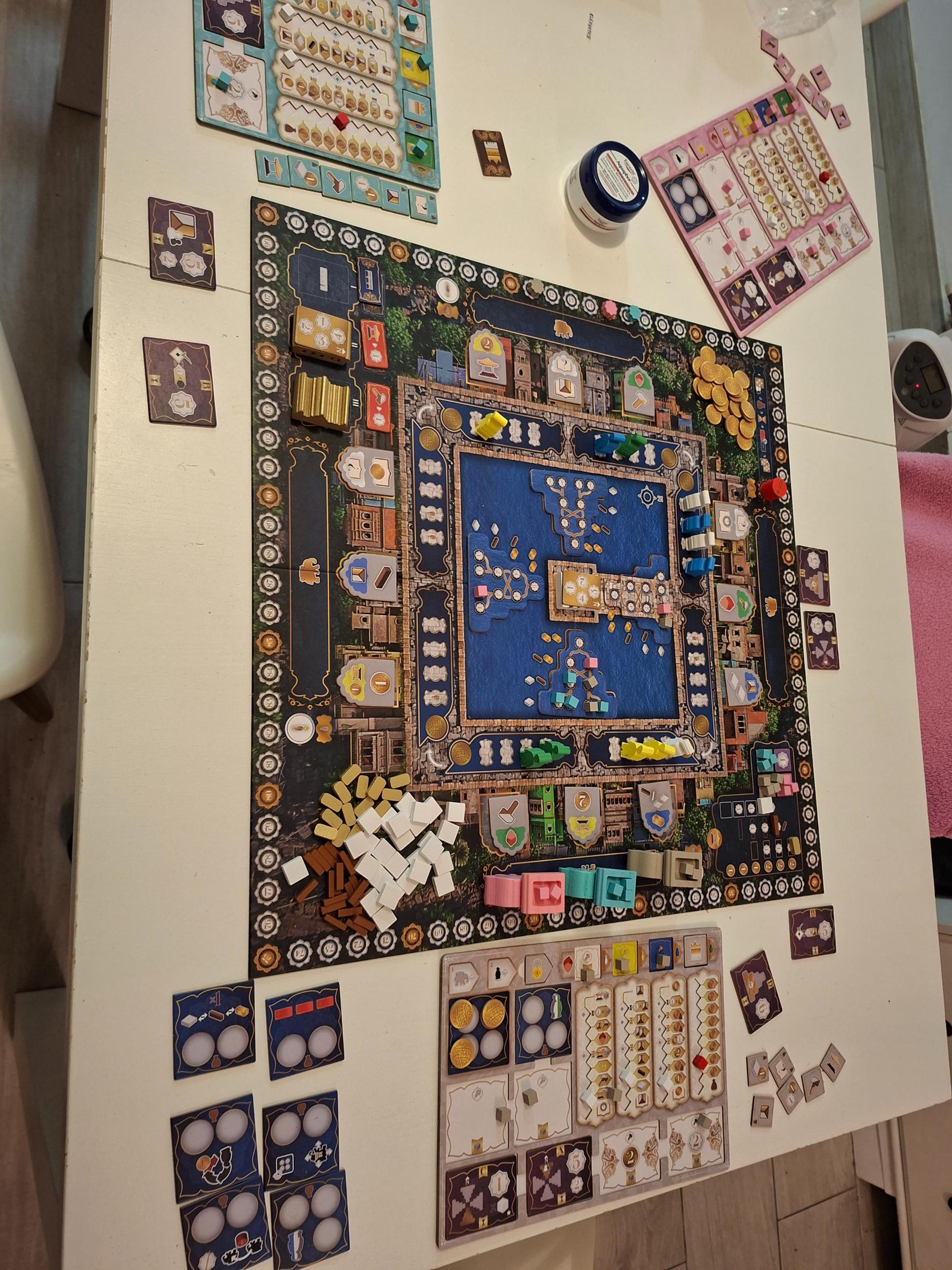
Où l'acheter
Prix des boutiques et exemplaires d'occasion, vérifiés chaque jour.
Sur les tables de Ludoya
Toutes les statistiques dans Ludoya- 143
- Parties enregistrées
- 193
- Joueurs
- 1h 50m
- Partie moyenne
- 66
- Dans des collections
- 12
- Dans des listes de souhaits
6,6/10
sur 29 avis Ludoya
Euro de mayorías con mecánica mancala y subetracks muy molón.
Garfield2,0 Mechanisms works, but this has a heavy AP warning on it! You can't plan ahead because the turn before yours can change much. Avoid playing it at 4 at all costs. Waiting time can be 10min between turns. Just mechnisms salad but it's not that fun.
Ddavebowman6,0 eladva


Questions de règles
Réponses tirées du livret par l'assistant de règles de Ludoya.
Do elephants and workers move on the same part of my turn, or are they separate?
They are separate: your turn has Phase 1 (optional) to move your Elephant, Phase 2 (obligatory) to move Workers, and a possible Phase 3 Elephant move only if you unlocked the Movement Token on your board (see p.5–6).
If the active player uses a Worker colour I also have a Mahout for, can I copy their action?
Yes — immediately after the active player finishes, other players clockwise may ‘follow’ and perform the Mahout action matching that Worker colour if they have it on their board; the active player scores 1 PP per follower (p.7).
Where and how can I make donations to the Temple?
You can only make donations using a Mahout Tile and only in the District where your Elephant is located; Donation Tiles have 4 Levels with specific resource costs and higher-Level spaces require the two spaces below to be occupied, and you gain PP as described when placing a Counter (p.5).
Can I buy and sell the same Resource type during the same turn or market action?
No — on the same turn you cannot buy and sell the same type of Resource, even if you perform multiple Market actions; also any Market action where you buy or sell grants a Donation Counter from your Market space to your Elephant (p.9).
Are Storehouse benefits one-time or permanent?
Acquired Storehouses can grant an immediate benefit (taken when you add that Storehouse) and/or a permanent benefit that applies for the rest of the game; your Starting Storehouse has no benefit (p.12).
When I move up a Knowledge track do I get its benefit right away or later?
You get the Benefit shown for the step immediately when you move up a Knowledge track; additionally the rules list special End-of-Decade and End-of-Game Knowledge effects that apply at those times (p.11).
Jeux similaires
 Terracotta Army: L'armée de terre cuite2022
 Satori2023
 Pilgrim2022
 Teotihuacan: City of Gods – Deluxe Master Set2024
 Baghdad: The City of Peace2025
 Small City: Deluxe Edition2023
 Ostia2022
 Tawantinsuyu: L'empire Inca2020
 Paladins du Royaume de l'Ouest2019
 Orloj2026
 Papyria2026
 Great Western Trail: Argentine2022







Gratuit, sur le web, Android et iOS
Jouez à Amritsar: Le Temple d'Or avec Ludoya
- Gardez-le dans votre collectionSuivez votre exemplaire et ses extensions, prêtez-le à vos amis ou ajoutez-le à votre liste de souhaits et soyez prévenu quand le prix baisse.Ajouter à votre collection
- Enregistrez chaque partieScores, gagnants, minuteurs et photos, puis vos statistiques : taux de victoire, nombre de joueurs préféré, meilleur score.Enregistrer une partie
- Réglez les questions de règlesPosez n'importe quelle question sur les règles et obtenez une réponse tirée du livret, avec la page pour vérifier.Demander à l'assistant de règles
- Trouvez des gens avec qui y jouerClubs, soirées jeux et événements près de chez vous qui mettent ce jeu sur la table.Voir les événements
Données du jeu (joueurs, durée, âge, crédits) issues de BoardGameGeek.