
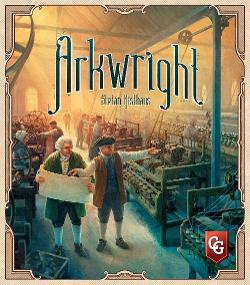
2014 · Economico
Arkwright
Players manage multiple textile factories in late-18th-century England, hiring workers, buying machines and upgrading technical levels to increase output and product quality. On each turn players place limited action tokens on an administration board and pay varying administration costs to build, modernize, hire, improve quality, set prices and secure shipping contracts. Labor costs are paid and one factory type produces each round; sales success depends on price, quality and promotional effort, and exported goods require a contract with the East India Company. Share ownership and share value determine victory after several rounds, so players balance production, market positioning and share purchases while reacting to opponents and revealed events.
- Giocatori
- 2–4 ideale in 4
- Tempo di gioco
- 120–240 min
- Età
- 12+
- Complessità
- 4,6 / 5
Il gioco
- Autori
- Illustrazioni
- Editori




Espansioni
Vedile in Ludoya

Foto dai tavoli di Ludoya
Tutte le foto in Ludoya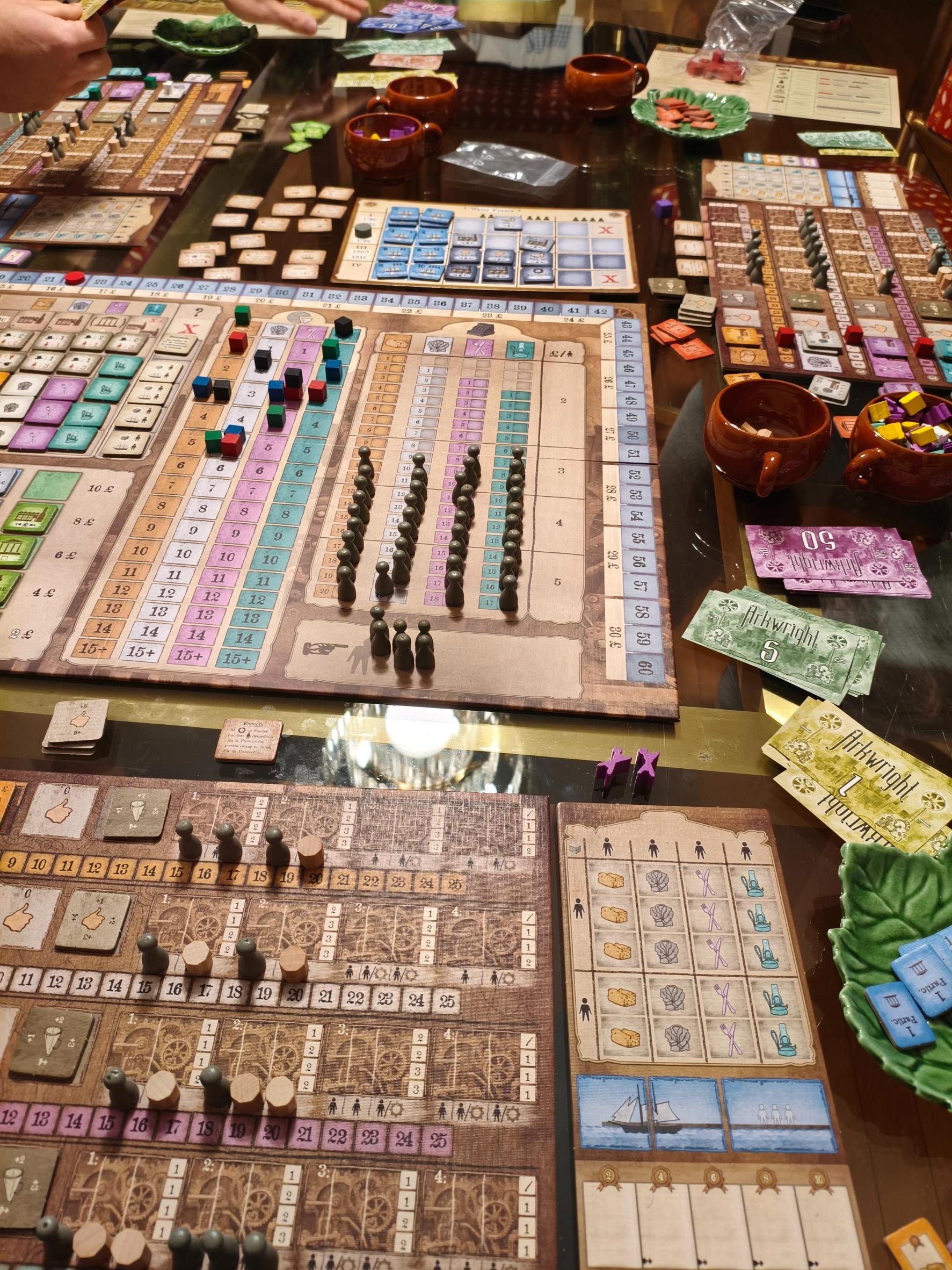
Dove comprarlo
Prezzi dei negozi e copie usate, controllati ogni giorno.
Sui tavoli di Ludoya
Tutte le statistiche in Ludoya- 73
- Partite registrate
- 108
- Giocatori
- 3h 50m
- Partita media
- 55
- Nelle ludoteche
- 18
- Nelle liste dei desideri
4,9/10
da 20 recensioni Ludoya
Evan1,6 In our first play, setup and rules started at 7:30 and ended at 11. For that much rules burden, this game needed to be a lot more compelling. Overall the game is fine. The general idea is you build and operate factories to produce goods, which you sell in one of two places, generating you money or money + stock value. You start the game with a certain amount of stock in yourself, and the key to the game is getting enough money to buy more of your own stock. It's extremely chartsy, which is a little dull, but ultimately fine. The game itself with 4 players went from around 11 til a little after 4am. Over the course of the game, there are decisions to be made, but I didn't feel like I had any difficult decisions. Mostly what you are doing is minimizing your costs and improving your output through upgrade actions, and then just lining up your sell actions fairly solitary and fairly robotically. The method by which goods are produced is a very fiddly process, which isn't great. Component wise the game is overall fine, although the upgrade tiles seem needlessly small and hard to read. The rulebook is also written very confusingly. Many times we had to check boardgamegeek or read the examples in the rulebook to have any idea about what was supposed to be happening. Despite all the time we spent going over the rules, I wound up taking a massive penalty in the last round because of a edge case scenario where you have to pay money if literally all the workers are gone when factories depreciated. Despite all the time we had put into the rules, we didn't read this one somehow, so I had no idea that this was going to happen or else I would have avoided the situation. It removed any hope I had of doing ok, which stung since I didn't have control of how many guys were in the worker pool. All this taken into consideration, I have to compare this to other longer games that I do like, and each of those games manages to capture some magic or excitement that this game just lacks. The player interaction here is low, there are decisions to be made, but none are particularly difficult or interesting, and of course there's no pretense at theme happening here, which isn't necessary but can sometimes carry a game like this. Overall, the game is fine and competent, just not worth the time investment to learn and play. :nostar: Art, Iconography and components functional :nostar: Clever or interesting mechanisms :star: Reasonably low downtime between turns with mildly AP players :nostar: Multiple plays stay interesting :star: Low or mitigatable luck elements :star::nostar::nostar::nostar::nostar: Raw enjoyment
setropo8,0 ECDE #14
halbert827,0 Essen'14 Joc econòmic de fabricació i venta de mercaderies al mercat. Les regles de oferta-demanda son molt interesants funcionen a la perfecció. El joc té poques accions disponibles, i pot existir alguna estrategia que sigui més potent que altres (vendre totes les accions al inici i fer baixar el preu al mínim mitjançant l'exportació per comprar el màxim d'accions possibles cap al final de la partida). A més, hi han losetes de "poder" especial molt bones i que provoquen que el joc giri al voltant d'elles (qui la deixa disponible i quan).

Domande sulle regole
Risposte tratte dal regolamento dall'assistente per le regole di Ludoya.
How many goods can I sell on the home market during the Production phase?
Your selling quantity is the lesser of your production (plus any goods taken from that factory’s warehouse) and the market limit: appeal minus demand; you cannot sell more than your appeal and you sell up to that allowed amount (see page 18).
If I didn’t produce the active good this round, can I still sell goods from my warehouse to the home market?
No — players who do not have a factory that produces the active good skip the Production phase entirely, so you may not sell to the home market in that round (see page 18).
Do ships have to be fully loaded, how many can I use, and how do I reactivate them?
Ships do not have to be fully loaded and you may only ship the active good; the basic shipping card provides 2 ships and you flip/use them as you ship, then reactivate used ships only during the Stock Exchange action (reactivate ships) (see pages 20 and 14).
Can I take bank loans to pay production costs if I don’t have enough cash?
No — you may not take bank loans during production; if you lack funds you must use the emergency fund which gives only half the current share value per loan token, and if you run out of loan spots you can be declared bankrupt and eliminated (see page 20, and loans explanation on page 14).
What happens when I employ workers — do wages or demand change for everyone?
After adding one or more worker cards you move the demand marker for all four goods one step (increasing demand) and move the wages marker one step to the right regardless of how many workers you added (see page 11).
Can I add, flip or move quality/distribution cards between factories and are there limits?
You may add, flip, rotate, remove or swap quality/distribution cards between your factories or reserve subject to development-level limits; each factory’s distribution and quality max is normally 4 (quality max 6 with Engineer), you may not add quality and distribution in the same turn, and distribution on a producing factory is reduced by 1 after production (see pages 12–13 and 21).












Gratis, sul web, Android e iOS
Gioca a Arkwright con Ludoya
- Tienilo nella tua ludotecaTieni traccia della tua copia e delle sue espansioni, prestala agli amici o mettila nella lista dei desideri e ricevi un avviso quando il prezzo scende.Aggiungilo alla tua ludoteca
- Registra ogni partitaPunteggi, vincitori, timer e foto, poi le tue statistiche: percentuale di vittorie, numero di giocatori preferito, miglior punteggio.Registra una partita
- Risolvi i dubbi sulle regoleChiedi qualsiasi cosa sulle regole e ottieni una risposta dal regolamento, con la pagina per verificarla.Chiedi all'assistente per le regole
- Trova persone con cui giocarloClub, serate di gioco ed eventi vicino a te che portano questo gioco in tavola.Vedi gli eventi
Dati del gioco (giocatori, durata, età, crediti) da BoardGameGeek.