
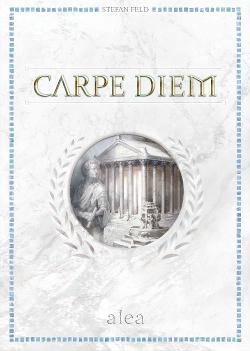
2018 · Antichità
Carpe Diem
I giocatori assumono il ruolo di ricchi patrizi nell’antica Roma e scelgono tessere per costruire un quartiere cittadino composto da ville, giardini ed edifici pubblici. A ogni turno, selezionano azioni da un tabellone condiviso per la costruzione di schemi, piazzano tessere, ampliano i quartieri e conquistano carte punteggio che stabiliscono obiettivi personali. La gestione delle risorse è astratta attraverso il piazzamento e la disposizione delle tessere, con diversi percorsi di punteggio e scelte tattiche che danno forma a strategie differenti. Il gioco enfatizza la pianificazione spaziale e il tempismo, mentre i giocatori fanno a gara per soddisfare le carte punteggio e massimizzare i punti prestigio entro la fine della partita.
- Giocatori
- 2–4 ideale in 3
- Tempo di gioco
- 45–75 min
- Età
- 10+
- Complessità
- 2,5 / 5
Il gioco
- Autori
- Illustrazioni


Espansioni
Vedile in Ludoya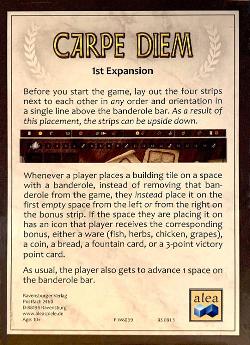
Dove comprarlo
Prezzi dei negozi e copie usate, controllati ogni giorno.
Sui tavoli di Ludoya
Tutte le statistiche in Ludoya- 411
- Partite registrate
- 380
- Giocatori
- 1h 5m
- Partita media
- 139
- Nelle ludoteche
- 14
- Nelle liste dei desideri
- 1
- Preordinato
6,3/10
da 72 recensioni Ludoya
Garfield2,0 Puzzle game, where you can get really frustrated because someone takes exactly the tile you need, and this can happen several times. No theme at all. And I really don't like the mechanism where the first one on a specific track can choose first what goals he can fulfill and the last one has to take what remains. Another Feld I don't like... [c] Theme: ★☆☆☆☆ <!-- size 7]No --> Gameplay: ★★☆☆☆ <!-- size 7]Move, get tiles, place them, nothing else --> Interaction: ★★☆☆☆ <!-- size 7]Just that others taking tiles you wanted --> Artwork: ★☆☆☆☆ <!-- size 7]Very ugly --> Luck: ★★☆☆☆ <!-- size 7]Very little --> Strategy: ★★★☆☆ <!-- size 7]Try to fulfill target cards, nothing more --> Components: ★★☆☆☆ <!-- size 7]Nothing special --> Play duration: ★★★★☆ <!-- size 7]At least it's over very fast --> Easy to teach: ★★★☆☆ <!-- size 7]Ok (25min) --> Rules quality: <!-- size 7]not read --> Setup time: ★★★★☆ <!-- size 7]Quite fast --> No downtime: ★★★★☆ <!-- size 7]Plays quite fast --> Replay value: ★★☆☆☆ <!-- size 7]Random placement of tiles --> [/c]
Evan4,6 In this game players zip around the central board following the lines to collect tiles that get added to your personal board. Completing features produce bonuses, then at the end of the round you place a score marker in an empty space between two cards, and score both cards. If for some reason you don't meet their requirement, you suffer a point penalty instead. At the end of the game you also score points if your features straddle certain row or column lines as dictated by the printed spaces on your starting setup border tiles. There's a little more luck in this game than I'd like. There's a degree of luck in terms of which tiles flip to what sections. Then more in terms with how that lines up with the victory card requirements on display. Then more when you place the secret goal card building, and draw 2 discard 1. There's mitigation in that some buildings produce gold which is a wild resource, and bread, which when you have enough of it, you can just pretend to meet the requirements of a card that you don't meet. It's just that tiles get snatched up so quickly from the pools that it can be difficult to have and then carry out any specific plans. This gets tough additionally when it's often enough penalty to not complete your feature, but then it can also cause you to have to place your scoring marker where suddenly you're getting a penalty because you relied on getting a single chicken tile for example, and none came up in that round. It also can feel a little harsh since scoring order is reliant on a victory points track at the bottom of the board, where the player with the most points gets first pick of scoring space. If someone ahead of you on that track is going for the same space you need, you might just be out of luck in that right as well. Overall I liked the experience of playing the game, it just felt a little too harsh for the kind of experience I look for. The kind of punchyness where there's no ability to really respond to counter-move your opponents, where it can feel like you get slapped twice for each setback. ☆ Art, Iconography and components functional ★ Clever or interesting mechanisms ★ Reasonably low downtime between turns with mildly AP players ★ Multiple plays stay interesting ★ Low or mitigatable luck elements ★★☆☆☆ Raw enjoyment
Review incoming. We love this one, a light salad point game, playable within 30 minutes (2p) or 40min (3p) once rules ok for all players. And with a really challenging deep proposal. 1 point less for the box artwork that tastes really oldy !

Domande sulle regole
Risposte tratte dal regolamento dall'assistente per le regole di Ludoya.
Devo per forza spostare il mio meeple a ogni turno, oppure posso restare fermo?
Devi muovere il tuo meeple a ogni turno — non შეგიძლ you can’t stay dove sei (eccezione indicata a pagina 7). L’unico modo per rimanere (o per muoverti in qualsiasi spazio) è pagare 1 pane all’inizio del tuo turno tramite l’abilità del Panettiere (pagina 4; Panettiere, pagina 7).
Cosa succede se mi muovo in uno spazio che non ha tessere edificio adiacenti?
Se ti muovi su uno spazio semicircolare senza tessere edificio adiacenti, ti muovi immediatamente di nuovo (seguendo le regole di movimento) finché non atterri su uno spazio con almeno una tessera accanto (pagina 4).
Come devo posizionare le tessere edificio — posso ruotarle o piazzarle in diagonale?
La prima tessera deve andare sullo spazio della pala e tutte le tessere successive devono essere posizionate ortogonalmente adiacenti (non in diagonale) a una tessera già presente; puoi ruotare liberamente le tessere, ma ogni lato a contatto deve combaciare (laghetto con laghetto, erba con erba, ecc.), e la cornice conta come ‘erba’ (pagina 5).
In una partita a 2 o 3 giocatori, quando vengono rimosse le tessere dal tabellone e non vengono usate?
Nella partita a 2 giocatori, le ultime due tessere su uno spazio vengono rimosse non appena viene presa la seconda tessera; nella partita a 3 giocatori, l’ultima tessera rimasta su uno spazio viene rimossa non appena viene presa la penultima tessera — rimettete le tessere rimosse nella scatola (pagina 5).
Posso usare il pane per evitare o soddisfare i requisiti di punteggio?
Sì — il pane ha due usi: spendi 1 pane all’inizio del tuo turno per muoverti (o restare) ovunque tramite il Fornaio, e spendi 3 pani durante il punteggio per soddisfare il requisito di una carta punteggio (funziona sia per le carte verdi “possedere” sia per le rosse “pagare”), così ricevi i premi di quella carta senza soddisfare il requisito stampato (pagina 7; carte punteggio, pagina 9).
E se non riuscissi a soddisfare بالكامل i requisiti di una carta punteggio — prendo punti parziali?
Se non riesci a soddisfare completamente i requisiti di una carta punteggio, non ottieni punti da quella carta e invece perdi 4 punti vittoria (quindi puoi perdere fino a 8 PV in un round di punteggio se entrambe le carte falliscono); scegli tu l'ordine in cui risolvere le tue due carte (pagina 10).
















Gratis, sul web, Android e iOS
Gioca a Carpe Diem con Ludoya
- Tienilo nella tua ludotecaTieni traccia della tua copia e delle sue espansioni, prestala agli amici o mettila nella lista dei desideri e ricevi un avviso quando il prezzo scende.Aggiungilo alla tua ludoteca
- Registra ogni partitaPunteggi, vincitori, timer e foto, poi le tue statistiche: percentuale di vittorie, numero di giocatori preferito, miglior punteggio.Registra una partita
- Risolvi i dubbi sulle regoleChiedi qualsiasi cosa sulle regole e ottieni una risposta dal regolamento, con la pagina per verificarla.Chiedi all'assistente per le regole
- Trova persone con cui giocarloClub, serate di gioco ed eventi vicino a te che portano questo gioco in tavola.Vedi gli eventi
Dati del gioco (giocatori, durata, età, crediti) da BoardGameGeek.