
2017 · Industrie / Herstellung
Agra
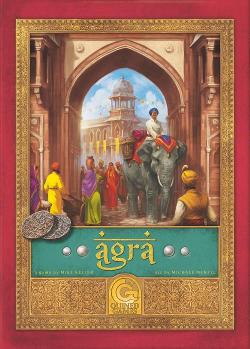
Im Nordindien des 16. Jahrhunderts, während der prunkvollen Geburtstagsfeierlichkeiten am Mogulhof, schlüpfen die Spieler in die Rolle rivalisierender Landbesitzer, die nach Status und Gewinn streben. Die Spieler verwalten Anwesen, die Baumwolle, Kurkuma, Holz und Sandstein produzieren, und verarbeiten sowie handeln diese Ressourcen dann, um höherwertige Waren zu erwerben. Waren und Einfluss werden ausgegeben, um Würdenträger und Gesandte anzulocken, die durch die Hauptstadt reisen, während konkurrierende Spieler um dieselben Chancen wetteifern. Das Gameplay dreht sich um Ressourcenmanagement, Handel und taktische Platzierung, um Einkommen und Ansehen zu maximieren, bevor die Feierlichkeiten zu Ende gehen.
- Spieler
- 2–4 am besten mit 4
- Spielzeit
- 90–120 Min.
- Alter
- 12+
- Komplexität
- 4,3 / 5
Über das Spiel
- Autoren
- Illustration
- Publisher


Erweiterungen
In Ludoya ansehen

Wo kaufen
Shop-Preise und gebrauchte Exemplare, täglich geprüft.
An Ludoyas Tischen
Alle Statistiken in Ludoya- 98
- Erfasste Partien
- 96
- Spieler
- 1h 46m
- Durchschnittliche Partie
- 38
- In Sammlungen
- 2
- Auf Wunschlisten
5,4/10
aus 19 Ludoya-Rezensionen
Evan4,6 Agra is a worker placement game where you place your workers on the central board's spaces to produce resources, or on the figures at the top to resolve their special actions. The resources can be sent by various methods to fill orders, which gets you some combination of money and reputation. Reputation then in turn increases the amount you get on future deliveries. The game is nearly devoid of luck. Every feature of the game is laid out at the very start, so the only thing in the way of you and your path is your own mistakes and the actions of other players. Unlike most worker placement games where you have to earn new workers, this game gives you a huge pile of workers right at the start, however they don't come back to you until someone else uses that space. There's also a possibility that you also get bonus marker when you get booted that can be spent on special free actions. The goods in the game have an interesting mechanism where they sit on the central board in the building space that produced them, and then there are upgrade arrows leading to refinement buildings. Once you have the basic goods, and the refinement buildings are constructed, you can resolve an action to move those goods along the arrow making them more valuable in their refined form. Refining these goods also allows for other players to follow you which generated more bonus action markers for the active player. I absolutely love this mechanism. The AP can be high in this game. The graphic design is also not great. Component wise, the game comes with this odd angled platform that tracks who delivered what to where, and it's easily jostled causing the tracking tokens to roll out. On the main board, the arrows that track the resource upgrade path are interrupted by the art so that the arrows can be shown going through an underpass or some such, which makes it slightly annoying to track what's connected to where when the board gets busy. There's also a boatman piece that tracks when new cards become available to send goods to, and along the river there are printed indicators as to when he moves. There's a spot where it shows two completed icons which indicates 2 completed cards in total instead of what we thought it meant, which was 2 more completed cards. More troubling, there's a glut of mechanisms in this game which amount to being a bit too much. There are powerful action cards you can gain by delivering the most goods to, but the way they are sent to and evaluated is a bit convoluted. There's also an special pawn that wanders the board moneying up action spaces, which ultimately works out to be just extra fiddle, as it doesn't seem to add much in terms of choosing what to go for and when. I think the extra rulesiness would be forgivable if the graphic design was cleaner, but when put in combination, it becomes a bit too much for me to want to get this back to the table with any regularity. :star: Art, Iconography and components functional :star: Clever or interesting mechanisms :nostar: Reasonably low downtime between turns with mildly AP players :star: Multiple plays stay interesting :star: Low or mitigatable luck elements :star::star::nostar::nostar::nostar: Raw enjoyment
Viciados6,0 Game takes hours to play. Bad for overthinkers like me. You will feel overwhelmed. Too many rules and options in the turn. Many many ways to win, not easy to know where you are. For me, the worst part is the board design. It is huge, no contrast, lines and spaces are no clear, icons small. Visually it's great but the game doesn't need a board this huge and confusing. and iconography is so vast that you normally end up looking at the manual. I had to create my summary in 6 handwritten pages to put together rules..., the manual is good, but some rules are just hard to remember and sometimes you notice something you didn't know about. Also I still have many questions about the rules, so many rules that are not clear. It's a good game, extremely complex in terms of paths but as the box says...30 minutes per player!!! Impossible. It takes around 3 hours for a 2 person game.














Kostenlos, im Web, für Android und iOS
Spiel Agra mit Ludoya
- Hab es in deiner SammlungVerwalte dein Exemplar und seine Erweiterungen, leih es Freunden oder setz es auf deine Wunschliste und erfahre, wenn der Preis fällt.Zur Sammlung hinzufügen
- Erfasse jede PartiePunkte, Sieger, Timer und Fotos, dann deine Statistiken: Siegquote, liebste Spielerzahl, beste Punktzahl.Partie erfassen
- Werte ohne PapierNutze die Wertungsbögen und Spielhelfer der Community und lass Ludoya die Punkte zusammenzählen.Wertungsbögen finden
- Finde Leute, mit denen du es spielstClubs, Spieleabende und Veranstaltungen in deiner Nähe, bei denen dieses Spiel auf den Tisch kommt.Veranstaltungen ansehen
Spieldaten (Spieler, Spielzeit, Alter, Mitwirkende) von BoardGameGeek.