
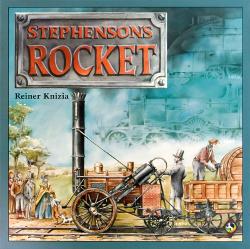
1999 · Transport
Stephensons Rocket
Es ist der Beginn des Dampfzeitalters: Die Spieler bauen konkurrierende Eisenbahngesellschaften im England der frühen 1800er-Jahre aus. Sie legen Gleisplättchen, verwalten Anteile und können gegen einen Preis die Erweiterungen anderer Spieler verhindern. Wenn Eisenbahnstrecken aufeinandertreffen, fusionieren sie zu einem einzigen Unternehmen. Das Spiel endet, wenn nur noch ein Unternehmen übrig ist oder keine Gleisplättchen mehr vorhanden sind. Wer das meiste Geld verdient, gewinnt.
- Spieler
- 2–4 am besten mit 4
- Spielzeit
- 60–90 Min.
- Alter
- 12+
- Komplexität
- 3 / 5
Über das Spiel
- Autoren




Erweiterungen
In Ludoya ansehen
Wo kaufen
Shop-Preise und gebrauchte Exemplare, täglich geprüft.
An Ludoyas Tischen
Alle Statistiken in Ludoya- 21
- Erfasste Partien
- 38
- Spieler
- 1h 30m
- Durchschnittliche Partie
- 13
- In Sammlungen
- 6
- Auf Wunschlisten
5,4/10
aus 8 Ludoya-Rezensionen
andycted8,3 Convoluted scoring gives this semi-light game quite some complication to raise to a medium weight. The stock/veto mechanics is pretty interesting. For a Knizia, you need more time than usual to grasp it. Nice interaction filled take on Acquire mixed with other Knizia stuff
5-mal gespielt
Evan4,0 This game is similar to Chicago Express or American Rails, or any of those games where players are laying track, buying stocks in companies and trying to connect those companies to cities to improve their value for endgame scoring. The things that make this game stand out are the way if one rail line runs into another it scores one last time for the player with the most shares, then it dissolves and becomes a part of the company it ran into, with players trading 2 shares in the dissolving company for 1 in the new one. This creates some odd opportunities as players get large point rewards for having the most of their station markers on a line when the line connects to something new, so expanding a smaller line with lots of your markers, might eventually connect to and cause you to be in the lead for a longer line. General gameplay is a hassle however, as anyone's action to add a rail to a line can be contested by any player who holds shares in that line. They can bid shares to basically take your turn for you. It's interesting in theory, that the player with the most control might give up some of their lead to keep opponents from linking things in bad ways for their position, but I found this to really drag down the flow and fun of the game, at least as compared to this game's cousins. Scoring is also a hassle, as eventually everything connects to nearly everything else, so there's a lot of counting each time something touches something new, as you get credit for each location the line touches. As the train lines blob into each other, the downtime of counting this out grows more and more. Not unplayably bad, but I don't see ever wanting to play this over the other stocks and rails games. ★ Art, Iconography and components functional ☆ Clever or interesting mechanisms ★ Reasonably low downtime between turns with mildly AP players ★ Multiple plays stay interesting ★ Low or mitigatable luck elements ☆☆☆☆☆ Raw enjoyment
Erste Eindrücke · 1 Partie













Kostenlos, im Web, für Android und iOS
Spiel Stephensons Rocket mit Ludoya
- Hab es in deiner SammlungVerwalte dein Exemplar und seine Erweiterungen, leih es Freunden oder setz es auf deine Wunschliste und erfahre, wenn der Preis fällt.Zur Sammlung hinzufügen
- Erfasse jede PartiePunkte, Sieger, Timer und Fotos, dann deine Statistiken: Siegquote, liebste Spielerzahl, beste Punktzahl.Partie erfassen
- Werte ohne PapierNutze die Wertungsbögen und Spielhelfer der Community und lass Ludoya die Punkte zusammenzählen.Wertungsbögen finden
- Finde Leute, mit denen du es spielstClubs, Spieleabende und Veranstaltungen in deiner Nähe, bei denen dieses Spiel auf den Tisch kommt.Veranstaltungen ansehen
Spieldaten (Spieler, Spielzeit, Alter, Mitwirkende) von BoardGameGeek.