
2011 · Antigüedad
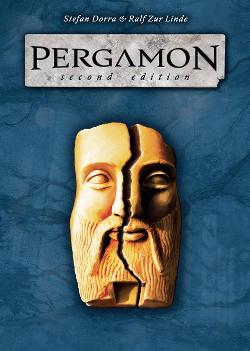
Pergamon
Los jugadores actúan como arqueólogos del siglo XIX que financian y llevan a cabo excavaciones alrededor de la antigua Pérgamo para reunir exhibiciones dignas de un museo. Cada ronda, los jugadores pujan por subvenciones federales de investigación, asignan fondos y envían expediciones a excavar fragmentos de artefactos, con una mecánica de primero en llegar, primero en excavar que favorece a quien llega antes y deja menos hallazgos para los jugadores posteriores. Las piezas recuperadas se ensamblan en vitrinas de exhibición que otorgan puntos de gloria; la partida se desarrolla a lo largo de un número fijo de rondas y requiere equilibrar las pujas, el orden de viaje y la gestión de recursos para maximizar el valor exhibido.
- Jugadores
- 2–4 mejor con 3
- Duración
- 45 min
- Edad
- 10+
- Complejidad
- 2,2 / 5
Sobre el juego
- Arte



En las mesas de Ludoya
Todas las estadísticas en Ludoya- 131
- Partidas registradas
- 108
- Jugadores
- 1h 4m
- Partida media
- 29
- En colecciones
- 5
- En listas de deseos
- 1
- En preventa
5,1/10
de 24 reseñas en Ludoya
Evan1,6 This is a push your luck game, where each round you position your meeple in a space along a line. Then cards flip which determines how much money is available, and players claim money in line order, with players to the front getting less, but more reliable payouts, and players in the back risking the possibility of getting more but maybe getting nothing if players ahead of them take everything. Then starting from the front of the line you can buy a set of tiles. The tiles are arranged in rows, with different spaces along the money line giving you access to different rows. The tiles have two half-features on them of various artifacts, and after everyone is done buying, in turn order each player can put on a display by arranging a line of completed artifacts. They then total the value of what they made and place a display marker on the chart in that same position. This is where my biggest problem with the game happens. When a player claims a new display, it devalues all other displays of equal or lower value by bumping them one lower on the track. If a player's marker falls off the back of the track, their set is removed. This is a bit frustrating as certain pieces are older than others, which scores a few bonus points during specific scoring phases where you look to see who has the oldest of a single type of artifact. Of course, if your artifact has been pushed off the score board, then it no longer counts, yet this doesn't seem like something you can plan for or against. Just something that happens over the course of the game. Despite the game being relatively short, it still outstays it's welcome for what I see as being a little bit too luck heavy and a little bit too punishing a game. :star: Art, Iconography and components functional :star: Clever or interesting mechanisms :star: Reasonably low downtime between turns with mildly AP players :nostar: Multiple plays stay interesting :nostar: Low or mitigatable luck elements :nostar::nostar::nostar::nostar::nostar: Raw enjoyment
Good filler with interesting mechanics of set collection. Has clever decisions and it's very enjoyable.










Gratis, en web, Android e iOS
Juega a Pergamon con Ludoya
- Tenlo en tu colecciónControla tu copia y sus expansiones, préstala a tus amigos o ponla en tu lista de deseos y te avisamos cuando baje de precio.Añadirlo a tu colección
- Registra cada partidaPuntuaciones, ganadores, temporizadores y fotos, y luego tus estadísticas: porcentaje de victorias, número de jugadores favorito, mejor puntuación.Registrar una partida
- Puntúa sin papelUsa las hojas de puntuación y ayudas de juego de la comunidad, y deja que Ludoya sume los puntos.Buscar hojas de puntuación
- Encuentra gente con quien jugarloClubes, noches de juegos y eventos cerca de ti que sacan este juego a la mesa.Ver eventos
Datos del juego (jugadores, duración, edad, créditos) de BoardGameGeek.