
2014 · Medieval
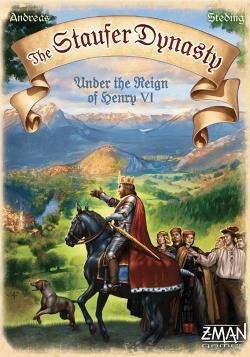
The Staufer Dynasty
Los jugadores asumen el papel de nobles del siglo XII que viajan con el emperador por seis regiones de su reino, colocando enviados y nobles para conseguir cargos e influencia. La partida dura cinco rondas; en cada ronda, cada jugador realiza tres acciones en el orden determinado por la colocación de los miembros de su familia. En una acción de suministro, un jugador toma figuras de un suministro y las lleva a su corte, además de reclamar un cofre del tesoro de ese espacio; los cofres tienen colores que otorgan puntos al final de la partida, puntos o figuras inmediatamente, bonificaciones de un solo uso o cartas de privilegio que modifican las acciones. En una acción de movimiento/despliegue, un jugador paga enviados para viajar alejándose del rey, ocupa un asiento de cargo pagando su coste y colocando figuras en el sentido de las agujas del reloj por las regiones, y reclama el cofre que hay bajo ese asiento. Después de cada ronda, una o dos regiones puntúan según la loseta de ronda: los jugadores obtienen puntos por las mayorías en los cargos y las bonificaciones de región, se retiran los ocupantes de la región puntuada, se vuelven a llenar los cofres y el rey avanza en el sentido de las agujas del reloj, recuperando los enviados por los que pasa. Tras cinco rondas, los jugadores puntúan los cofres del tesoro y los cargos secretos para determinar quién gana.
- Jugadores
- 2–5 mejor con 4
- Duración
- 90 min
- Edad
- 13+
- Complejidad
- 3 / 5
Sobre el juego
- Diseño
- Arte

Dónde comprarlo
Precios de tiendas y copias de segunda mano, revisados cada día.
En las mesas de Ludoya
Todas las estadísticas en Ludoya- 40
- Partidas registradas
- 55
- Jugadores
- 1h 33m
- Partida media
- 15
- En colecciones
- 2
- En listas de deseos
5,6/10
de 11 reseñas en Ludoya
Juego de control de áreas con unas reglas reguleras, no quedan claros ciertos puntos. El juego es de control de áreas y es una gran ensalada de puntos que aparenta una gran complejidad cuando al final solo puedes hacer dos cosas durante tu turno, todo te da bonus y todo sirve para darte puntos, aparte cada turno se van puntuando dos regiones por mayorías. El juego está bien diseñado y desarrollado y una vez que lo conoces es fácil de explicar y jugar, pero estoy cansado de buscar los patrones de puntuación en las ensaladas de puntos.
Primeras impresiones · 1 partida
Praxy8,0 This another great, lean and focus game from Andreas Steding. Only one resource and 2 possible actions, but such a depth behind where one can really try to plan ahead. Some of the gameplay remind me of Hansa Teutonica, I can't explain why but maybe I like it a bit less than Hansa Teutonica's master piece, but overall a great game.
Primeras impresiones · 1 partida
Evan4,0 In this game, you have 15 turns to get the most points possible by predicting which regions will score, when they will score, and how best to position yourself for bonus points from the three secret endgame cards in your hand. To do this, you have to take actions that grant you chests with useful powers, and then know when best to use the chests. On your turn, you make one simple choice. Get more guys, or place guys you have. This is not a game that gives you a turn to figure out things before stuff starts mattering; the clock is fierce. While the game has that puzzle like quality to it, the puzzle is not solvable, as you are competing with other players for chests, powers, and meeple spots. It's very easy to set up for something early and have it taken away from you through other player's moves, and since actions are so limited, you have little if any ability to make a counter move in response. Additionally, for the first four rounds of the game, when a region scores, every meeple in a scoring spot gets removed from the board, which means they are no longer lined up to help with your two endgame points. You only know half of the provinces that score each game for certain, the other half gets assigned if a certain criteria is met. This can get quite annoying if you are a person who likes having a plan and then following through with said plan. Of course in any area majority game, turn order can be very important. If you go first you might grab the exact spot with the exact chest you need. If you go last, you can be the determining factor which second region scores, or beat someone out for a majority. The problem here is that players who took 'get more meeple' actions in the previous round go earlier in the current one. Players who took actions on the board go later. This makes for a sort of boom/bust cycle where your turn order is more to do with when you have to take meeples, than it is about having a specific strategy. Since taking meeples is one of the few actions you get in a current round, it usually means it's best to just sort of pick a few rounds to sit out and just collect, and then a few rounds where you have all the guys and you do all the things. The ebb and flow of this is alright, and i'm sure I never manage it that well, but regardless it bothers me. ★ Art, Iconography and components functional ☆ Clever or interesting mechanisms ☆ Reasonably low downtime between turns with mildly AP players ★ Multiple plays stay interesting ☆ Low or mitigatable luck elements ★★☆☆☆ Raw enjoyment
Lo ha jugado 3 veces







Gratis, en web, Android e iOS
Juega a The Staufer Dynasty con Ludoya
- Tenlo en tu colecciónControla tu copia y sus expansiones, préstala a tus amigos o ponla en tu lista de deseos y te avisamos cuando baje de precio.Añadirlo a tu colección
- Registra cada partidaPuntuaciones, ganadores, temporizadores y fotos, y luego tus estadísticas: porcentaje de victorias, número de jugadores favorito, mejor puntuación.Registrar una partida
- Puntúa sin papelUsa las hojas de puntuación y ayudas de juego de la comunidad, y deja que Ludoya sume los puntos.Buscar hojas de puntuación
- Encuentra gente con quien jugarloClubes, quedadas de juegos y eventos cerca de ti que sacan este juego a la mesa.Ver eventos
Datos del juego (jugadores, duración, edad, créditos) de BoardGameGeek.