
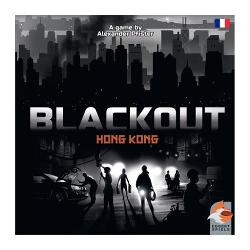
2018 · Économique
Blackout: Hong Kong
Une panne d’électricité plonge toute la ville dans le chaos et pousse des groupes rivaux à rétablir l’ordre. Les joueurs recrutent et déploient des spécialistes, collectent et dépensent des ressources dont la disponibilité fluctue, et accomplissent des tâches pour stabiliser les quartiers et les infrastructures essentielles. Le jeu utilise une disponibilité des ressources changeante et un marché commun qui obligent à s’adapter à chaque tour. Les joueurs doivent trouver l’équilibre entre les actions de secours à court terme et l’influence à long terme, combiner les capacités des spécialistes pour enchaîner les effets et rivaliser pour le contrôle des lieux clés pendant que la ville se remet.
- Joueurs
- 1–4 idéal à 3
- Temps de jeu
- 75–150 min
- Âge
- 14+
- Complexité
- 3,5 / 5
À propos du jeu
- Auteurs
- Illustration
- Éditeur



Photos des tables de Ludoya
Toutes les photos dans Ludoya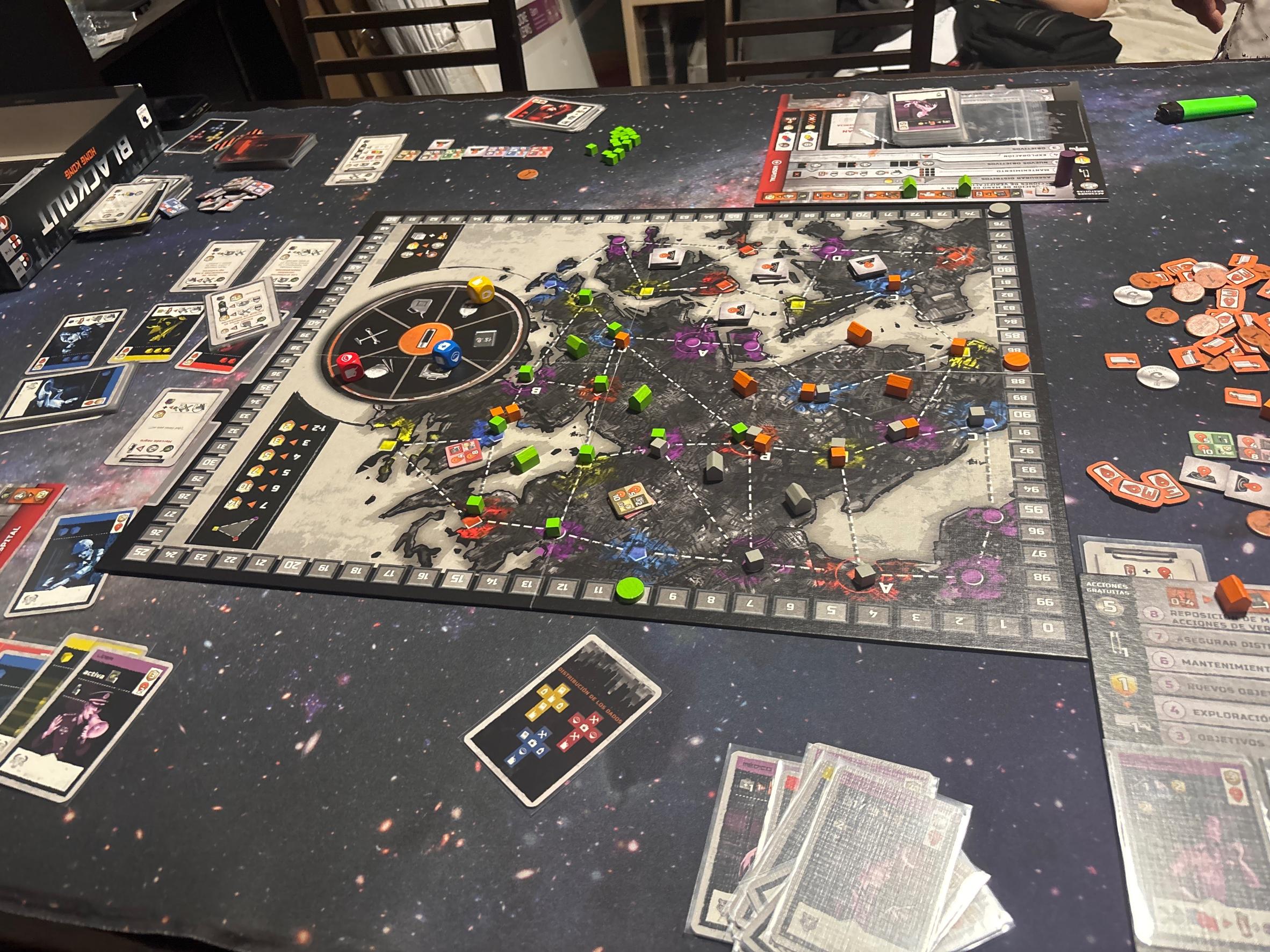
Où l'acheter
Prix des boutiques et exemplaires d'occasion, vérifiés chaque jour.
- LudifolieEn stock44.9 €
- GameplayVérifier le stock49.99 €
- 401 GamesRupture de stock49.95 $
- PlayoteketVérifier le stock459 kr
- Outlet GamesEn stock41.07 €
- Dungeon MarvelsPrécommande43.95 €
- TLAMA gamesRupture de stock1119 Kč
- Juegos de la Mesa RedondaRupture de stock49.95 €
Sur les tables de Ludoya
Toutes les statistiques dans Ludoya- 177
- Parties enregistrées
- 134
- Joueurs
- 1h 45m
- Partie moyenne
- 59
- Dans des collections
- 12
- Dans des listes de souhaits
6,7/10
sur 31 avis Ludoya
Poteet7,8 Not my favorite Pfister, but still a solid game.
Evan5,9 Each round, the start player rolls three dice and places them on the resource area matching the icon on the die. Players get what start as symmetrical decks of cards where the majority of the cards are played for their cube icons. Each cube icon on a card produces a cube into the box where the die of the matching color currently resides. Once players resolve their cards, they take turns completing goals. The goals tend to give you a cube on the central map, and a new card for your hand for future rounds, although two of them are printed on your board and give you the ability to reset your hand faster, or play one additional card each round. Then players select a pile of facedown tokens. The tokens have different difficulty ratings on them and if you meet the requirement to claim one, you shuffle up the cards that contributed to taking the token and place one at random in the "hospital" area of your board. This can serve to cull cards from your deck, but each player also has a doctor card that retrieves one of the injured cards and additionally produces that card's value in victory points. There's some tensions here as to wanting your best guys to get hurt so you can score the healing process, but then they're not available to be played in the next turn while they're injured. Lastly, players can buy new goal cards from the faceup display next to the board. The order the cards come out is totally random, so navigating this fliplucky process is both an interesting challenge and a somewhat frustrating one. A row replenishes immediately when it runs out of cards. Money is tight in the game, and cards cost more depending on the number of cards taken from that row. The central board has regions that score once one player has a cube on every node surrounding the area, and then there's endgame scoring for having a set of explore tokens that all have a different type of reward. The game is really hard to boil down to it's core ideas. In fact, in the process of playing it, what a good move looks like and why feels a bit hard to focus on. There's some good planning that can be done, but despite numerous luck mitigation mechanisms, the dice and the cards in the purchasable array will sometimes favor you and sometimes they don't. Engine building elements are minimal. Player interaction is also minimal. I want to play this a little more to see if I can get a better sense of it, but it hasn't been the immediate hit that Mombasa and Great Western Trail were. ★ Art, Iconography and components functional ★ Clever or interesting mechanisms ★ Reasonably low downtime between turns with mildly AP players ★ Multiple plays stay interesting ★ Low or mitigatable luck elements ★★☆☆☆ Raw enjoyment
Garfield7,0 Too dry too keep it. Unfortunately a little bit multiplayer-solitaire. But really good mechanism. The theme is not really good. I expected quests to turn on the lights again. It's too abstract. [c] Theme: ★★☆☆☆ <!-- size 7]Not really good --> Gameplay: ★★★★☆ <!-- size 7]Right amount of choices --> Interaction: ★★☆☆☆ <!-- size 7]Just 'fighting' for be the first who encloses an area --> Artwork: ★★★☆☆ <!-- size 7]Ok, nothing special --> Luck: ★★☆☆☆ <!-- size 7]Dice rolling --> Strategy: ★★☆☆☆ <!-- size 7]Not many strategies possible --> Components: ★★★☆☆ <!-- size 7]Nothing special --> Play duration: ★★★☆☆ <!-- size 7]Ok --> Easy to teach: ★★★☆☆ <!-- size 7]Really ok for such a game --> Rules quality: ★★★★★ <!-- size 7]Almost perfect --> Setup time: ★★☆☆☆ <!-- size 7]A lot, but still ok --> No downtime: ★★★★☆ <!-- size 7]Little to none, because you can play simultaneously --> Replay value: ★★☆☆☆ <!-- size 7]Not much I can think of --> [/c]





Gratuit, sur le web, Android et iOS
Jouez à Blackout: Hong Kong avec Ludoya
- Gardez-le dans votre collectionSuivez votre exemplaire et ses extensions, prêtez-le à vos amis ou ajoutez-le à votre liste de souhaits et soyez prévenu quand le prix baisse.Ajouter à votre collection
- Enregistrez chaque partieScores, gagnants, minuteurs et photos, puis vos statistiques : taux de victoire, nombre de joueurs préféré, meilleur score.Enregistrer une partie
- Comptez les points sans papierUtilisez les feuilles de score et les aides de jeu de la communauté, et laissez Ludoya additionner les points.Trouver des feuilles de score
- Trouvez des gens avec qui y jouerClubs, soirées jeux et événements près de chez vous qui mettent ce jeu sur la table.Voir les événements
Données du jeu (joueurs, durée, âge, crédits) issues de BoardGameGeek.