
2025 · Mythologie
Eternal Decks
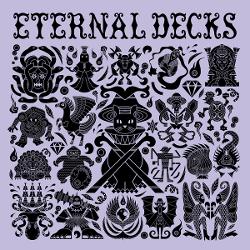
Players cooperate with limited communication to complete a sequence of stages before any player can no longer take actions. Each player manages a personal deck and can spend a turn to play a card to the field or river, use a card ability, generate a jewel, or give a card to a teammate. Cards come from a shared pool of character decks with distinct eight-card profiles, and playing cards is subject to placement restrictions: adjacent cards in the three field rows cannot share color or number, and each stage imposes additional row-specific rules. Jewels counteract negative effects from the characters. The campaign runs six stages with differing objectives—scoring, survival, maze navigation, boss encounters, and similar challenges—requiring coordination of card play and resource use to succeed.
- Joueurs
- 1–4 idéal à 4
- Temps de jeu
- 30–40 min
- Âge
- 10+
- Complexité
- 2,8 / 5
À propos du jeu
- Auteurs
- Illustration
- Éditeurs




Photos des tables de Ludoya
Toutes les photos dans Ludoya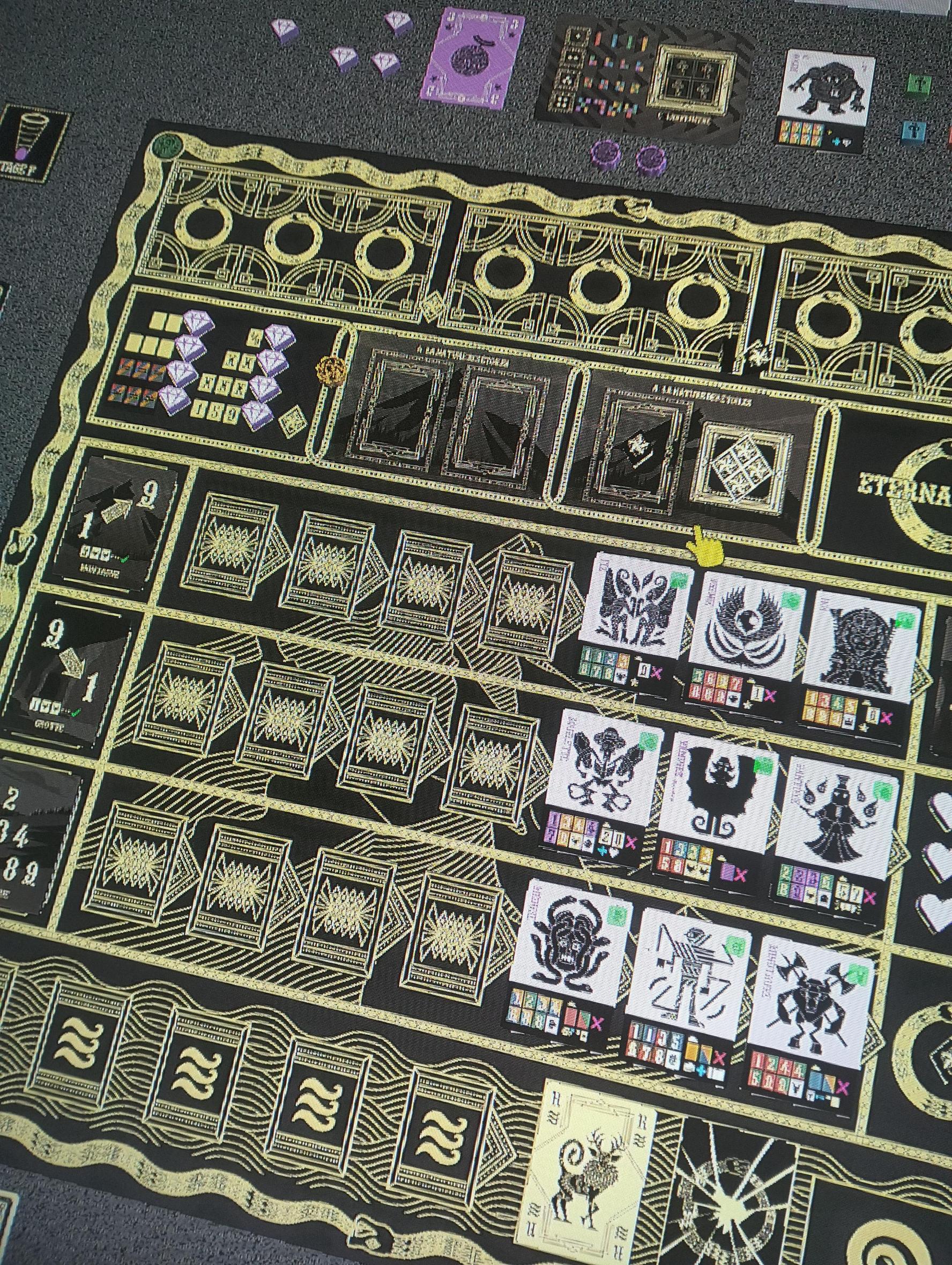
Où l'acheter
Prix des boutiques et exemplaires d'occasion, vérifiés chaque jour.
Sur les tables de Ludoya
Toutes les statistiques dans Ludoya- 80
- Parties enregistrées
- 68
- Joueurs
- 44m 3s
- Partie moyenne
- 19
- Dans des collections
- 49
- Dans des listes de souhaits
- 10
- Précommandé
8,0/10
sur 10 avis Ludoya
Questions de règles
Réponses tirées du livret par l'assistant de règles de Ludoya.
Can I say "I have a 1" or "I have a yellow card" out loud to my team?
You cannot directly state the number or color of Number Cards in your hand, though you may talk about Rare/Ability cards or cards already played; indirect hints and Communication Discs are encouraged (page 20).
Where exactly can I place common, Field, Two‑Color and Rare cards on the rows?
Follow the Common Placement Rules (no same color or same number adjacent), then the specific Field card rule for that row (e.g., Mountain ascending, Cave descending); Two‑Color cards may be rotated but cannot be adjacent to the same color on either side when placed; Rare cards ignore both common and Field placement restrictions (see pages 10–11).
What happens when an Eternal is revived — do we move cards or get curses?
When a player completes a row next to the Eternals they flip one Eternal into the Revival Area and place that Eternal’s eight‑card mini‑deck under their Player Deck, then clear the row to the Discard Area; reviving an Eternal also activates its Curse which prevents playing certain cards to the Field until the Curse is removed (pages 12–13).
What does playing cards to the River do, and can the River end the game?
There are no placement rules for the River; when the 5th card is played you take a River Rare as the River Bonus and then move those cards to the Discard Area, but if there are no River Rare cards left the active player receives a Game Over and everyone immediately loses (page 15).
How do I generate Jewels and do the cards used for Jewels count toward the River?
You use hand cards to complete one of eight Jewel recipes (each recipe is used once) and give the produced Jewel to a Revived Eternal to cover its Curse; cards used for a Jewel are played to the River (they can trigger the River Bonus), and cursed cards, Two‑Color and Rare/Ability cards have specific rules for recipes (page 16).



Gratuit, sur le web, Android et iOS
Jouez à Eternal Decks avec Ludoya
- Gardez-le dans votre collectionSuivez votre exemplaire et ses extensions, prêtez-le à vos amis ou ajoutez-le à votre liste de souhaits et soyez prévenu quand le prix baisse.Ajouter à votre collection
- Enregistrez chaque partieScores, gagnants, minuteurs et photos, puis vos statistiques : taux de victoire, nombre de joueurs préféré, meilleur score.Enregistrer une partie
- Réglez les questions de règlesPosez n'importe quelle question sur les règles et obtenez une réponse tirée du livret, avec la page pour vérifier.Demander à l'assistant de règles
- Trouvez des gens avec qui y jouerClubs, soirées jeux et événements près de chez vous qui mettent ce jeu sur la table.Voir les événements
Données du jeu (joueurs, durée, âge, crédits) issues de BoardGameGeek.